
Echo Go Hydrogen Water Bottles Compared by Size and Features

The Echo Go is the closest match for someone seeking an Echo Go hydrogen water bottle, with 3- and 10-minute cycles and a 380-milliliter glass bottle. Choose the Go+ instead if you want a 10-ounce bottle described as rechargeable, or the Flask if app tracking matters more than matching the Echo Go name.
Hydrogen water bottles use electrolysis components to generate dissolved hydrogen in water; they are not ordinary insulated bottles. Hydrogen concentration and cycle time are the key differences here, not evidence of a health benefit.
We earn a commission if you buy through links on this page. As an Amazon Associate I earn from qualifying purchases. Products are compared on manufacturer specifications, not hands-on testing.
- Best overall: Echo Go 380 ml – The Echo Go name matches the search, and its maker gives two hydrogen cycle options.
- Best for a compact 10-ounce bottle: Echo Go+ 10 oz – The Go+ is a 10-ounce rechargeable bottle with a sealed top.
- Best for app tracking: Echo Flask 12 oz – The 12-ounce Flask pairs its LCD touch screen with Echo App tracking.
| Product | Best for | Capacity | Hydrogen output | Material | Shop |
|---|---|---|---|---|---|
| Echo Go 380 ml | Echo Go match | 12.9 oz | 1,200 or 1,800 ppb | Glass | Check Price on Amazon |
| Echo Go+ 10 oz | Sealed portable bottle | 10 oz | Adjustable levels | Food-grade polycarbonate | Check Price on Amazon |
| Echo Flask 12 oz | App-based tracking | 12 oz | Up to 8,000 ppb | — | Check Price on Amazon |
| PIURIFY Hydrogen Water Bottle 10 oz | Long warranty term | 10 oz | 6,300+ ppb | — | Check Price on Amazon |
Echo Go Hydrogen Water Bottles and Alternatives
Compare capacity, cycle or output claims, and construction to find a bottle that fits your preferred routine.
Echo Go 380 ml

The Echo Go is the direct name match, and its maker gives two cycle choices: 3 or 10 minutes, producing 1.2 or 1.8 ppm of hydrogen. Its 380-milliliter glass bottle is larger than the two 10-ounce options here. The maker also advises tightening the bottle bottom and body together to prevent leaks, so assembly matters before carrying it. Choose this version if you want the Echo Go name and selectable cycle length. Its output is lower than the up-to-8-ppm claim for the Flask, which may matter if comparing only the makers’ concentration figures.
Bottom line: Pick this if the Echo Go name and two cycle choices are your priorities.
Echo Go+ 10 oz
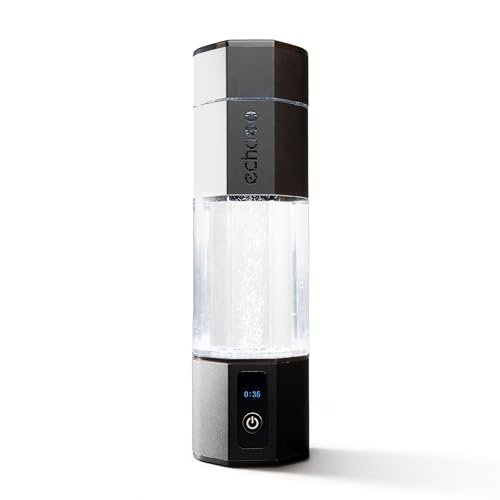
The Echo Go+ differs from the glass Echo Go with a 10-ounce food-grade polycarbonate body and a sealed bottle top. Its maker describes the bottle as rechargeable and says hydrogen levels are adjustable, but gives no numerical concentration in the specifications. That makes the Go+ a reasonable fit for buyers who value a smaller bottle and a sealed top over an output figure. Its capacity is smaller than the Echo Go’s 380 milliliters, so it may not suit someone who wants fewer refills.
Bottom line: Choose this for a sealed, rechargeable 10-ounce format.
Echo Flask 12 oz

The Echo Flask is the option for buyers who want digital tracking rather than the Echo Go’s glass-bottle format. Its maker claims up to 8 ppm hydrogen concentration and describes an LCD touch screen plus Echo App hydration tracking; the 12-ounce capacity is also larger than the Go+’s 10 ounces. The body material is not included in the specifications, so confirm material before ordering if that is a deciding factor. Choose it for the tracking features, not as a name-identical Echo Go.
Bottom line: Pick this when app tracking and a 12-ounce capacity matter most.
PIURIFY Hydrogen Water Bottle 10 oz

The PIURIFY stands apart from the Echo models with a 10-year warranty and an included nasal cannula, according to its specifications. Its maker claims 6,300-plus ppb output and identifies SPE/PEM technology; the black bottle holds 10 ounces. This is a related hydrogen-water generator, not an Echo Go model.
Bottom line: Consider this related option if the warranty term is your deciding factor.
How to choose an Echo Go hydrogen water bottle
Start with capacity and the controls you will use, then compare the makers’ output claims. The Echo Go holds 380 milliliters, while the Go+ holds 10 ounces and the Flask 12 ounces. One ppm equals 1,000 ppb, so the Echo Go’s maker-claimed 1.2- and 1.8-ppm cycles equal 1,200 and 1,800 ppb; compare those numbers only as stated output claims, not as proof of a health effect. The Go+ has adjustable levels but no numeric output in its specifications. If a numerical output is essential, favor an option with a figure and verify that its operating cycle suits your routine.
Hydrogen concentration and cycle time
Cycle duration and concentration are separate specifications: a longer cycle does not by itself establish a higher concentration. The Echo Go maker gives 3- and 10-minute cycles with 1.2- and 1.8-ppm outputs, while the Flask maker claims up to 8 ppm without a cycle duration in the specifications. The PIURIFY maker claims 6,300-plus ppb, equivalent to more than 6.3 ppm. These are maker claims, not a common independent measurement. A useful decision rule is to compare figures only when the source gives the unit and the cycle conditions; otherwise, choose based on capacity, construction, and controls instead of treating the numbers as directly comparable.
Bottle capacity, material, and portability
Capacity is the clearest physical difference: 10 ounces is about 296 milliliters, 12 ounces is about 355 milliliters, and 380 milliliters is about 12.9 ounces. The Echo Go fields identify glass, and the Go+ fields identify food-grade polycarbonate; material is not provided for the other two products. Glass can be heavier and more breakable than plastic, so consider where the bottle will travel and whether it will share a bag with hard objects. For daily carry, choose a capacity you can comfortably refill and a material you are willing to handle. Verify the bottle’s closure and assembly before putting it in a bag.
Using and caring for a hydrogen water bottle
Use the bottle only with water appropriate for the device, and keep charging and electrical components dry. Electrolysis bottles contain powered parts, so do not immerse a charging port or operate a damaged unit. The Echo Go maker specifically says to tighten the base and body together to prevent leaks. Bottle-care routines differ by material and design: wash drinking surfaces and lids regularly, avoid abrasive cleaning on surfaces that can scratch, and let removable parts dry fully before reassembly.
Frequently Asked Questions
How many ounces are in a 380-milliliter bottle?
A 380-milliliter bottle holds about 12.9 US fluid ounces. That is roughly 2.9 ounces more than a 10-ounce bottle.
What does 1.8 ppm mean in ppb?
A concentration of 1.8 ppm equals 1,800 ppb. This conversion changes units only; it does not establish that two devices measured hydrogen under the same conditions.
Can I put a hydrogen water bottle in a dishwasher?
Do not assume a hydrogen water bottle is dishwasher-safe. These bottles include powered components, so keep electrical parts away from water and confirm cleaning compatibility for the specific bottle before using a dishwasher.
How often should I clean a reusable water bottle?
Wash a reusable bottle and its lid daily when used for drinking water, especially parts that contact the mouth. Dry the pieces fully before reassembling them to reduce trapped moisture.
Does a longer hydrogen cycle guarantee more hydrogen?
No; cycle duration alone does not establish the resulting concentration. Compare output figures only when the maker specifies the relevant cycle conditions and units.