
Dremel Diamond Bits for Stone: 5 Sets Compared

For stone projects that need holes in several diameters, Drilax 1–3 mm Diamond Drill Bits is the closest match because its 30 diamond-coated bits cover 1, 2, and 3 mm. Choose 52-Piece Diamond Grinding Bit Kit, 20-Piece 120-Grit Diamond Grinder Bits, or 20-Piece 60-Grit Diamond Grinding Bits instead for varied grinding and carving shapes; choose Drilax 1 mm Diamond Drill Bits, 30-Piece when every bit should drill a 1 mm hole.
We earn a commission if you buy through links on this page. As an Amazon Associate I earn from qualifying purchases. Products are compared on manufacturer specifications, not hands-on testing.
- Best overall: Drilax 1–3 mm Diamond Drill Bits – Its 1, 2, and 3 mm bits support several small hole sizes.
- Best for varied shapes: 52-Piece Diamond Grinding Bit Kit – The 52-piece set includes multiple grinding-head profiles.
- Best for coarse grinding: 20-Piece 60-Grit Diamond Grinding Bits – Its 60-grit diamond heads suit rougher grinding work.
| Product | Best for | Bit count and size | Grit | Shop |
|---|---|---|---|---|
| Drilax 1–3 mm Diamond Drill Bits | Small drilled holes | 30; 1, 2, 3 mm | — | Check Price on Amazon |
| 52-Piece Diamond Grinding Bit Kit | Shape variety | 52 pieces | — | Check Price on Amazon |
| 20-Piece 120-Grit Diamond Grinder Bits | Fine grinding work | 20 pieces; 6 mm heads | 120 grit | Check Price on Amazon |
| 20-Piece 60-Grit Diamond Grinding Bits | Coarse grinding | 20 pieces; various shapes | 60 grit | Check Price on Amazon |
| Drilax 1 mm Diamond Drill Bits, 30-Piece | Repeated 1 mm holes | 30; 1 mm | — | Check Price on Amazon |
Dremel Diamond Bits for Stone Compared
Match the bit style to whether your project needs drilled holes or shaped, ground surfaces.
Drilax 1–3 mm Diamond Drill Bits
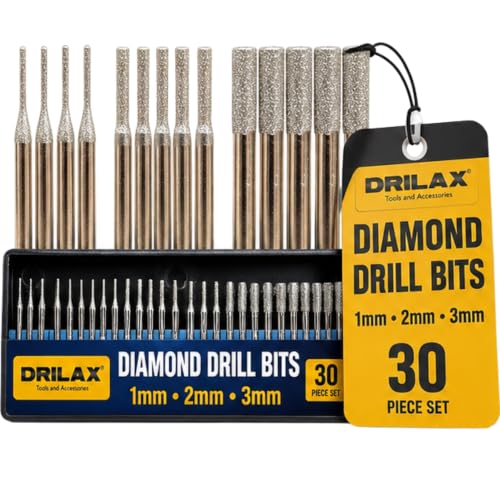
Drilax 1–3 mm Diamond Drill Bits stands apart as a small-hole drilling set with three diameters rather than a collection of grinding burr shapes. It includes 10 bits each at 1, 2, and 3 mm, plus a case, and the 1/8-inch shank fits Dremel and other rotary tools. The maker says the diamond coating grinds rather than chips delicate materials such as sea glass and gemstones. This is a good fit for jewelry holes; it is less suited to broad shaping because the set is focused on narrow drill bits.
Bottom line: Choose this set when a project calls for small holes in more than one diameter.
52-Piece Diamond Grinding Bit Kit

52-Piece Diamond Grinding Bit Kit is the shape-focused option, with spherical, conical, cylindrical, oval, bullet, flat rectangular, and teardrop profiles among its assortment. The 1/8-inch shank is compatible with Dremel tools, and the maker says the diamond bits can engrave, polish, grind, drill, and cut hard materials including tile, glass, jade, and granite. This range suits projects that move between contouring and surface work.
Bottom line: Pick this kit for a broad selection of profiles for carving and surface work.
20-Piece 120-Grit Diamond Grinder Bits

20-Piece 120-Grit Diamond Grinder Bits pairs a 120-grit rating with six head shapes, making it a grinding-burr set rather than a set organized around different drill diameters. Each head is 6 mm across, and the 3 mm shank is compatible with Dremel-style rotary tools. The maker describes uses including grinding, engraving, trimming, polishing, and carving across materials such as stone, glass, ceramic, and resin. It fits projects needing a range of small grinding tasks; the 6 mm heads are not the choice for making tiny jewelry holes.
Bottom line: Choose these when 120-grit grinding heads and multiple shapes match the work.
20-Piece 60-Grit Diamond Grinding Bits
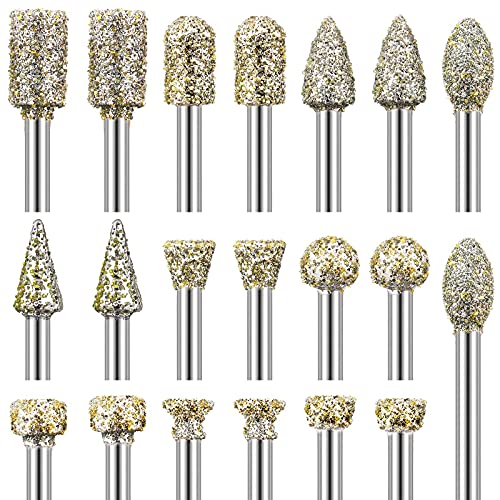
20-Piece 60-Grit Diamond Grinding Bits is the coarser-rated grinding set here: its diamond-coated heads are 60 grit and come in varied shapes. The 1/8-inch shanks fit most rotary tools and die grinders, and the maker describes use for sculpting, precision grinding, sanding, and dressing ceramic, glass, and stone. That combination is suited to rougher material removal and shaping rather than delicate hole drilling. Buyers who need defined drill diameters or a finer-rated surface tool should choose a drill-bit set or a different grit instead.
Bottom line: Pick this set for rougher grinding and shaping rather than precision drilling.
Drilax 1 mm Diamond Drill Bits, 30-Piece
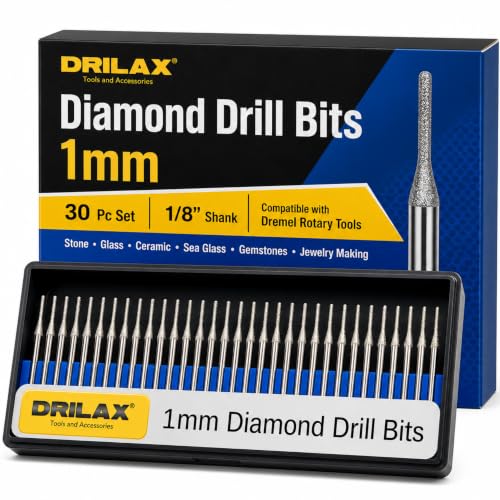
Drilax 1 mm Diamond Drill Bits, 30-Piece differs from the mixed-diameter drill set by supplying 30 bits all sized for 1 mm holes. Its 1/8-inch shank fits rotary tools, and the body is alloy steel with triple-layer diamond coating. The maker says the bits are intended for drilling glass, stone, shells, and gemstones. This is useful when many projects call for the same small hole size; it offers no larger bit diameter for a pendant hole that needs more clearance.
Bottom line: Choose these when all the holes you need are 1 mm wide.
Choose between drilling and grinding bits
Choose a drill bit for a defined hole and a grinding burr for shaping, engraving, or smoothing a surface. Drill-bit sets identify hole diameters, while grinding kits typically distinguish themselves by head shape and grit; a 1 mm bit makes a much smaller opening than a 6 mm grinding head. Diamond-coated tools abrade hard material rather than cutting with a conventional twist-drill edge. For jewelry holes under 3 mm, select a set with the needed diameter; for carving contours, prioritize a profile assortment. Use the rotary tool at a controlled speed and avoid forcing the bit, which can overheat the work or break a small shank.
Check the shank and hole size
A 1/8-inch shank is the common fit across these sets, but verify that the rotary tool collet accepts that size before installing a bit. The 1 mm, 2 mm, and 3 mm drills make distinct hole sizes; diameter is not interchangeable with a grinding head’s width. Match the hole to the wire, jump ring, or cord that must pass through it, leaving a little clearance rather than choosing an exactly equal hole. For a project needing a hole wider than 3 mm, these drill assortments do not provide a larger drill size, so choose a suitable bit separately.
Understand grit and head shape
Grit and shape affect how a grinding burr meets stone: lower grit numbers are coarser, while higher numbers are finer. The 60-grit set is the coarser-rated choice here, and the 120-grit set is the finer-rated one; neither rating states a drilling diameter. Spherical and oval heads reach curved areas, while cylindrical and flat profiles can work along flatter faces or edges. Use a coarse profile to remove material, then switch to a finer abrasive for a smoother finish. Do not assume an assortment contains a particular exact profile unless its contents identify it.
Use diamond bits safely on stone
Wear eye protection when grinding stone or glass because abrasive work can throw small fragments and dust. Keep the tool moving and use light pressure; pausing in one spot concentrates heat and can damage a bit or crack a fragile piece. For drilling glass or stone, water cooling is commonly used to control heat and dust, but keep liquid away from electrical parts and follow the rotary tool maker’s wet-use limits. Secure the work rather than holding a tiny stone in your fingers, and stop if the bit binds or the material shifts.
Frequently Asked Questions
Can diamond bits drill holes in stone?
Diamond-coated bits can abrade stone to create holes, especially when the bit diameter matches the desired opening. Use light pressure and cooling appropriate to the tool and material; a grinding burr is intended for shaping rather than a precisely sized hole.
What shank size fits most Dremel rotary tools?
A 1/8-inch shank is a common rotary-tool accessory size and is the size used by these sets. Confirm the installed collet matches the shank before running the tool.
Which grit should I choose for stone grinding?
A 60-grit head is coarser than a 120-grit head, so it is the more suitable choice for rough shaping, while 120 grit is the finer-rated option. Neither grit tells you the exact finish or removal rate on every stone.
How do I keep a stone from cracking while drilling?
Use a secure support, light pressure, and avoid letting the bit overheat; fragile glass and stone can crack from stress or heat. Cooling can help during drilling, but only use water if the rotary tool is rated for that setup.
Can I use grinding burrs to make jewelry holes?
Grinding burrs can remove material, but they do not define a hole diameter as clearly as drill bits sized in millimeters. For a 1, 2, or 3 mm opening, choose a drill bit with that stated diameter.