
Drip Pan for Portable Air Conditioner: 3 Options Compared

For most portable air conditioners, choose 25.6-Inch Square Silicone Drip Pan if its 25.6-inch square footprint fits your floor space; its larger coverage is the deciding difference. If your unit sits in a tighter area, consider 20 × 16-Inch Silicone Drip Mat or EWX 20-Inch Square Silicone Mat instead, but measure the appliance base and available floor area before choosing.
We earn a commission if you buy through links on this page. As an Amazon Associate I earn from qualifying purchases. Products are compared on manufacturer specifications, not hands-on testing.
- Best overall: 25.6-Inch Square Silicone Drip Pan – Its 25.6-inch square footprint offers the broadest coverage.
- Best for compact spaces: 20 × 16-Inch Silicone Drip Mat – The 20-by-16-inch mat takes less floor area.
| Product | Best for | Footprint | Raised edge | Shop |
|---|---|---|---|---|
| 25.6-Inch Square Silicone Drip Pan | Broad floor coverage | 25.6 × 25.6 in | — | Check Price on Amazon |
| 20 × 16-Inch Silicone Drip Mat | Tight floor spaces | 20 × 16 in | 0.6 in | Check Price on Amazon |
| EWX 20-Inch Square Silicone Mat | Square appliance bases | 20 × 20 in | 0.4 in | Check Price on Amazon |
Drip Pans for Portable Air Conditioners
Match the tray footprint to the unit base and the floor space available around it.
25.6-Inch Square Silicone Drip Pan
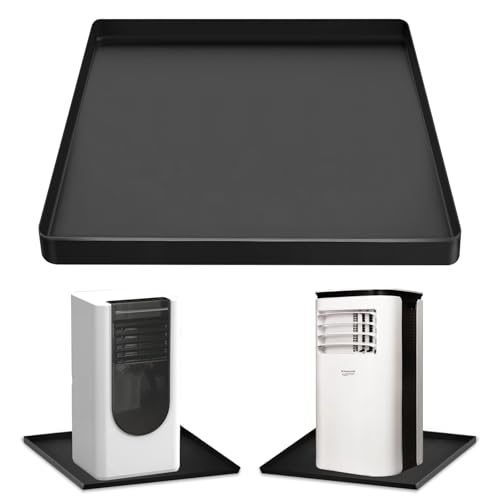
For a larger protected area around a portable AC, this square pan measures about 25.6 inches on each side and is intended for 5,000–14,000 BTU units. Its broad footprint can also suit other appliances such as mini fridges, washers, and dehumidifiers. The maker says it is silicone and non-slip. Check that the square tray fits the floor area and does not obstruct the unit’s wheels or airflow. The specifications do not give a raised-edge height, so buyers who need a specific containment depth should confirm that measurement before choosing.
Bottom line: Choose this when you have room for a broad square footprint.
20 × 16-Inch Silicone Drip Mat

For a narrower floor area, this mat is 20 inches long by 16 inches wide, with a 0.6-inch raised edge. The maker says it suits portable AC units rated 5,000–14,000 BTU and uses flexible silicone with a non-slip surface. The lower footprint is its key distinction from the larger square choices, but it leaves less area around the appliance to catch stray water. Measure the unit’s base rather than relying on its BTU rating; the footprint must sit fully inside the raised edge.
Bottom line: Pick this for a compact footprint and a clearly measured raised edge.
EWX 20-Inch Square Silicone Mat

This option gives a 20-inch square footprint and a 0.4-inch raised edge, a middle ground between the compact rectangular mat and the broader square pan. Its silicone construction is described as waterproof, and the maker lists portable ACs, ice makers, humidifiers, and mini fridges as uses. It is a practical match when a square base fits better than a 20-by-16-inch rectangle.
Bottom line: Choose this when your appliance base suits a 20-inch square mat.
How to choose a portable AC drip pan
Choose by the unit’s base footprint first, then by the floor area and edge height. A pan should support the whole base without blocking caster wheels, a condensate outlet, or required airflow; allow room for the appliance’s intake and exhaust setup. Measure the widest points of the base and compare them with the pan’s usable interior, since raised edges reduce the flat area slightly. A 0.4-inch edge contains less depth than a 0.6-inch or 1.2-inch edge, but edge height alone does not tell you the pan’s capacity. For a base wider than 20 inches, avoid assuming a 20-inch square mat will fit—measure before selecting.
Drip pan sizes and fit
Portable AC drip mats commonly use a low-profile, shallow tray format, while washer-style pans are deeper and bulkier. A useful fit rule is to leave roughly 1–2 inches of clearance beyond each side of the appliance base when the room permits; that margin catches drips and avoids a tight, difficult placement. Confirm that the pan can sit level on the floor, especially on carpet or uneven tile, because standing liquid can migrate toward a low edge. A pan catches leaks but does not replace the AC’s normal condensate drainage. Route any drain hose as the appliance manual requires, and empty or inspect the pan regularly rather than allowing collected water to sit.
Silicone mats versus plastic drip pans
Silicone mats are flexible and low profile, so they are easier to position under appliances with small clearances; polypropylene pans are more rigid and can have deeper side walls. This comparison helps match the tray style to the job.
| Type | Typical advantage | Check before choosing |
|---|---|---|
| Silicone mat | Flexible placement and a shallow profile | Footprint and edge height |
| Polypropylene pan | Rigid walls and larger stated capacity on some models | Base clearance and pan dimensions |
Neither material makes a pan maintenance-free: inspect for cracks, warping, or trapped debris during routine floor cleaning. Do not treat a catch pan as a substitute for fixing a leaking hose, clogged drain, or appliance fault. If water is near electrical cords or outlets, unplug the unit only if it is safe to do so and address the source promptly.
Frequently Asked Questions
How much larger should a drip pan be than the AC base?
Aim for about 1–2 inches of extra space on each side when the floor area allows. Measure the base and the pan’s usable flat area, not just its outer dimensions.
Can a portable AC drip pan replace its drain hose?
No, a drip pan is a backup catch for leaks and overflow, not a replacement for normal condensate drainage. Keep the hose routed as the AC manual specifies and inspect the pan routinely.
How often should I empty a portable AC drip pan?
Inspect the pan at least weekly while the AC is running, and empty it as soon as water collects. Hot, humid conditions or a drainage problem can fill a shallow pan faster.
Will a drip pan work on carpet?
A waterproof pan can help shield carpet from drips, but it must sit level and remain fully under the appliance. Carpet can make a tray tilt, so check for pooling and edge overflow after placement.
What should I do if water reaches an outlet?
Keep the appliance off and avoid touching standing water near energized cords or outlets. Have the leak and electrical area made safe before resuming use; a drip tray is not electrical protection.