
Stock Tank Heater for Plastic Tanks: 3 Options Compared

For a stock tank heater for plastic tanks, Farm Innovators Ice Chaser 1,500W is the closest match because it is a 1,500-watt submersible de-icer described as safe for plastic. Choose K&H Stock Tank Deicer 500W if floating or submersible placement and a 500-watt option suit your setup better.
Stock tank deicers warm water to help keep an open drinking area during freezing weather. Match wattage to tank size and local cold, and use only equipment designed for the tank material.
We earn a commission if you buy through links on this page. As an Amazon Associate I earn from qualifying purchases. Products are compared on manufacturer specifications, not hands-on testing.
- Best overall: Farm Innovators Ice Chaser 1,500W – A 1,500-watt submersible de-icer with an anti-chew cord protector, described as safe for plastic.
- Best for flexible placement: K&H Stock Tank Deicer 500W – Its 500-watt design can float or submerge and includes a protective cage and cord clip.
| Product | Best for | Wattage | Placement | Tank fit | Shop |
|---|---|---|---|---|---|
| Farm Innovators Ice Chaser 1,500W | Plastic tank use | 1,500 W | Submersible | Plastic-safe | Check Price on Amazon |
| Farm Innovators 1,500W Deicer, 2-Pack | Two tank setups | 1,500 W per heater | Submersible | Plastic or metal | Check Price on Amazon |
| K&H Stock Tank Deicer 500W | Floating or submersible | 500 W | Floating or submersible | Plastic, rubber, or metal | Check Price on Amazon |
Stock tank heaters for plastic tanks
Compare heater power, placement and material compatibility before choosing a deicer for your tank.
Farm Innovators Ice Chaser 1,500W

Farm Innovators Ice Chaser 1,500W stands out for its cast-aluminum Ice Chaser construction and 1,500-watt output, making it the strongest-powered option here. Its thermostat switches the heater on as needed, and an anti-chew cord protector addresses a common livestock-area hazard. The unit is submersible and is described as safe for plastic tanks. Its 9.5-inch height and 10-inch width are useful dimensions to compare with available water depth and placement space. The tradeoff is that this model is submersible only, so choose another design if you need a floating heater.
Bottom line: Pick this for a plastic tank that can accommodate a submersible 1,500-watt unit.
Farm Innovators 1,500W Deicer, 2-Pack

Farm Innovators 1,500W Deicer, 2-Pack is the only two-pack among these choices, making it useful when two tanks need separate heaters. The product is described as suitable for plastic or metal containers, and its design rests at the tank bottom with a protective cage. It is submersible, so placement and water depth matter; it does not offer the floating-use option described for K&H Stock Tank Deicer 500W. The maker gives conflicting wattage references, so confirm the wattage of each unit before ordering. Consider this set when the two-heater format is the deciding need.
Bottom line: Choose this when you need two submersible heaters and can confirm per-unit wattage.
K&H Stock Tank Deicer 500W
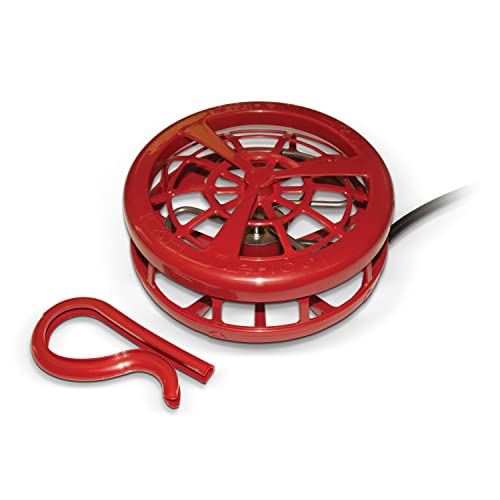
K&H Stock Tank Deicer 500W differs by supporting either floating or submersible placement, while its 500-watt output is lower than the 1,500-watt options. It is designed for plastic, rubber and metal stock tanks, and includes a full protective cage and cord clip to secure positioning. The thermostat turns the unit on and off as needed to help prevent freezing over. Lower wattage may be a limitation for a larger tank or harsher cold, so use the maker’s zone chart to match wattage to your conditions before choosing it.
Bottom line: Pick this if placement flexibility matters and 500 watts fits your tank and climate.
How to choose a plastic stock tank heater
Choose by tank capacity, exposure and the heater’s intended materials, not wattage alone. A useful decision rule is to favor a lower-wattage unit for a small container and consult the manufacturer’s wattage chart for a larger tank or severe cold. Wind, water volume and how often animals drink all affect heat loss. A thermostat reduces run time by cycling as needed, but it cannot compensate for a unit too small for the conditions. Confirm tank compatibility and the available electrical supply before installation.
Floating versus submersible deicers
Floating units sit at the surface, while submersible models are placed in the water, often near the bottom. A protective cage helps keep animals from contacting the heating element, and a cord clip or protector can help keep the cord positioned away from chewing or disturbance. Use the placement intended by the heater design, and do not let a heating element rest against plastic unless its instructions allow that contact. The practical choice is simple: select a floating-capable model when surface placement is needed, and a submersible model when the tank permits stable underwater placement.
Tank material and fit checks
Plastic tanks need a heater specifically described as compatible with plastic; compatibility should not be assumed from wattage or a similar appearance. Also check water depth, heater dimensions and cord routing before placing a submersible unit. Avoid improvising brackets or removing protective cages, since those parts help maintain safe positioning around livestock and water.
Electrical and winter-use safety
Water and electricity require a protected outdoor-rated supply and a ground-fault circuit interrupter (GFCI); keep plugs and connections out of standing water. Use a heater only while it is submerged or positioned as its design requires, and disconnect power before handling or moving it. A damaged cord, cracked housing or missing cage is a reason to stop use rather than patch the heater in place. Check the tank routinely for secure positioning and adequate open water, especially after animals disturb the cord. The thermostat controls cycling, but it is not a substitute for a suitable wattage, safe electrical protection or regular visual checks.
Frequently Asked Questions
How many watts does a plastic stock tank heater need?
There is no single wattage for every tank; volume, wind and cold exposure change the heat load. The options here range from 500 to 1,500 watts, and K&H Stock Tank Deicer 500W directs buyers to a wattage zone chart for matching conditions.
Can a deicer touch a plastic tank wall?
Only if the heater’s instructions permit contact with that tank material. Use the intended floating or submerged position and keep any protective cage in place to reduce contact risk.
Can stock tank deicers stay plugged in all winter?
Thermostatic deicers are designed to cycle on and off as needed, but inspect their position, cord and housing regularly. Disconnect power before moving a unit or working in the water.