
12V Vehicle Air Conditioning: 4 Systems Compared

VEVOR 10,000 BTU Split AC suits most truck and camper buyers who want a complete 12V split system rated at 10,000 BTU; choose Universal 10,000 BTU Under-Dash AC/Heat Kit instead if you need an under-dash heating-and-cooling kit. A 12V vehicle air conditioner runs from a vehicle battery, so confirm the available electrical capacity and installation space before choosing.
We earn a commission if you buy through links on this page. As an Amazon Associate I earn from qualifying purchases. Products are compared on manufacturer specifications, not hands-on testing.
- Best overall: VEVOR 10,000 BTU Split AC – A 10,000 BTU split system with 400 m³/h airflow is aimed at truck and camper cabs.
- Best for under-dash installation: Universal 10,000 BTU Under-Dash AC/Heat Kit – The kit combines heating and cooling components in an under-dash format.
- Best for five-way airflow: 12V DC 9,000 BTU Split AC – Its indoor unit has five adjustable air outlets and a 9,000 BTU rating.
| Product | Best for | Cooling capacity | Voltage | Weight | Shop |
|---|---|---|---|---|---|
| VEVOR 10,000 BTU Split AC | Truck cabs | 10,000 BTU | 12V | 56.44 lb | Check Price on Amazon |
| Universal 10,000 BTU Under-Dash AC/Heat Kit | Heat and cooling | 10,000 BTU | 12V DC | — | Check Price on Amazon |
| 12V DC 9,000 BTU Split AC | Adjustable airflow | 9,000 BTU | 12V DC | 53 lb | Check Price on Amazon |
| AClengda 12V 9,000 BTU Split AC | Outdoor durability | 9,000 BTU | 12V | 50 lb | Check Price on Amazon |
12V Vehicle Air Conditioning Systems
Compare the complete systems by cooling capacity, power supply and installation style.
VEVOR 10,000 BTU Split AC
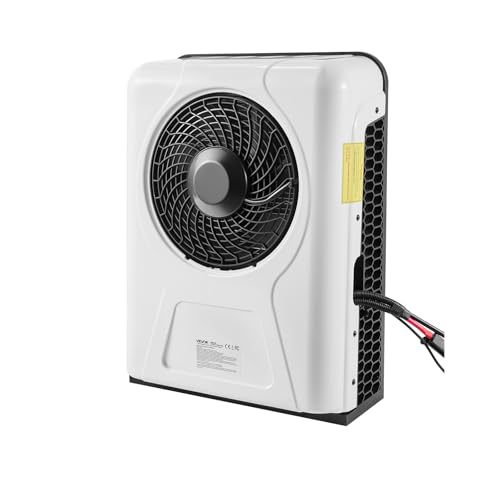
For truck and camper cabs, this split-style unit pairs a 10,000 BTU cooling rating with 400 m³/h airflow. Its dimensions are 21.26 × 25.59 × 9.45 inches, so measure the proposed mounting area and route before selecting it. The maker says the inverter compressor can run for 6–8 hours on a 12V battery and reports noise as low as 65 dB; actual runtime depends on battery capacity, condition and operating load. This option is a cooling system, not the under-dash heating-and-cooling kit offered by Universal 10,000 BTU Under-Dash AC/Heat Kit.
Bottom line: Pick this if you want a split-style 12V system for a truck or camper cab.
Universal 10,000 BTU Under-Dash AC/Heat Kit

Unlike the split cab units, this universal under-dash kit combines heating and cooling components, including an evaporator, condenser, receiver dryer and compressor. The maker says its electric scroll compressor provides 10,000 BTU of cooling and can operate from a car battery or external power, including with the engine off. The maker does not give dimensions or a weight, so check the space available under the dash and the vehicle’s electrical requirements before committing. Choose it for a retrofit where cabin heat as well as air conditioning is needed.
Bottom line: Choose this when an under-dash retrofit needs both heating and cooling.
12V DC 9,000 BTU Split AC

Five rotatable indoor outlets distinguish this 9,000 BTU split system, allowing air direction to be adjusted around a truck, RV, van or camper. The unit is rated at 850 watts, and its dimensions are 8.3 × 19.3 × 26 inches. The maker says the system can cool while parked without starting the engine and reports indoor noise as low as 40 dB. Its rated capacity is lower than the 10,000 BTU options, which matters for buyers comparing cooling loads; confirm that its mounting arrangement suits the vehicle.
Bottom line: Pick this if adjustable outlets and a 9,000 BTU rating suit your cab.
AClengda 12V 9,000 BTU Split AC

This 9,000 BTU split system is distinguished by its outdoor unit, which has ABS plastic housing, a hollowed design for heat dissipation and a waterproof feature. The maker says the compressor uses variable-frequency control and can cool with the engine off from battery power. At 50 pounds and 8.3 × 19.3 × 26 inches, the unit needs a suitable mounting location and support; the waterproof feature applies to the external unit and does not establish that every electrical connection is weatherproof. Its capacity is below the 10,000 BTU systems in this group.
Bottom line: Choose this for a 12V split setup with a waterproof-featured outdoor unit.
How to choose a 12V vehicle air conditioner
Start with system type and electrical load, then compare cooling capacity. A split system separates indoor and outdoor components, while an under-dash unit places its cabin assembly below the dashboard; the two layouts have different space and routing needs. Cooling capacity is measured in BTU per hour, but a higher rating alone does not guarantee suitable performance in a sun-exposed or poorly insulated cab. A 12V system can draw substantial current: at 850 watts, the ideal current is about 71 amps at 12 volts, before conversion losses. Measure mounting space and check the vehicle battery, charging setup, wiring and fuse requirements against the chosen system before purchase.
Battery runtime and electrical safety
Battery runtime depends on usable battery energy and the air conditioner’s actual draw, not its voltage alone. As a rough planning rule, a 12V, 100 amp-hour battery stores 1,200 watt-hours nominally; a continuous 850-watt load would consume that amount in about 1.4 hours before losses and reserve limits. Battery chemistry, age, temperature and compressor cycling change the usable time, so do not assume a quoted runtime applies to every vehicle. High-current 12V equipment needs conductors sized for current and cable length, plus a correctly rated fuse placed near the battery. Have a qualified installer confirm the circuit rather than relying on a general-purpose accessory outlet.
Split and under-dash systems compared
Choose the layout that fits the vehicle and installation plan. Split units place a cabin section and an outdoor section separately, while an under-dash retrofit puts the evaporator assembly inside the cab. Check that the outdoor component has a location with airflow and that tubing and cables can be routed without sharp bends or contact with hot or moving parts. Use this guide to narrow the layout before comparing individual capacity ratings.
| Need | System layout to consider | What to measure |
|---|---|---|
| Cabin retrofit needing heat and cooling | Under-dash kit | Under-dash clearance and component routing |
| Separated indoor and outdoor components | Split system | Cabin and exterior mounting areas |
| Parked operation | Battery-powered 12V system | Usable battery energy and expected load |
Fit and installation checks for vehicle AC
Measure all mounting surfaces before ordering, including clearance for airflow, service access and cable routing. A component’s length, width and height describe its outer size, not the additional space needed for brackets, hoses or ventilation. For split equipment, confirm that the vehicle can support both indoor and outdoor sections and that the route between them avoids exhaust heat, abrasion and moving parts. For an under-dash kit, check passenger legroom and dashboard clearance. Electrical planning is equally important: compare the unit’s voltage and power rating with battery and alternator capacity, and ensure the installer can size wiring and overcurrent protection for the actual circuit.
Frequently Asked Questions
How many amps does a 12V vehicle air conditioner use?
Current depends on electrical power: an 850-watt load draws about 71 amps at 12 volts before losses. Compressor cycling can change the average draw, so size the circuit for the unit’s requirements rather than assuming a steady low load.
How long can a 12V air conditioner run on a battery?
Runtime is usable battery watt-hours divided by the air conditioner’s average watt draw. For example, 1,200 nominal watt-hours divided by 850 watts is about 1.4 hours before losses and any battery reserve, so battery condition and chemistry matter.
Can a 12V vehicle AC run with the engine off?
A battery-powered 12V unit can operate with the engine off if the battery and circuit can supply its load. A high-current cooling load can drain a starter battery quickly, so plan runtime around usable capacity and preserve enough charge to start the vehicle.
What does 9,000 BTU mean for vehicle air conditioning?
BTU per hour is a measure of cooling capacity, with 9,000 BTU/h representing a lower rated capacity than 10,000 BTU/h. Cabin size, insulation, sun exposure and air leakage affect how much capacity a vehicle needs.
Are 12V split air conditioners waterproof?
Water resistance is specific to the component and its rating; a waterproof feature on an outdoor housing does not prove that connectors or the full installation are waterproof. Keep electrical connections protected and verify any required ingress rating for the mounting location.