
Solar Panels for Charging Phones: 4 Models Compared

For most phone users who want flexible outdoor charging, SOLUPUP 30W Foldable Solar Panel is the best fit because its 30W rating and USB-A and USB-C ports balance output with a foldable design.
We earn a commission if you buy through links on this page. As an Amazon Associate I earn from qualifying purchases. Products are compared on manufacturer specifications, not hands-on testing.
- Best overall: SOLUPUP 30W Foldable Solar Panel – Its 30W rating and USB-A plus USB-C ports support two-device charging in a foldable panel.
- Best for lighter carry: FlexSolar 10W USB-A Solar Panel – At 0.66 lb, it is the lightest panel here and has a single USB-A port.
- Best for compact carry: GEYOTO 35W Solar Charger – Its 35W panel measures 8.29 by 4.76 inches and has USB-C and USB-A ports.
| Product | Best for | Output | Ports | Weight | Shop |
|---|---|---|---|---|---|
| SOLUPUP 30W Foldable Solar Panel | Trail charging | 30W | USB-A and USB-C | 2.4 lb | Check Price on Amazon |
| FlexSolar 10W USB-A Solar Panel | Lightweight carry | 10W | USB-A | 0.66 lb | Check Price on Amazon |
| GEYOTO 35W Solar Charger | Compact dual-port | 35W | USB-A and USB-C | 1.54 lb | Check Price on Amazon |
| GEYOTO 45W Solar Panel Charger | Higher rated output | 45W | USB-A and USB-C | 1.65 lb | Check Price on Amazon |
Solar panels for charging phones
Compare output, connection options and carrying weight to choose a panel or power bank that suits your charging setup.
SOLUPUP 30W Foldable Solar Panel

SOLUPUP 30W Foldable Solar Panel stands apart with a foldable 30W design, USB-A and USB-C ports, and an adjustable stand for positioning toward the sun. The panel can charge two devices at once and is intended for phones, tablets and power banks. Its 23% monocrystalline cells and 7.87-by-10.63-inch folded size make it a practical match for hikers who want a panel rather than a battery pack. It has no built-in battery, so output can fluctuate with sunlight; pairing it with a power bank helps buffer charging when conditions change.
Bottom line: Choose this if you want a foldable dual-port panel and can carry 2.4 pounds.
FlexSolar 10W USB-A Solar Panel

FlexSolar 10W USB-A Solar Panel is the lightest panel in this group at 0.66 pound and keeps its charging setup simple with one USB-A port and a 10W maximum output. Its IP67-rated monocrystalline cells have an ETFE surface, and the maker gives a 24% conversion-efficiency figure for full sunlight. This suits a hiker prioritizing low carry weight and basic USB-A compatibility. The single port and lower output are limiting if you want to charge multiple devices or need USB-C; the panel also cannot store electricity, so direct sun is essential for charging.
Bottom line: Pick this for minimal carry weight and a single USB-A charging connection.
GEYOTO 35W Solar Charger
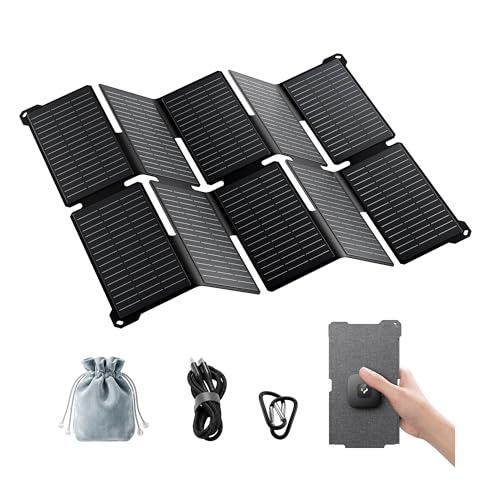
GEYOTO 35W Solar Charger combines a 35W output rating with USB-A and USB-C ports, allowing two compatible devices to charge at once. Its compact stated dimensions are 8.29 by 4.76 inches, and its weight is 1.54 pounds. The maker says its monocrystalline cells reach up to 26% conversion efficiency in direct sunlight, which may appeal to campers balancing output against pack size. The claimed output depends on sun and device compatibility, and the specifications do not identify a built-in battery; choose it as a panel, not as guaranteed stored power.
Bottom line: Choose this for a compact, dual-port panel with a 35W output rating.
GEYOTO 45W Solar Panel Charger

GEYOTO 45W Solar Panel Charger has the highest panel output rating among the options here at 45W, with USB-A and USB-C connections. The maker describes a 25W PD USB-C port and up to 26% conversion efficiency in direct sunlight; the panel is listed at 1.65 pounds. This can suit buyers prioritizing higher rated output while keeping a portable panel setup. The USB-C port’s 25W PD figure is distinct from the 45W panel rating, so a compatible device and favorable sunlight are needed to approach the advertised charging behavior.
Bottom line: Pick this when its 45W panel rating and 25W PD USB-C port match your needs.
How to choose a solar phone charger
Start with the port your phone accepts, then choose panel output around how many devices you need to charge. USB-C is common on newer phones, while USB-A works with many older cables; a USB-C port does not guarantee fast charging unless the panel and phone support compatible charging standards. For one phone and a backup battery, a 10W panel can be a lighter option; for two devices or more headroom, look at panels rated 30W or higher. Panel wattage is a rating under favorable conditions, not a promise of constant phone input. If you will be away from direct sun, choose a setup that includes or pairs with a power bank.
Solar panel output and real charging conditions
Portable panel output changes with sun angle, shade, cloud cover and heat, so rated watts are best treated as a ceiling rather than a steady output. Point a panel toward direct sun and reposition it as the sun moves; even partial shade across a cell section can sharply reduce output. A phone may also pause or restart charging when clouds make power fluctuate. For a dependable charge during variable weather, connect the panel to a power bank that can accept solar input, then charge the phone from the bank. Keep the panel uncovered and ventilated, and avoid leaving a phone baking in direct sun while it charges.
Panel, foldable charger and solar power bank differences
A standalone panel sends power to a connected device in real time, while a solar power bank stores energy in a battery and can charge later. Foldable panels emphasize carrying and positioning convenience; they still need sunlight and compatible cables. The table below separates the main use cases.
| Type | Best use | Trade-off |
|---|---|---|
| Small panel | Low carry weight, one device | Lower rated output |
| Foldable dual-port panel | Multiple devices in sun | No stored energy unless paired with a bank |
| Solar power bank | Charging from stored energy | Solar recharging can be slow |
Choose a bank-based setup if you need phone charging after sunset; choose a panel-only setup if you can place it in sun while charging.
Safe setup and common charging mistakes
Keep phones and power banks out of excessive heat: lithium-ion batteries age faster when hot, and charging can pause if a device overheats. A panel’s waterproof rating applies to the panel design, not necessarily to connected phones, cables or power banks, so keep those components dry unless their own ratings allow exposure. Do not assume that a higher panel wattage forces that much power into a phone; compatible charging electronics regulate the draw. Match the cable and port to the device, position the panel in unobstructed sun, and use a power bank as a buffer when clouds or movement make direct output unstable.
Frequently Asked Questions
Can a solar panel charge a phone directly?
Yes, a USB solar panel can charge a compatible phone directly when sunlight is strong and steady. Because clouds or shade can interrupt output, a power bank is a better buffer for variable conditions.
How many watts does a phone solar charger need?
A 10W panel can serve a single phone in good sun, while 30W or more provides headroom for multiple devices or charging a power bank. Actual phone input depends on sunlight and the phone’s charging capability.
Does a solar phone charger work on cloudy days?
A panel can still produce some power in cloudy conditions, but output falls as sunlight weakens and varies with cloud cover. For a reliable charge through changing weather, store energy in a power bank during brighter periods.
Can I leave my phone connected in direct sun?
Direct sun can heat a phone enough to trigger charging protection or accelerate battery wear. Keep the panel in the sun but place the phone in shade with airflow, especially when ambient temperatures are high.
Is a solar power bank better than a panel?
A power bank is more convenient when you need to charge after the sun sets because it stores energy first. A standalone panel can be lighter or offer higher rated output, but it requires sun while the device is charging.