
Navfalcon Hidden Camera Detectors: Models Compared

Navfalcon 6-Level Detector is the direct match for Navfalcon hidden camera detectors, with six sensitivity levels and four modes named in its product name. Choose another model if you want a frequency range or specific scanning modes; Tefodovar 6-in-1 Detector gives a frequency range and lists six modes.
These handheld detectors look for radio transmissions or camera lenses, depending on their scanning functions. No single scan guarantees a clean room: RF scanning can miss devices that are off or not transmitting.
We earn a commission if you buy through links on this page. As an Amazon Associate I earn from qualifying purchases. Products are compared on manufacturer specifications, not hands-on testing.
- Best overall: Navfalcon 6-Level Detector – The only Navfalcon model in this selection, with six sensitivity levels and four professional modes named.
- Best for frequency range: Tefodovar 6-in-1 Detector – Its RF detection range is 1 MHz to 6.5 GHz, and it lists six modes.
- Best for directional RF scans: Extendable-Antenna Camera Detector – Its extendable-antenna and adjustable sensitivity are intended to help locate wireless signals across larger areas.
| Product | Best for | Modes or scan features | Dimensions (inches) | Shop |
|---|---|---|---|---|
| Navfalcon 6-Level Detector | Navfalcon match | 4 modes; 6 sensitivity levels | 4.49 × 1.57 × 3.86 | Check Price on Amazon |
| Hero Privacy Pen Detector | Multiple alerts | 6-in-1 functions; adjustable sensitivity | 4.72 × 1.26 × 0.55 | Check Price on Amazon |
| Nilcozy 10-in-1 Pen Detector | Pen-style carry | 10-in-1 in name; one-key operation | 4.72 × 2.76 × 1.57 | Check Price on Amazon |
| Tefodovar 6-in-1 Detector | Stated RF range | 6 modes | 4.4 × 0.5 × 1.0 | Check Price on Amazon |
| Extendable-Antenna Camera Detector | Room-wide RF sweeps | Adjustable sensitivity; infrared scan | — | Check Price on Amazon |
Navfalcon Hidden Camera Detectors and Alternatives
Compare the scanning functions and physical measurements, then choose based on the type of signal or camera you need to check.
Navfalcon 6-Level Detector

Navfalcon 6-Level Detector is the only Navfalcon-branded detector in this group, and its name specifies six sensitivity levels and four professional modes. Its dimensions are about 4.49 × 1.57 × 3.86 inches, so check whether that form factor suits your travel kit. RF detectors generally look for active transmissions; they cannot confirm that a room has no hidden device.
Bottom line: Pick this if the Navfalcon name and its sensitivity levels and mode count are your priorities.
Hero Privacy Pen Detector

Hero Privacy Pen Detector emphasizes alerts suited to noisy settings: the product says it combines flashing LEDs, vibration, and adjustable audio beeps. At about 4.72 × 1.26 × 0.55 inches, its dimensions are compact. This is an alternative rather than a Navfalcon model, and the maker does not give a frequency range for buyers comparing RF coverage.
Bottom line: Choose this if multiple alert types matter more than a clearly specified function count.
Nilcozy 10-in-1 Pen Detector

Nilcozy 10-in-1 Pen Detector is the pen-style alternative, with one-key operation and a pocket-sized design highlighted in its product features. The maker says its RF detector uses an upgraded high-sensitivity chip and is optimized to reduce false alerts; those are performance claims, not a guarantee that a sweep will find every device. Its dimensions are about 4.72 × 2.76 × 1.57 inches.
Bottom line: Choose this if one-key operation and a pen-style design suit your carry needs.
Tefodovar 6-in-1 Detector

Tefodovar 6-in-1 Detector is the clearest alternative for shoppers comparing a RF range: the maker gives 1 MHz to 6.5 GHz and lists camera, infrared, wireless-signal, magnetic, guard, and SOS modes. Its four alert selections are mute, sound, vibration, or both sound and vibration. The dimensions are about 4.4 × 0.5 × 1.0 inches. The product says infrared camera detection should be used indoors in a dark room; that makes it less convenient when you cannot dim the space. A broad frequency range does not by itself guarantee detection of non-transmitting devices.
Bottom line: Choose this if a RF range and named scanning modes are important to your comparison.
Extendable-Antenna Camera Detector
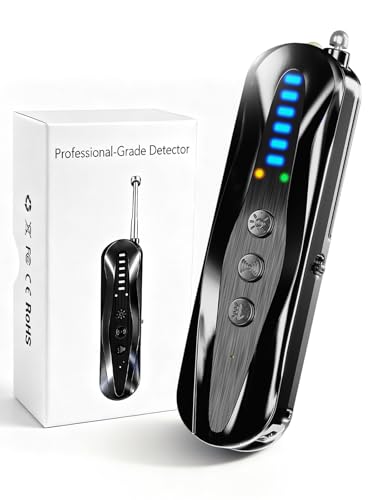
Extendable-Antenna Camera Detector differs by describing an extendable-antenna intended to help with directional RF pickup in larger rooms, along with adjustable sensitivity. It also describes infrared scanning for pin-hole cameras that do not use Wi-Fi, so its functions address two different detection approaches. The specifications give no dimensions, which makes pocket-fit comparisons difficult. RF scanning is most useful when a device is transmitting; an offline camera or recorder may not produce a detectable signal. For that reason, its infrared scan is relevant when checking camera lenses rather than relying on RF alerts alone.
Bottom line: Choose this if an extendable-antenna and a separate infrared scan fit your room-sweeping approach.
How to choose a hidden camera detector
Choose by the device behavior you need to check: RF scanning looks for active radio transmissions, while infrared or lens-reflection functions target cameras optically. A detector with adjustable sensitivity can help narrow a signal as you move closer, but high sensitivity can also pick up nearby phones, routers, and other transmitters. Start at a lower setting and increase it as you approach a suspicious area. With a room under 100 square feet, a slow sweep around fixtures and furniture is manageable; larger rooms benefit from a directional antenna or repeated passes. No handheld detector can establish that a room is completely free of surveillance equipment.
What RF and camera scans can detect
RF detectors respond to transmissions, so an unplugged device, a recorder storing data locally, or a camera that is not transmitting can evade an RF sweep. Wi-Fi and Bluetooth devices commonly use the 2.4 GHz band, while many Wi-Fi systems also use 5 GHz; household equipment can create signal clutter. Optical lens finders work differently by illuminating a camera lens and looking for its reflection, so scan darkened rooms slowly and inspect reflective spots by eye. A frequency span is useful for comparison, but coverage depends on the detector’s design and the device’s operating state.
How to sweep a hotel room or office
Begin by silencing or moving your own transmitting electronics, then scan near likely power sources and objects with a view of the bed, desk, or changing area. Move slowly and change the detector’s angle; a strong signal may come from an ordinary router or phone, not a hidden device. Check smoke alarms, clocks, chargers, and vents visually, but do not dismantle safety equipment or fixtures. For an infrared or lens scan, reduce room lighting and sweep likely camera positions rather than assuming one pass covers every angle. An alert is a reason to investigate carefully, not proof that a device is surveillance equipment.
Compare detector features by your priority
Use the functions to narrow the choice, then weigh RF coverage against optical scanning and portability. A frequency range describes the range the maker says its device can scan; it does not guarantee that every signal in that range will be found.
| Need | Feature to prioritize | Trade-off |
|---|---|---|
| Check active wireless signals | RF scan and adjustable sensitivity | Nearby devices can cause signal clutter |
| Look for camera lenses | Infrared or lens-reflection scan | Requires deliberate visual inspection |
| Work in a noisy room | Vibration or light alerts | Alerts still require follow-up |
| Cover a larger room | Directional or extendable-antenna | Move slowly and scan from several positions |
Frequently Asked Questions
Can a detector find a camera that is turned off?
An RF detector generally cannot find a camera that is off and not transmitting. An optical lens finder may still reveal a lens reflection, so use it as a separate check rather than relying on RF alone.
Will a hidden camera detector find every bug?
No handheld detector can guarantee that it will find every device. RF scans can miss offline or non-transmitting equipment, and nearby Wi-Fi or Bluetooth signals can complicate alerts.
How should I scan a hotel room for cameras?
Scan slowly near objects with a view of private areas, then inspect any alert rather than treating it as proof. Darken the room for an infrared or lens scan, and visually check likely hiding places such as chargers and clocks.
Why does my detector keep alerting near Wi-Fi?
Wi-Fi commonly transmits in the 2.4 GHz band and may also use 5 GHz, which RF detectors may pick up. Lower sensitivity, move closer to isolate signal direction, and account for your own phone and router.
Do infrared camera finders need a dark room?
Many infrared or lens-reflection scans are easier to use in low light because reflections stand out more clearly. One product here specifically says to use its infrared mode indoors with the room as dark as possible.