
Nordica HF 75 Ski Boots: Fit and Models Compared

Nordica HF 75 Women’s 26.5 is the closest match for most skiers seeking Nordica HF 75 ski boots because it combines a 102 mm last with a rear-entry shell and medium flex. Choose another model if you need a different boot size, a stiffer flex, or a more conventional four-buckle design.
The HF 75 is a women’s rear-entry alpine ski boot designed for easier entry and exit.
We earn a commission if you buy through links on this page. As an Amazon Associate I earn from qualifying purchases. Products are compared on manufacturer specifications, not hands-on testing.
- Best overall: Nordica HF 75 Women’s 26.5 – Its 102 mm last, medium flex, and rear-entry closure match the HF 75 search.
- Best for heat customization: Nordica Women’s HF 75 W 27.5 – Infrared Technology is designed to customize pressure points.
- Best for a firmer flex: Nordica HF 85 Women’s 25.5 – The HF 85 keeps the 102 mm last and rear-entry design with a higher flex number.
| Product | Best for | Flex | Last | Entry or sole | Shop |
|---|---|---|---|---|---|
| Nordica HF 75 Women’s 26.5 | Easy rear entry | Medium | 102 mm | Rear entry | Check Price on Amazon |
| Nordica Women’s HF 75 W 27.5 | Pressure customization | — | — | Rear entry | Check Price on Amazon |
| Nordica HF 85 Women’s 25.5 | Higher flex option | 85 | 102 mm | Rear entry; GripWalk | Check Price on Amazon |
| Nordica HF 120 Men’s 27.5 | Stiffer men’s boot | 120 | 102 mm | Rear entry; GripWalk | Check Price on Amazon |
| Nordica Speedmachine 3 75 Women’s 24.5 | Mid-volume fit | 75 | 100 mm | Four-buckle design | Check Price on Amazon |
Nordica HF 75 ski boots compared
Compare the HF 75 options by fit, flex, and the features that distinguish each model.
Nordica HF 75 Women’s 26.5
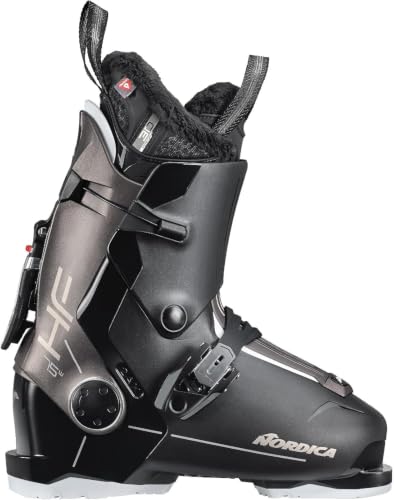
Nordica HF 75 Women’s 26.5 is the direct HF 75 match, with a 102 mm last, medium flex, and a rear-entry shell. The Easy Entry Shell opens 40 degrees, and the monolock buckle closes by pressing it down with a foot. The 26.5 size and high-volume fit make this a candidate for skiers who prioritize easier entry and a roomier shape. The PrimaLoft-insulated liner is intended to retain warmth when wet. A high-volume shell may feel loose on a narrow foot, so fit should take priority over the convenience features.
Bottom line: Choose this if a high-volume fit and rear entry are your priorities.
Nordica Women’s HF 75 W 27.5

Nordica Women’s HF 75 W 27.5 adds Infrared Technology for customization at pressure points, setting it apart from the other HF 75 option here. Its PrimaLoft insulation is water-resistant, and the HF back-buckle monolock is designed to close with a downward push and open with a pole. The 27.5 size suits shoppers whose boot-fit assessment calls for that shell size. This model is still an HF 75, but its maker does not establish the last width or flex; do not assume those measurements match Nordica HF 75 Women’s 26.5.
Bottom line: Pick this if the infrared customization feature matters and 27.5 is your fit size.
Nordica HF 85 Women’s 25.5

Nordica HF 85 Women’s 25.5 keeps the HF rear-entry approach and 102 mm last but changes the model to an HF 85 with a medium flex designation. Its 25.5 size, GripWalk sole, and heat-moldable cork liner distinguish it from the HF 75 choices. It may suit a skier looking for a similar high-volume entry style in a different shell size and model. The model number is not a standardized flex measurement, so it should not be treated as a direct numerical stiffness comparison with boots from other brands.
Bottom line: Choose this when the 25.5 size and HF 85 model fit your needs.
Nordica HF 120 Men’s 27.5

Nordica HF 120 Men’s 27.5 is a men’s HF model with a 120 flex designation, a 102 mm last, and GripWalk compatibility, rather than the women’s HF 75 requested. Its Easy Entry Shell opens 40 degrees, while the rear monolock closure is designed for hands-free fastening. A heat-moldable cork liner is another distinction. The stiff flex makes this a poor substitute for skiers specifically seeking the HF 75’s medium-flex feel; model flex numbers are not a universal scale across brands.
Bottom line: Consider this only if you want a men’s boot with a much stiffer flex.
Nordica Speedmachine 3 75 Women’s 24.5

Nordica Speedmachine 3 75 Women’s 24.5 is a women’s Nordica boot with a 100 mm mid-volume shell, unlike the HF 75’s high-volume rear-entry format. It uses a moldable shell, a heat-moldable liner, and micro-adjustable aluminum shell and cuff buckles. The 24.5 size may suit a skier whose measured fit calls for that size and a more conventional buckle arrangement. Its 75 flex designation is not directly interchangeable with other brands’ flex numbers, and the narrower stated last does not guarantee a comfortable fit without trying the boot.
Bottom line: Pick this if you need a mid-volume fit and prefer multiple adjustment buckles.
How to choose Nordica HF 75 ski boots
Choose by shell fit first, then entry style and flex. Ski boot sizes use the Mondo scale, based on foot length in centimeters; measure both feet and fit the longer one. As a practical shell-fit check, remove the liner, slide the foot forward until the toes lightly touch, and look for roughly 1 to 2 fingers of space behind the heel for a recreational fit. Less space generally means a closer fit, while more may feel loose during turns. Last width is a reference at a particular shell size, not a promise of comfort: foot shape, instep height, and liner thickness all affect fit. If you have under 1 cm of heel space in the shell, ask a boot fitter to assess sizing before skiing.
Rear-entry ski boots and fit differences
Rear-entry boots open at the back so the foot can enter without navigating a tall front cuff; the HF shell’s opening is 40 degrees. A wider last and high-volume construction can be useful for a broad foot or a skier who values easier entry, but can leave a narrow heel less secure. Alpine boots generally use a flex index, but flex numbers are not standardized across manufacturers, and temperature and skier weight also change how a boot feels. The HF 75 is specified as medium flex; compare that category and fit rather than assuming its number equals another brand’s. Test ankle hold and heel lift with ski socks, not thick everyday socks.
Ski boot soles and binding compatibility
Match boot soles to the binding before skiing; GripWalk soles require a binding explicitly compatible with GripWalk or a suitable multi-norm binding. Traditional alpine soles and GripWalk soles have different contact geometry, so a boot that clicks into a binding is not automatically compatible. Look for the sole type molded or marked on the boot and verify the binding’s compatibility marking; have a qualified ski shop check release settings after any boot change. The HF 85 and HF 120 entries specify GripWalk, while that sole type is not included among the specifications for the HF 75 options. Never modify a boot sole to force a fit.
Common ski boot fitting mistakes
The most common mistake is choosing a shell by street-shoe size or by a roomy feel while standing still. Ski boots should hold the heel and instep firmly, with toes lightly touching when upright and easing back as the knees flex forward. Try boots with one thin ski sock; bulky socks can compress circulation and create cold feet. A liner can pack out with use, so a boot that feels comfortably loose in the store may become less supportive. Heat molding can alter some liners or shells, but it cannot reliably correct a shell that is fundamentally too large or too small. Ask a boot fitter to assess pressure points before heating or punching a shell.
Frequently Asked Questions
How should ski boots fit around the toes?
Ski boot toes should lightly touch the front while standing upright, then pull back slightly when the knees flex forward. A heel that lifts noticeably during a forward flex may indicate excess volume or an incorrect shell size.
What does a 102 mm ski boot last mean?
A 102 mm last is a width reference measured at a particular boot size, commonly around Mondo 26/26.5. The same labeled width can feel different with foot shape, instep height, and shell volume.
Can GripWalk boots work with older ski bindings?
Only if the binding is marked compatible with GripWalk or is a compatible multi-norm model. A boot that physically clicks in is not proof of safe release compatibility, so have a ski shop verify the pairing.
Do ski boot flex numbers compare across brands?
No, ski boot flex indices are not standardized across manufacturers. Use the flex category, skier weight, ability, and fit together rather than treating numbers from different brands as equivalent.
Should I wear thick socks in ski boots?
Wear one thin ski sock rather than thick or layered socks. Extra fabric can bunch, reduce circulation, and make a boot feel tighter without improving heel hold.