
Chargeworx Solar Powered Power Bank Alternatives Compared

The Chargeworx solar powered power bank is not among these options; BLAVOR Solar Power Bank 10,000mAh is the closest match, with a 10,000mAh battery, wireless charging and a 20W USB-C output. Choose a different model if you need greater capacity or built-in cables for multiple devices.
A solar power bank combines a rechargeable battery with a small solar panel, but its panel is best treated as emergency backup rather than a dependable way to refill the battery quickly.
We earn a commission if you buy through links on this page. As an Amazon Associate I earn from qualifying purchases. Products are compared on manufacturer specifications, not hands-on testing.
- Best overall: BLAVOR Solar Power Bank 10,000mAh – 10,000mAh capacity, wireless charging and a 20W USB-C output in a compact format.
- Best for more devices: BLAVOR Solar Power Bank 20,000mAh – 20,000mAh capacity, four built-in cables and wireless charging.
- Best for maximum capacity: Solar Power Bank 38,800mAh – 48,000mAh capacity and four solar panels.
| Product | Best for | Capacity | USB-C output | Built-in cables | Shop |
|---|---|---|---|---|---|
| BLAVOR Solar Power Bank 10,000mAh | compact charging | 10,000mAh | 20W | — | Check Price on Amazon |
| BLAVOR Solar Power Bank 20,000mAh | multi-device charging | 20,000mAh | 20W | 4 cables | Check Price on Amazon |
| Solar Power Bank 38,800mAh | lightweight capacity | 38,800mAh | — | — | Check Price on Amazon |
| Solar Power Bank 38,800mAh with 4 Cables | cable-free packing | 38,800mAh | 22.5W | 4 cables | Check Price on Amazon |
| SOARAISE Solar Power Bank 48,000mAh | maximum capacity | 48,000mAh | — | 4 cables | Check Price on Amazon |
Solar Powered Power Banks
Compare these alternatives by battery capacity, charging connections and the features that fit your devices.
BLAVOR Solar Power Bank 10,000mAh
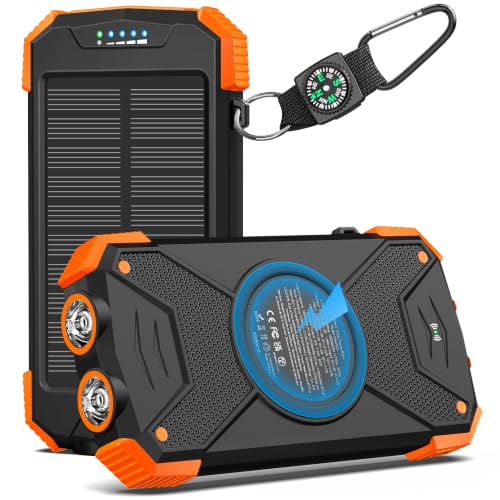
For a smaller battery with wireless charging, BLAVOR Solar Power Bank 10,000mAh pairs a 10,000mAh capacity with a 20W USB-C output. BLAVOR says it can charge an iPhone 15 to 65% in 30 minutes; the actual result depends on the phone and charging conditions. The bank supports up to three devices simultaneously and measures 5.9 by 3.1 by 0.8 inches, so it suits buyers prioritizing a smaller pack over maximum capacity. Its 10,000mAh reserve is the limitation for extended trips or charging several devices repeatedly.
Bottom line: Choose this if you want a smaller 10,000mAh pack with wireless charging.
BLAVOR Solar Power Bank 20,000mAh

Unlike BLAVOR Solar Power Bank 10,000mAh, BLAVOR Solar Power Bank 20,000mAh supplies four built-in cables alongside wireless charging, including an Apple Watch charging area. Its 20,000mAh battery and USB-C 20W fast charging suit travelers who want fewer separate cables and more capacity than a 10,000mAh bank. BLAVOR says the built-in connections and ports can charge up to six devices at once; simultaneous charging divides available power among devices. The 7.28-inch height is a notable tradeoff if you need a particularly compact pack.
Bottom line: Pick this for built-in cable variety and a larger battery.
Solar Power Bank 38,800mAh

At 9.9 ounces, Solar Power Bank 38,800mAh stands apart from the higher-capacity options by pairing a 38,800mAh rating with a lightweight build. It has two USB-A outputs and a USB-C input/output port for compatible phones and other devices. Its 5.9-by-2.95-inch footprint suits day hikes and travel, while the 0.98-inch thickness is worth considering when packing space is tight. The features provided identify solar as emergency backup, so charge the bank through USB-C before a trip rather than depending on sunlight to replenish it.
Bottom line: Choose this if weight and a large stated capacity matter.
Solar Power Bank 38,800mAh with 4 Cables

Solar Power Bank 38,800mAh with 4 Cables combines a 38,800mAh capacity with 22.5W USB-C charging and four built-in cables, a different setup from Solar Power Bank 38,800mAh, which has two USB-A outputs and USB-C. The manufacturer says it supports up to six devices at once and includes overcharge, over-current, short-circuit and overheat protection. Its 6.3-by-3.07-by-1.38-inch body is larger in each dimension than Solar Power Bank 38,800mAh, which matters when minimizing pack volume. Choose it for integrated cable convenience, not for a slimmer form.
Bottom line: Pick this if you want built-in cables and faster specified USB-C output.
SOARAISE Solar Power Bank 48,000mAh
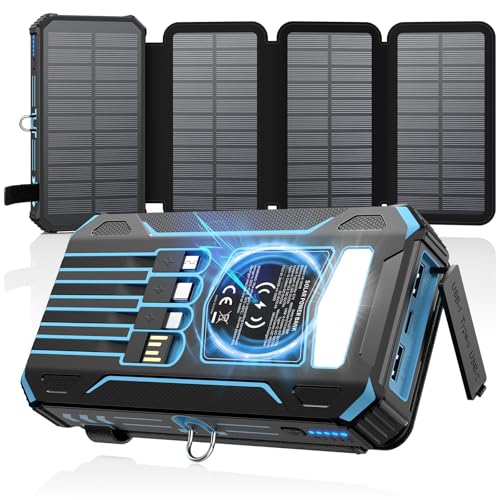
SOARAISE Solar Power Bank 48,000mAh has the highest capacity here at 48,000mAh and uses four solar panels, unlike the single-panel configurations implied by the other solar-bank options. It also includes four built-in cables and PD/QC 3.0 fast charging, making it suited to longer trips where capacity and cable variety take priority. The manufacturer says its four panels charge up to five times faster than standard single-panel chargers; sunlight, angle and weather affect solar input. Its weight is about 1.37 pounds, a tradeoff for buyers carrying gear on foot.
Bottom line: Choose this for the largest capacity and four-panel solar design.
How to choose a solar powered power bank
Choose capacity and charging connections before treating solar as a deciding feature. A 10,000mAh bank is a smaller everyday reserve, while 20,000mAh or more gives more stored capacity for trips or multiple devices; usable output is lower than the battery’s rated capacity because voltage conversion loses energy. USB-C Power Delivery is the common fast-charge standard for compatible phones, but the device and cable must also support the needed wattage. A bank’s total output may be shared when several devices are connected, so a multi-device claim does not mean every device receives full-speed charging at once. For hikes, favor a pack you can fully recharge from a wall outlet before departure.
What solar charging can realistically do
Small panels on portable banks are best regarded as a slow emergency trickle, not a replacement for wall charging. Solar input changes with panel area, sun angle, shade, cloud cover and temperature; placing a bank inside a backpack or behind glass reduces exposure. A four-panel design offers more collection area than a single-panel design, but panel count alone does not establish a refill time. For a measurable choice, if you need the bank ready for a specific departure time, charge it by USB-C or another rated input beforehand rather than relying on a few hours outdoors. Keep the battery out of excessive heat and follow its charging limits.
Capacity, cables and charging ports
mAh ratings describe battery capacity, not the exact number of phone charges; phone battery size, conversion losses and charging behavior all affect the total. Built-in cables reduce the cords to pack, but a damaged or incompatible cable can limit usefulness, so check that the connector type matches each device. Wireless charging avoids a cable at the device but typically charges more slowly than wired fast charging and requires correct coil alignment. Use this quick comparison to match a trip need to a charging setup.
| Need | Choose a setup |
|---|---|
| Smaller reserve | 10,000mAh bank |
| More integrated connectors | Bank with built-in cables |
| Higher stored capacity | 38,800mAh or 48,000mAh bank |
| Faster replenishment | USB-C input from a wall charger |
Safe use and care for solar power banks
Portable banks contain lithium batteries, so avoid puncturing, crushing or leaving one in a hot parked vehicle; heat can damage cells and increase fire risk. Keep charging equipment dry unless its water-resistance rating is known, and do not infer waterproofing from an outdoor-use label. Use a compatible cable and charging input, and disconnect a pack that becomes unusually hot, swollen or damaged. Solar charging can raise surface temperature in direct sun, so shade the bank while keeping its panels exposed when practical. Store the pack partly charged in a cool, dry place if it will sit unused for months, and inspect cables before relying on them for travel.
Frequently Asked Questions
Can a solar power bank charge fully from sunlight?
Usually, a small portable panel is better for emergency trickle charging than fully replenishing a large battery. Sun angle, shade, cloud cover and panel area can make charging much slower than USB-C input.
Is 10,000mAh enough for a weekend trip?
A 10,000mAh bank is a compact reserve, but whether it lasts depends on your phone’s battery size and how often you use it. For multiple devices or repeated recharges, consider a higher-capacity bank and recharge it before departure.
Do built-in cables charge every phone?
Built-in cables work only with devices that use compatible connectors and charging protocols. Check the cable types against your phone and accessories, and carry a separate cable if any device uses a connector the bank does not include.
Can I charge several devices at full speed?
Not necessarily; when a bank powers multiple devices at once, its available output may be divided among the connections. Check the supported total output and each port’s rating if charging speed matters.
Is it safe to leave a power bank in direct sun?
Prolonged heat can damage lithium batteries, even when the solar panel needs sunlight to collect energy. Keep the battery portion shaded where possible, and stop using a bank that becomes unusually hot, swollen or damaged.