
Rifle Scope Leveling Kit: Compare 5 Mounting Tools

For most scope installations, Wheeler Professional Reticle Leveling System is the strongest fit because its adjustable barrel clamp works around large barrels and its magnetic reference level provides a separate alignment point. Choose a rail-mounted tool instead if you need a compact setup that attaches directly to a Picatinny rail; a wedge is suited to one-piece mounts or rings with a measured gap.
We earn a commission if you buy through links on this page. As an Amazon Associate I earn from qualifying purchases. Products are compared on manufacturer specifications, not hands-on testing.
- Best overall: Wheeler Professional Reticle Leveling System – Combines an adjustable, non-marring barrel clamp with a magnetic reference level.
- Best for magnetic leveling: EZshoot Magnetic Scope Leveling Kit – Pairs a magnetic reference level with a rail level and 10 mm calibration distance.
- Best for rail attachment: Vortex Riflescope Pro Leveling Kit – Clips to Picatinny rails and uses dual levels for alignment.
- Best for measured gaps: DISCOVERYOPT Scope Leveling Wedge – Includes wedge sizes covering base-to-turret gaps from 0.180 to 1.053 inches.
| Product | Best for | Mounting method | Material | Adjustment or fit range | Shop |
|---|---|---|---|---|---|
| Wheeler Professional Reticle Leveling System | Barrel clamp setups | Adjustable barrel clamp | Anodized aluminum | — | Check Price on Amazon |
| EZshoot Magnetic Scope Leveling Kit | Magnetic reference use | Rail level and magnetic reference | — | 0.39 in calibration distance | Check Price on Amazon |
| Vortex Riflescope Pro Leveling Kit | Picatinny rail fit | Picatinny rail clip | 6061 aluminum | Any Picatinny rail | Check Price on Amazon |
| DISCOVERYOPT Scope Leveling Wedge | Gap-based leveling | Wedge between turret and base | Aluminum | 0.180–1.053 in | Check Price on Amazon |
| WarBull Universal Scope Leveling Kit | Case included | Barrel clamp and magnetic base | Anodized aluminum alloy | — | Check Price on Amazon |
Rifle scope leveling kits by setup type
Compare how each tool establishes a level reference and whether its mounting method suits your scope installation.
Wheeler Professional Reticle Leveling System
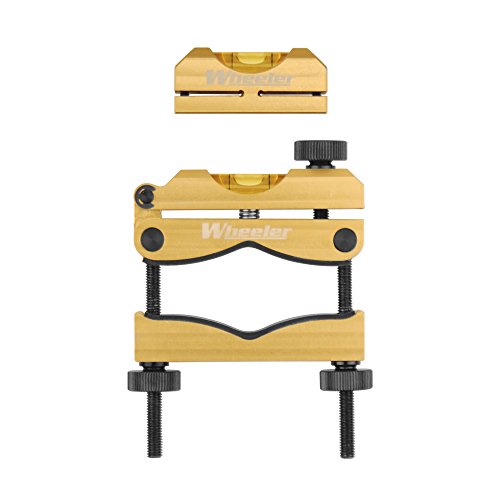
The adjustable barrel clamp is the distinguishing feature here, making this kit a fit for rifles or shotguns where a level can sit around the barrel rather than attach to a rail. Wheeler includes two calibrated machined aluminum level housings, a reference level with a magnetic bottom, and a case. Non-marring pads protect the contact points, and the clamp adjusts for large-diameter barrels. Each level has an integrated bubble. The limitation is that the process uses a separate reference level and barrel-mounted level, rather than a single clip-on rail tool; account for both when planning the setup.
Bottom line: Choose this if you want a barrel-clamp reference that also accommodates larger barrels.
EZshoot Magnetic Scope Leveling Kit

The 10 mm calibration distance distinguishes this set, which combines a level for rails with a universal magnetic reference level. The maker says fluorescent green fluid improves visibility and that the reference level’s magnetic base can sit on steel inside a turret cap. That arrangement suits users who want to compare a rail reference with the scope’s turret area. The measurements are compact at 0.55 by 2.56 inches. This set is less suitable when a barrel clamp is needed, since its described method centers on rail and magnetic placement rather than clamping around the barrel.
Bottom line: Choose this for a compact rail-and-magnetic reference approach.
Vortex Riflescope Pro Leveling Kit

The clip-on Picatinny attachment and one-handed operation set this apart from kits that use a barrel clamp or a wedge. Its dual levels provide separate alignment readings, and the maker says the tool is machined from 6061 aluminum. At 0.0625 pounds, the weight is notably easy to carry with other setup tools. This design is specifically for Picatinny rails, so it is not the match for a mounting setup without that rail interface or for someone who needs a wedge to bridge a measured base-to-turret gap.
Bottom line: Choose this if your leveling setup uses a Picatinny rail.
DISCOVERYOPT Scope Leveling Wedge

This aluminum wedge levels the reticle by inserting between the bottom turret and the base plate, a different method from using a magnetic level or a barrel clamp. The small wedge adjusts across gaps of 0.180 to 0.559 inches, while the large wedge covers 0.490 to 1.053 inches. Measure the gap before selecting a wedge, since the ranges overlap but do not cover every possible spacing. The kit is intended for one-piece mounts or scope rings; it does not provide the separate bubble levels included with the other styles.
Bottom line: Choose this when the measured mount gap falls within its wedge range.
WarBull Universal Scope Leveling Kit

The included storage case and CNC-machined anodized aluminum alloy body distinguish this universal kit. The maker describes a barrel-clamp level and a reference level with magnetic bottom for placement on a rail or compatible open turret cap, combining two common leveling approaches. Its gold finish also differs from the black and bronze options. The maker does not establish a clamp diameter or a quantified adjustment range, so measure and confirm barrel compatibility before choosing it if barrel size is a close fit; the Wheeler option explicitly describes adjustment for large barrels.
Bottom line: Choose this if you want a case-equipped kit with clamp and magnetic reference methods.
How rifle scope leveling kits establish alignment
Most scope leveling setups compare the rifle’s level reference with the reticle’s vertical line, but the contact point differs by tool. A barrel-clamp system references the barrel; a rail tool references a Picatinny rail; a wedge works between a turret and mount base. A level bubble responds to gravity, so a canted rifle can make a properly aligned reticle appear off. Stabilize the unloaded firearm on a secure rest and keep the action open while working. For repeatable alignment, use the same stable rifle reference throughout rather than switching between barrel, rail, and receiver surfaces mid-adjustment.
How to choose a mounting method
Choose the method based on the surface and gap your setup actually offers. If the firearm has a usable Picatinny rail, a rail clip gives a direct reference; if rail access is absent or you need a broader barrel fit, a clamp is an alternative. For wedge tools, measure from the bottom turret to the base plate before selecting the wedge size. Most conventional rifle scopes use a 1-inch or 30 mm main tube, but tube diameter alone does not determine the base-to-turret gap. Keep the selection tied to mounting geometry, not tube size alone.
| Setup condition | Suitable tool style | Check first |
|---|---|---|
| Picatinny rail available | Rail clip or rail level | Rail is securely mounted |
| Barrel accessible for clamping | Barrel clamp and reference level | Clamp accommodates barrel diameter |
| Gap between turret and base | Scope leveling wedge | Measured gap is within wedge range |
How to avoid a canted scope reticle
A canted reticle causes the scope’s elevation adjustments to track on a diagonal rather than a true vertical line. Keep the rifle level first, then rotate the scope until the reticle’s vertical line aligns with the gravity reference; tightening rings can shift the tube, so recheck alignment as screws are snugged evenly. Ring screws are commonly tightened in a cross pattern in small increments to avoid uneven pressure, but the correct torque depends on the mount and scope maker. Never overtighten a ring screw to force alignment, and verify that the firearm is unloaded before adjusting the optic.
What to check before leveling a riflescope
Inspect the mount and rail for movement before using a leveling tool, because a loose base can invalidate the alignment reference. Confirm that the chosen level contacts a flat, stable surface; curved or angled surfaces can make a bubble reading misleading. For wedge kits, a gap outside the adjustment span cannot be corrected by forcing the wedge. After alignment, check eye relief and that the scope’s adjustment turrets remain accessible, since rotating the tube can alter how controls sit. Firearm work should take place with ammunition removed from the work area and the muzzle pointed in a safe direction.
Frequently Asked Questions
Why does a rifle scope reticle need to be level?
A level reticle keeps elevation adjustments aligned with the rifle’s vertical plane. A canted scope can shift point of impact sideways as elevation is dialed, especially at longer distances.
Can I level a scope without a Picatinny rail?
Yes, a barrel-clamp system or a wedge can work without a Picatinny rail. The clamp needs to fit the barrel, while a wedge requires a measured gap between the turret and mount base.
How should I measure a scope wedge gap?
Measure the space from the bottom of the scope turret to the mount base plate with the scope positioned in its rings. The wedge ranges here span 0.180 to 1.053 inches, so compare the actual gap before selecting a size.
Does scope tube diameter determine the leveling tool?
No; tube diameter does not determine whether a rail, clamp, or wedge method fits. A 1-inch or 30 mm tube measurement is separate from the barrel diameter, rail interface, and turret-to-base gap that govern tool compatibility.
Should the rifle be unloaded while leveling a scope?
Yes, remove ammunition from the firearm and work area before adjustment. Keep the muzzle pointed in a safe direction and stabilize the unloaded firearm so the level reference does not move.