
Sugar Scoop Welding Helmets: 3 Models Compared

For a sugar scoop welding helmet with adjustable ratcheting headgear, choose Tefuawe Medium-Cut Fiberglass Sugar Scoop; its medium-cut shell and adjustable eyes-to-lens distance are the deciding features. Choose a different model if you want a helmet with a fixed shade 10 filter included or need another shell design.
A sugar scoop, also called a pipeliner hood, has a compact shell intended to help welders work in confined spaces.
We earn a commission if you buy through links on this page. As an Amazon Associate I earn from qualifying purchases. Products are compared on manufacturer specifications, not hands-on testing.
- Best overall: Tefuawe Medium-Cut Fiberglass Sugar Scoop – Ratcheting headgear and adjustable eyes-to-lens distance provide flexibility for fit and respirator clearance.
- Best for included filter: Armour Guard White Fiberglass Sugar Scoop – Comes with a fixed shade 10 filter that can be replaced with a 2 x 4.25-inch filter lens.
- Best for compact access: Fibre-Metal Pipeliner 110WH – Compact Pipeliner design is intended for areas without room for a standard helmet.
| Product | Best for | Shell material | Headgear | Shop |
|---|---|---|---|---|
| Tefuawe Medium-Cut Fiberglass Sugar Scoop | Adjustable fit | Fiberglass | Ratcheting | Check Price on Amazon |
| Armour Guard White Fiberglass Sugar Scoop | Included shade filter | Fiberglass reinforced | — | Check Price on Amazon |
| Fibre-Metal Pipeliner 110WH | Tight work areas | SuperGlas Plus | Ratcheting | Check Price on Amazon |
Sugar Scoop Welding Helmets
Compare shell design, lens setup and headgear to choose a hood suited to your work area and fit preferences.
Tefuawe Medium-Cut Fiberglass Sugar Scoop

Adjustable eyes-to-lens distance distinguishes this medium-cut fiberglass hood, including for welders who need to make room for a respirator. The ratcheting headgear has multiple adjustments and a wraparound backrest, and the maker says its fiberglass is moisture-proof and impact-resistant. The chopped medium cut is intended to reduce interference with the chest and head. This is a fit-focused choice for people who adjust their setup through the day; the specifications do not identify an included filter, so buyers who need a ready-to-use lens setup should consider a model that specifies one.
Bottom line: Choose this hood if adaptable headgear and respirator clearance are priorities.
Armour Guard White Fiberglass Sugar Scoop
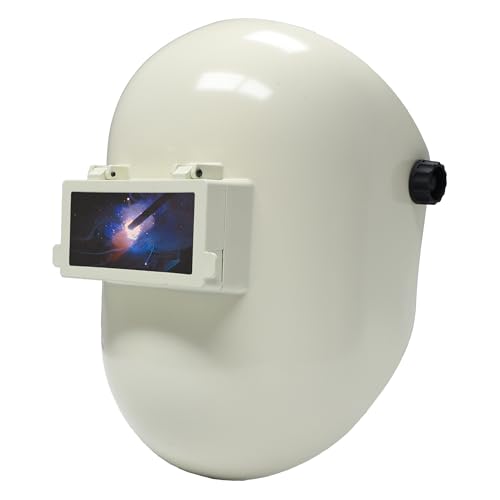
An included fixed shade 10 filter sets this white fiberglass-reinforced hood apart from the other models. The filter accepts a 2 x 4.25-inch replacement lens, and the flip front provides access to the lens without removing the helmet. The maker says the moisture-proof shell is impact-resistant and designed to help prevent cracking, chipping and splitting; the product also identifies ANSI Z87.1 and CSA Z94.3 compliance. This option suits buyers who want a specified filter included. Its shade is fixed, so welders who need a different shade should verify lens compatibility before ordering.
Bottom line: Pick this hood if an included fixed shade 10 filter and flip front suit your setup.
Fibre-Metal Pipeliner 110WH
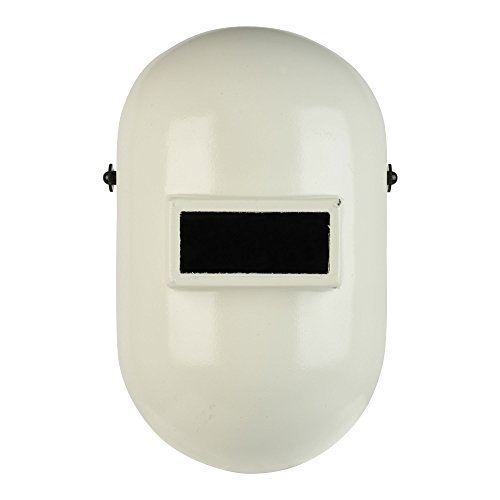
The compact Pipeliner profile is the distinguishing feature of this Fibre-Metal hood, designed for areas where a standard helmet may not fit. Its shell is molded from SuperGlas Plus, and the specified 110WH version has ratcheting headgear. The maker describes the material as formulated for lightweight strength and says the shell resists moisture and impact. This model fits buyers prioritizing a compact pipeliner design with adjustable headgear.
Bottom line: Choose this model for compact access paired with ratcheting headgear.
How to choose a sugar scoop welding helmet
Start with shell clearance, lens setup and headgear rather than color: those determine how the hood fits your work and face. Compact pipeliner shells are useful where overhead or side clearance is limited, while a flip front lets you raise the lens assembly without lifting the whole hood. Headgear adjustability matters when the hood must sit at a particular distance from the eyes or accommodate a respirator. Compare the lens shade and dimensions against the welding process and current range you use; a fixed shade cannot be tuned like a variable-shade lens. For example, Armour Guard White Fiberglass Sugar Scoop has a fixed shade 10 filter and specified replacement lens dimensions, while Tefuawe Medium-Cut Fiberglass Sugar Scoop offers eyes-to-lens adjustment.
A fit decision rule: if the shell touches your chest when lowered or blocks access to the joint, prioritize a shorter-cut or more compact hood before choosing by material.
Sugar scoop lens and filter fit
Lens size and shade are separate checks: a lens can fit the opening yet still be the wrong shade for the process and amperage. Armour Guard White Fiberglass Sugar Scoop uses a 2 x 4.25-inch replacement lens format and includes a fixed shade 10 filter; the other models need lens compatibility checked against the hood before purchase. Welding shade charts commonly place shade 10 in the mid-range for processes such as stick and MIG, but the right shade changes with amperage, process and applicable guidance. Do not assume one shade covers every job. A cover plate protects the filter from spatter and scratches, and should be replaced when damaged or obscured. Keep the viewing area clean so slag or grime does not block the weld zone.
Before ordering, confirm the replacement lens dimensions and shade are appropriate for your process and the hood opening.
Fiberglass and compact pipeliner shells
Fiberglass-reinforced shells are common in pipeliner hoods because they combine a rigid form with resistance to moisture and impact; the exact formulation differs by model. Fibre-Metal Pipeliner 110WH uses SuperGlas Plus, while Tefuawe Medium-Cut Fiberglass Sugar Scoop and Armour Guard White Fiberglass Sugar Scoop identify fiberglass construction. Compact contours can improve access in narrow spaces, but a shell that clears a pipe may still interfere with a respirator, collar or shoulder when tilted down. Try the lowered position with the clothing and respiratory gear used on the job. A larger lens opening is not automatically better if the shell prevents a stable fit or reduces clearance. Treat impact-resistant construction as shell protection, not a substitute for inspecting the hood after a hard strike or visible damage.
For confined pipeline work, choose the shell that clears the joint in both the raised and lowered positions.
Welding helmet fit and eye safety
A welding hood protects the face and eyes during welding, but it does not eliminate the need for appropriate eye protection while the hood is raised. Wear safety glasses with side protection under the hood to guard against flying particles, and use the shade suitable for the process and current. A secure headgear fit keeps the lens aligned with the eyes; ratcheting adjustment can help fine-tune fit during the shift. Check that the hood lowers reliably and remains in place when you move your head. Shell certification or impact resistance does not make an unsuitable lens shade safe for arc exposure. Replace cracked shells, damaged filters and scratched cover plates that obstruct vision.
Use the welding procedure’s shade guidance and never look at an active arc through a raised hood or an unsuitable filter.
Frequently Asked Questions
What does sugar scoop mean in a welding helmet?
A sugar scoop is a compact pipeliner-style welding hood shaped to help with access in tight work areas. Its cut and headgear still need to fit your shoulders, neck and respirator when lowered.
Is a shade 10 welding filter enough for every job?
No; shade depends on welding process and amperage, so one fixed shade is not suitable for every task. Shade 10 is commonly used for mid-range stick and MIG work, but check the process-specific shade guidance before welding.
Can I use any 2 by 4 lens in a sugar scoop?
No; the lens dimensions must match the hood’s opening and retaining setup. Armour Guard White Fiberglass Sugar Scoop accepts a 2 x 4.25-inch replacement lens, so confirm compatibility for other hoods separately.
Should safety glasses be worn under a welding hood?
Yes, safety glasses with side protection help guard against flying particles when the welding hood is raised. Use a suitable welding filter before viewing an active arc.
How should I check a welding hood fit?
Lower the hood and check that its lens stays aligned with your eyes and the shell clears your chest and shoulders. Repeat the fit check with the respirator and clothing you use at work.