
Best Sounding 6 1 2 Speakers: Three Models Compared

The JVC CS-J620 suits most listeners seeking the best sounding 6.5-inch speakers because its 92 dB sensitivity and 35 Hz–22 kHz response give useful comparison points. Choose Kenwood KFC-1666R Road Series instead if its 30 W RMS rating and 40 Hz–22 kHz range better match your amplifier; Kenwood KFC-1666S may suit a simpler replacement, though its fields provide fewer sound-related specifications.
These coaxial speakers combine a woofer and tweeter in one assembly, but fit still depends on your vehicle’s opening, mounting depth and wiring.
We earn a commission if you buy through links on this page. As an Amazon Associate I earn from qualifying purchases. Products are compared on manufacturer specifications, not hands-on testing.
- Best overall: JVC CS-J620 6.5-Inch – Its 92 dB sensitivity and 35 Hz–22 kHz response provide concrete comparison points for a factory-system upgrade.
- Best for RMS clarity: Kenwood KFC-1666R Road Series – The 30 W RMS rating and 40 Hz–22 kHz response help match it to an amplifier or head unit.
- Best for simple replacement: Kenwood KFC-1666S – A polypropylene woofer, PEI dome tweeter and included grilles give it a straightforward two-way setup.
| Product | Best for | Power handling | Frequency response | Shop |
|---|---|---|---|---|
| JVC CS-J620 6.5-Inch | Factory stereo upgrade | 30 W RMS; 300 W peak | 35 Hz–22 kHz | Check Price on Amazon |
| Kenwood KFC-1666R Road Series | Amplifier matching | 30 W RMS; 300 W peak | 40 Hz–22 kHz | Check Price on Amazon |
| Kenwood KFC-1666S | Basic two-way swap | 300 W peak; RMS — | — | Check Price on Amazon |
6.5-Inch Coaxial Speakers
Compare the specifications that help distinguish these 6.5-inch options, then confirm the fit for your vehicle.
JVC CS-J620 6.5-Inch

The 92 dB sensitivity and 35 Hz–22 kHz frequency range distinguish this pair in the group, making it a useful option when upgrading a factory stereo without a separate amplifier. Each speaker uses a 6.5-inch mica-cone woofer and 1-inch PEI tweeter, with 4-ohm impedance and a 1-23/32-inch top-mount depth. JVC gives 30 W RMS and 300 W peak per speaker. The shallow top-mount depth may help where space behind the door panel is tight, but confirm the vehicle’s opening and mounting depth before ordering; the response range alone cannot predict how the speakers will sound in a particular cabin.
Bottom line: Choose this pair if sensitivity and a shallow top-mount depth matter for your factory-system upgrade.
Kenwood KFC-1666R Road Series
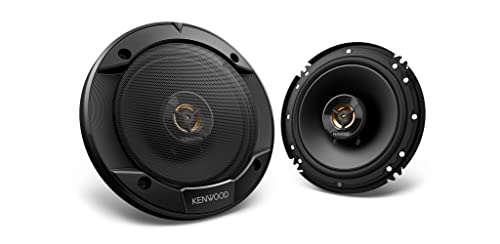
The published 30 W RMS rating makes this pair easier to compare with a head unit or amplifier than options without an RMS figure. Kenwood pairs a cloth woofer with a balanced-dome tweeter and gives a 40 Hz–22 kHz frequency response, 4-ohm impedance and 300 W peak rating. Those figures describe electrical matching and stated response, not guaranteed bass output or sound quality in every vehicle. The coaxial layout keeps the woofer and tweeter together for a single speaker position.
Bottom line: Pick this pair if its 30 W RMS and 4-ohm ratings fit your existing audio system.
Kenwood KFC-1666S

The polypropylene woofer and treated-cloth surround set this model apart for shoppers who want a conventional two-way replacement with a specified cone material. Its 1-inch PEI balanced-dome tweeter handles the high-frequency driver role, and the package includes grilles. Kenwood gives a 300 W peak rating, but peak power is not the same as continuous RMS handling, so do not use that number alone to match an amplifier. The maker does not give a frequency range or sensitivity for comparison with the other pairs. This choice suits a basic speaker swap where those missing comparison points are less important than the included grille and driver materials.
Bottom line: Choose it for the specified woofer materials and included grilles rather than for power matching.
How to choose 6.5-inch speakers for sound
Start with sensitivity and RMS power, not a peak-watt number. Sensitivity is commonly expressed in dB at 1 W/1 m; a 3 dB increase represents roughly twice the acoustic output for the same input power under comparable conditions. RMS power is a better matching figure than peak power because it represents continuous handling, while peak figures describe brief maximum input. A factory radio often supplies less power than an external amplifier, so higher sensitivity can be useful in a no-amplifier setup. Frequency-response ranges are only a rough comparison: cabin acoustics, installation, and measurement methods change the result. For these choices, prioritize verified RMS and sensitivity figures that match your system rather than assuming a wider range means better sound.
Check speaker fit before replacing a door speaker
A 6.5-inch label is a nominal size, not a promise that every speaker fits the same opening. Door locations can differ in cutout diameter, mounting depth, screw pattern, and clearance behind the window glass; measure the old speaker and available space before choosing. The JVC pair gives a 1-23/32-inch top-mount depth, which can be compared directly with the available clearance. A mounting adapter may be needed when the factory opening or fasteners differ. Check whether the vehicle uses a factory connector or requires wiring changes, and make sure the window can travel fully without touching the speaker. Disconnect the vehicle’s negative battery terminal before working on speaker wiring to reduce the risk of an electrical short.
What coaxial speakers do in a car
Coaxial speakers place more than one driver in a single mounting assembly, commonly a woofer for lower and midrange sound plus a tweeter for high frequencies. That arrangement replaces a factory speaker location without requiring separate tweeter locations, but it does not eliminate the vehicle’s mounting and wiring constraints. Component speakers instead separate the drivers and use a crossover, which can allow more placement control but needs compatible mounting locations and installation work. In a basic door replacement, coaxials are often the simpler layout; with dedicated tweeter locations and room to tune placement, component sets may be worth considering. The models here are two-way coaxials, so choose among them by fit and available electrical specifications, not by the driver count alone.
Match speaker power and wiring safely
Use RMS power and impedance to judge compatibility; a 300 W peak label does not mean a speaker needs or can continuously use that much power. The 4-ohm rating on the JVC and Kenwood Road Series pairs is a key electrical specification to compare with the head unit or amplifier’s supported load. Lower impedance can increase amplifier demand, so do not wire speakers in parallel unless the amplifier supports the resulting load. Keep polarity consistent at each speaker so the positive and negative leads are not reversed relative to one another. Before reconnecting the battery, secure loose wiring away from moving window parts and metal edges; a pinched lead can short and damage equipment.
Frequently Asked Questions
Does 92 dB sensitivity make a car speaker louder?
A 92 dB sensitivity rating can indicate more output than a lower rating when measured under the same conditions and driven with the same power. The JVC figure is useful for comparison, but installation and cabin acoustics also affect perceived loudness.
Is peak power the same as RMS power?
No; RMS is the more useful continuous power-handling figure for matching speakers and amplifiers. A 300 W peak rating should not be treated as 300 W RMS.
Will every 6.5-inch speaker fit my car?
No; the nominal size does not guarantee a matching cutout or mounting depth. Measure the opening, depth behind the panel, screw spacing, and window clearance before selecting a replacement.
Should I disconnect the battery before speaker wiring?
Yes; disconnect the negative battery terminal before working on vehicle speaker wiring to reduce short-circuit risk. Keep wiring clear of window tracks and sharp metal edges.
Do frequency response numbers guarantee better bass?
No; a range is not a measure of bass output in your car. Door sealing, mounting, cabin acoustics, and measurement conditions affect the result, so use response figures as one comparison point rather than a guarantee.