
Aosu Security Cameras: 5 Models Compared by Fit

For aosu security cameras, aosu D1 Max 4-Cam Kit suits shoppers prioritizing 4K outdoor coverage, expandable storage and tracking. Choose aosu 2K Indoor Camera instead for an indoor camera with two-way audio, or compare the other kits if you need a different camera count or coverage setup.
We earn a commission if you buy through links on this page. As an Amazon Associate I earn from qualifying purchases. Products are compared on manufacturer specifications, not hands-on testing.
- Best overall: aosu D1 Max 4-Cam Kit – It combines 4K imaging, solar power, 360-degree PTZ tracking and storage expandable to 1TB.
- Best for indoor rooms: aosu 2K Indoor Camera – Its 360-degree horizontal rotation, 155-degree tilt and one-touch calls are suited to indoor monitoring.
- Best for wide coverage: aosu T2 Pro 3K Dual Cam – A fixed 170-degree wide-angle camera works with a 360-degree PTZ camera in one outdoor device.
| Product | Best for | Resolution | Power | Storage | Shop |
|---|---|---|---|---|---|
| aosu D1 Max 4-Cam Kit | 4K outdoor coverage | 4K (8MP) | Solar | Expandable to 1TB | Check Price on Amazon |
| aosu T2 Pro 3K Dual Cam | Wide outdoor views | 3K | Solar | Local storage | Check Price on Amazon |
| aosu 2K Solar 2-Cam Kit | Expandable 2K setup | 2K | Solar | Local storage | Check Price on Amazon |
| aosu D1 Classic 4-Cam Kit | Local video storage | 2K (3MP) | Solar | 32GB built-in | Check Price on Amazon |
| aosu 2K Indoor Camera | Indoor room monitoring | 2K | — | — | Check Price on Amazon |
Aosu security cameras compared
Compare each model’s camera type, coverage approach and storage before deciding which setup matches your property.
aosu D1 Max 4-Cam Kit

Among these options, the D1 Max is the only kit with 4K (8MP) imaging and storage expandable to 1TB. A four-camera system combines solar power, 360-degree PTZ coverage and cross-camera auto tracking. The maker says on-device AI detects people and vehicles, and that vehicle monitoring can alert you to nearby movement; it also describes full-color night vision and infrared mode. This setup suits buyers who want multiple outdoor cameras and room to expand storage. It may be more than needed for a single indoor room or a small area covered by one device.
Bottom line: Choose it for a multi-camera outdoor system with 4K imaging and expandable storage.
aosu T2 Pro 3K Dual Cam

The T2 Pro uses two lenses in one outdoor camera rather than a multi-camera kit: a fixed 170-degree view watches broadly while a 360-degree PTZ camera follows activity. The maker says the cameras coordinate to detect people, vehicles and pets, then track movement; it also describes 8× zoom, local storage and full-color night vision. Solar power and the dual view suit a driveway or entry area where broad context and a closer moving view are both useful. A single unit is not the same as a four-camera system, so buyers needing several separate viewpoints should compare the kits.
Bottom line: Pick it for one outdoor mounting point that needs a wide view and PTZ tracking.
aosu 2K Solar 2-Cam Kit

The 2-cam kit offers a smaller starting system than the four-camera kits, with an option to add cameras as coverage needs grow. Its split solar-panel design lets the camera and panel be mounted separately, which can help when the best camera position is not the sunniest spot. The maker says the system includes cross-camera tracking, AI human detection, full-color night vision and local storage without a subscription. It fits buyers covering a few priority outdoor areas. Solar performance can vary with sunlight, season, placement and settings, so a shaded mounting location may require extra planning.
Bottom line: Choose it to start with two solar cameras and leave room to expand.
aosu D1 Classic 4-Cam Kit
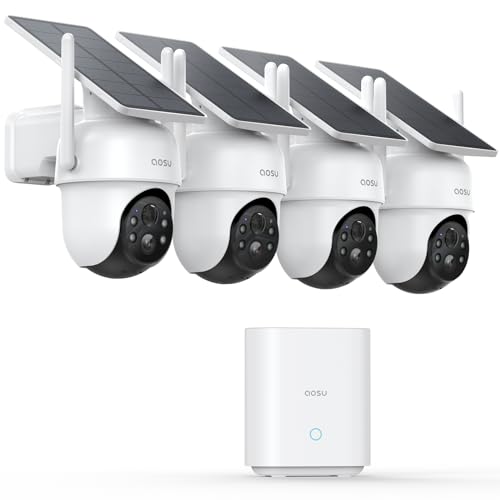
The D1 Classic distinguishes itself with 32GB of built-in storage in the aosuBase and a four-camera outdoor kit. The maker says recordings are encrypted and stored locally without a subscription, with up to four months of loop recording; actual retention depends on how much footage the system records. Features also include 360-degree auto tracking and viewing four live streams on one screen. This suits buyers who want multiple cameras and a defined onboard storage capacity. Its 32GB capacity is smaller than the D1 Max’s expandable 1TB, so shoppers prioritizing maximum storage should compare that model.
Bottom line: Pick it for four solar cameras and a defined 32GB local-storage capacity.
aosu 2K Indoor Camera

Unlike the outdoor solar kits, this single camera is designed for indoor monitoring and combines a 360-degree horizontal rotation with a 155-degree vertical tilt. The maker says motion tracking follows activity, and the camera includes two-way audio with one-touch calls, infrared night vision and 24/7 recording. It connects to 2.4GHz Wi-Fi only, so check that your home network provides a compatible 2.4GHz connection where the camera will sit. This is a fit for a room, family or pet monitoring, not a substitute for a multi-camera outdoor system.
Bottom line: Choose it for a single indoor room with two-way audio and motion tracking.
How to choose an aosu security camera
Choose by coverage first: a single indoor camera, a dual-lens outdoor unit and a two- or four-camera kit solve different layout problems. For one room, a pan-and-tilt camera can reposition its view; for separate outdoor zones, multiple cameras can watch distinct areas. Resolution also changes the tradeoff: higher pixel counts provide more image detail, but usable identification still depends on distance, lighting and camera angle. If you need footage retained locally, compare capacity rather than relying on a generic retention claim; motion frequency and recording settings affect how quickly storage fills. Select a solar setup only where the panel can receive useful direct sunlight, and account for seasonal shade.
Outdoor camera placement and field of view
Mount outdoor cameras about 7 to 9 feet high as a common starting point, then adjust for the target area and mounting constraints. A higher position covers more ground but can make faces harder to identify; aim toward approach paths rather than directly into bright windows or the rising or setting sun. Wide-angle views cover more area but make distant subjects smaller, while a PTZ camera can turn toward movement but cannot show every direction at once. For a driveway or entry, check that the camera’s view includes the approach and the stopping point. Avoid aiming across a neighbor’s private spaces, and verify local privacy rules before recording beyond your property.
Solar power, Wi-Fi and recording choices
Solar cameras need a panel position with consistent sunlight, and a split-panel design can separate the camera’s ideal view from the panel’s sunniest position. Shade, winter daylight and camera activity can all affect charging, so do not assume a solar camera will behave identically at every location. Wi-Fi placement matters too: 2.4GHz networks generally reach farther through walls than 5GHz, but walls, metal and distance still weaken a signal. Before mounting, test the intended spot for reliable live video and alerts. Local storage keeps footage on a hub or camera rather than requiring cloud storage; estimate retention from your recording mode, activity and capacity.
Indoor and outdoor camera types compared
Indoor pan-and-tilt cameras prioritize room coverage and two-way conversation; outdoor kits prioritize weather-exposed placement, multiple viewpoints or solar charging. A dual-lens outdoor camera combines a fixed wide view with a moving PTZ view, which is different from installing two cameras in separate locations. The table maps common needs to the camera type that addresses them; confirm the mounting location and network before choosing.
| Need | Camera type | Tradeoff |
|---|---|---|
| One room and two-way talk | Indoor pan-and-tilt | Not an outdoor multi-camera system |
| Several separate outdoor zones | Multi-camera kit | Requires planning camera placement |
| Broad view plus moving close-up | Dual-lens PTZ camera | One mounting point covers one area |
Frequently Asked Questions
How high should an outdoor security camera be mounted?
About 7 to 9 feet is a useful starting range for many outdoor cameras. Lower mounting can improve face detail, while higher mounting can broaden the area in view.
Does a solar security camera work in shaded areas?
Solar charging works best with direct sunlight on the panel. Shade and seasonal daylight can reduce charging, so place a split panel in the sunniest suitable spot and test the camera before final mounting.
Is a 2.4GHz Wi-Fi camera compatible with 5GHz Wi-Fi?
A camera limited to 2.4GHz needs a 2.4GHz network connection; a 5GHz-only network will not meet that requirement. Many dual-band routers offer both bands, but confirm the 2.4GHz signal reaches the camera location.
How much storage does a security camera need?
Storage needs depend on resolution, recording schedule, clip length and how often motion occurs. Continuous recording typically uses space faster than motion-triggered clips, so compare retention needs against the camera system’s capacity.
Where should an outdoor camera point at night?
Aim toward the path or area where people approach, and avoid pointing directly at bright lights or reflective windows. Infrared night vision can reflect off nearby glass, so outdoor cameras generally work better outside the window rather than behind it.