
5 Pin Electrical Connector Options Compared by Fit

For most automotive wiring jobs, PLUXPAER 14AWG 5-Way Waterproof Connectors is the clearest fit because it pairs five-way connectors with 14 AWG leads and an IP67 rating.
We earn a commission if you buy through links on this page. As an Amazon Associate I earn from qualifying purchases. Products are compared on manufacturer specifications, not hands-on testing.
- Best overall: PLUXPAER 14AWG 5-Way Waterproof Connectors – Includes three pairs of wired connectors with 14 AWG leads and an IP67 rating.
- Best for terminal assembly: TMH 220-Piece 5-Pin Connector Kit – The 220-piece kit includes male and female terminals and 100 rubber seals.
| Product | Best for | Wire gauge | Quantity | Shop |
|---|---|---|---|---|
| PLUXPAER 14AWG 5-Way Waterproof Connectors | Automotive wiring | 14 AWG | 3 pairs | Check Price on Amazon |
| NAOEVO 16AWG 5-Pin Waterproof Connector Set | Six-set wiring | 16 AWG | 6 pairs | Check Price on Amazon |
| TMH 220-Piece 5-Pin Connector Kit | Loose terminal work | — | 220 pieces | Check Price on Amazon |
| 5-Pair Waterproof 5-Pin Wire Connectors | Basic sealed pairs | — | 5 pairs | Check Price on Amazon |
5 Pin Electrical Connectors Compared
Match the connector style, cable gauge and fit requirements to the wiring job before choosing.
PLUXPAER 14AWG 5-Way Waterproof Connectors
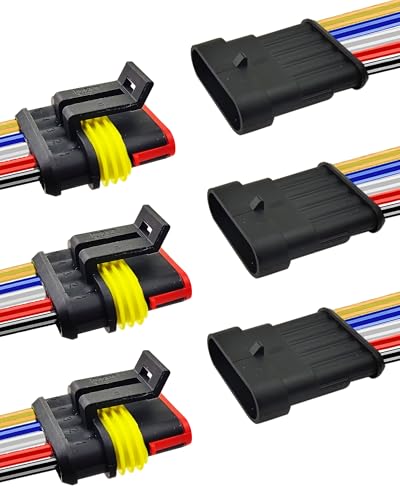
The PLUXPAER set stands out for its heavier 14 AWG leads, making it the strongest match here when the wiring job calls for that gauge. Each of the three male-female pairs has 5.9-inch wires, and the connector is rated IP67 for dust and water protection. The PA66 nylon body and tinned copper wire round out the prewired assembly. This option suits automotive, boat or motorcycle wiring where a wired plug pair is preferable to individual terminals. Its limitation is the fixed short lead length, so buyers needing longer runs must plan separate wiring.
Bottom line: Choose this for a 14 AWG prewired connector pair with an IP67 rating.
NAOEVO 16AWG 5-Pin Waterproof Connector Set

The NAOEVO set supplies six connector pairs, more than the other prewired automotive-style options here. Each pair has 4.9-inch wires, a PA66 nylon body and heat-shrink tubing; the connector is rated IP68. Its 16 AWG leads make it a different choice from the 14 AWG option, so select it only when that gauge suits the circuit. The crimp-or-solder installation offers flexibility for assembly, but short leads make this a poor match for installations that need extended cable length before reaching the harness.
Bottom line: Pick this when six pairs and 16 AWG leads match the job.
TMH 220-Piece 5-Pin Connector Kit

The TMH kit differs from the prewired sets by supplying loose terminals and seals for connector assembly. Its 220 pieces include male and female connector housings, 50 male terminals, 50 female terminals and 100 rubber seals. The copper-plated terminals are intended for crimping or soldering, while a buckle helps retain inserted contacts. This format suits repair work or custom harness assembly when wire lengths need to be cut to the installation.
Bottom line: Choose this for assembling or repairing connectors from loose parts.
5-Pair Waterproof 5-Pin Wire Connectors

This five-pair set is a basic choice for buyers seeking male-female waterproof plug-and-socket connectors without a cable assembly. The specifications describe rubber seals and solder installation, along with resistance to heat and corrosion. That makes it a different format from the prewired options: the installer supplies and prepares the conductors. Verify those requirements for the application before selecting this general-purpose set.
Bottom line: Choose this for a basic five-pair connector set when exact gauge is not required.
How to choose a 5 pin electrical connector
Start with the connector’s job: loose terminal assembly, prewired harness splice, or an extension for a matching device. Gauge matters because a wire must suit the circuit’s current and length; common automotive wire gauges include 14, 16 and 22 AWG, but they are not interchangeable for every load. Match the required wire size and terminal style before selecting by piece count. An IP rating alone does not establish suitability for every depth, duration or installation.
This comparison includes loose terminals, short prewired leads and an LED-specific extension style. Confirm the mating connector geometry and circuit requirements before ordering, especially where an existing harness must remain compatible.
Waterproof ratings and exposure
IP ratings help compare enclosure protection, but the number does not mean a connector can withstand every wet environment. IP65 indicates dust-tight protection and resistance to water jets; IP67 indicates dust-tight protection and temporary immersion under test conditions. IP68 covers continuous immersion at parameters set by the manufacturer, so the rating alone does not state the allowed depth or duration. Keep connector seals seated, use the correct mating half and avoid leaving an open connector exposed to moisture.
For vehicle, boat or outdoor wiring, also consider vibration, salt exposure and strain on the cable. A sealed connector does not make an entire splice waterproof if the wire entry, crimp or heat-shrink joint leaves a path for water. De-energize the circuit before cutting, stripping or crimping conductors.
Wire gauge and lead length
Wire gauge and lead length determine whether a prewired connector can reach the harness and carry the intended circuit. Lower AWG numbers indicate thicker conductors: 14 AWG is thicker than 16 AWG, and both are thicker than 22 AWG. The appropriate wire size depends on current, conductor material, run length and allowable voltage drop, so do not choose a connector solely by pin count.
Measure the route before choosing short pigtails: the compared prewired leads are 4.9 or 5.9 inches, while the LED extension cables are 7.87 inches per end. Leave slack for movement without letting the cable pull on the seal. If the run is too long or the current requirement is unknown, size the wire for the actual circuit rather than extending it blindly.
Connector installation and fit mistakes
A five-pin connector only works when pin arrangement, gender and mating housing match the existing wiring. Mark each conductor before disconnecting an old plug, then verify pin positions against the equipment wiring diagram; matching wire colors alone can be misleading. Crimp connectors require the correct terminal and crimp tool, while soldered joints need insulation and strain relief after cooling.
For a connector with a threaded or push-in retention feature, check its mating system and physical clearance before installation. Avoid forcing mismatched halves, and do not energize wiring until exposed conductors are insulated and the connection is secured against vibration.
Frequently Asked Questions
What does IP67 mean on a five-pin connector?
IP67 means the enclosure is dust-tight and has passed a temporary immersion test under defined conditions. It does not set the depth or duration allowed for every real installation.
Is 14 AWG thicker than 16 AWG wire?
Yes, 14 AWG wire is thicker than 16 AWG wire. Choose gauge according to circuit current, wire-run length and the equipment’s requirements, not pin count alone.
Can I use any five-pin connector with an LED strip?
No, the connector must match the strip’s pin layout and mating housing. Some LED connector systems are brand-specific, and a matching five-pin count does not ensure compatibility.
How much lead length should a connector have?
Measure the wire route and leave enough slack to prevent tension at the connector seal. Short pigtails around 5 to 6 inches can suit nearby harness joins, while longer routes need correctly sized additional wire.
Should I crimp or solder a five-pin connector?
Either method can work when the connector terminals are designed for it and the joint is insulated and strain-relieved. Use a correctly sized crimp tool for crimp terminals, and disconnect power before working on the circuit.