
Compression Socks Without Feet: 3 Calf Sleeves Compared

For compression socks without feet, BLITZU Calf Compression Sleeves is the most straightforward pick because its sizing guidance starts with measuring the thickest part of your calf. These footless sleeves cover the lower leg while leaving the foot uncovered.
Choose Sosation 6-Pair Calf Sleeves if you want several colors in a six-pair set, or CTHH 3-Pair Graduated Calf Sleeves if you prefer a three-pair set. Calf circumference matters more than shoe size; confirm a comfortable fit before extended wear.
We earn a commission if you buy through links on this page. As an Amazon Associate I earn from qualifying purchases. Products are compared on manufacturer specifications, not hands-on testing.
- Best overall: BLITZU Calf Compression Sleeves – Its sizing guidance uses calf circumference and advises sizing up or down based on preferred tightness.
- Best for color variety: Sosation 6-Pair Calf Sleeves – The set includes six pairs in six different colors.
- Best for a smaller set: CTHH 3-Pair Graduated Calf Sleeves – The set includes three pairs of graduated-compression calf sleeves.
| Product | Best for | Pack size | Size shown | Shop |
|---|---|---|---|---|
| BLITZU Calf Compression Sleeves | Calf-fit guidance | — | Small/Medium | Check Price on Amazon |
| Sosation 6-Pair Calf Sleeves | Color variety | 6 pairs | Small | Check Price on Amazon |
| CTHH 3-Pair Graduated Calf Sleeves | Three-pair set | 3 pairs | Large-XL | Check Price on Amazon |
Compression socks without feet compared
Compare sleeve measurements, sizing guidance and pair counts when choosing a calf sleeve.
BLITZU Calf Compression Sleeves

BLITZU Calf Compression Sleeves stands out for its explicit calf-measurement guidance: measure the thickest part of the calf with a soft tape, then use the brand’s sizing chart. The product is a footless calf sleeve intended for men and women, and the nude option is Small/Medium. The brand says the sleeve has graduated compression and positions it for activities such as running, nursing, fitness and travel. Its limitation is that the size information gives no sleeve length or pressure value, so buyers who need either specification should confirm the fit and compression level before extended wear.
Bottom line: Choose it if measuring your calf and selecting a size by the chart is your priority.
Sosation 6-Pair Calf Sleeves

Sosation 6-Pair Calf Sleeves is the color-variety choice, with six pairs in six different colors and an approximately 11-inch sleeve length. The Small sleeve uses a V-shaped design; its dimensions give a top stretch range of about 3.93–7.87 inches and an ankle stretch range of about 2.95–7.08 inches. The nylon-and-spandex blend is machine washable. The limitation is that this option is Small and designed for women, so buyers should compare their calf and ankle measurements with the ranges rather than assume the size will fit every wearer.
Bottom line: Choose it if you want a multi-color set and its Small measurements fit your leg.
CTHH 3-Pair Graduated Calf Sleeves
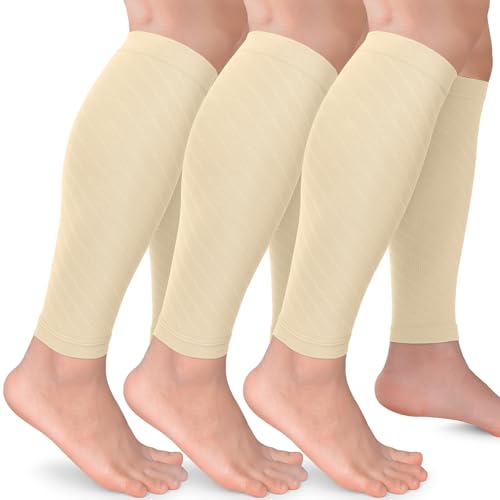
CTHH 3-Pair Graduated Calf Sleeves differs with a three-pair set in beige and a Large-XL size, making it the option for buyers who want fewer pairs than the six-pair set. The brand describes the footless calf sleeves as graduated compression and intended for men and women, with uses including walking, fitness and soccer. The beige color is the available option. The limitation is that the specifications give no sleeve length or numerical compression level; buyers who need a specific pressure range or exact coverage should verify those measurements before choosing it.
Bottom line: Choose it if Large-XL and a three-pair set suit your needs.
How to choose footless compression sleeves
Start with calf circumference, because a sleeve must fit the widest part of the calf without bunching or slipping. Measure the thickest point with a flexible tape; if your measurement falls between sizes, a looser fit generally favors sizing up, while a tighter fit favors sizing down when the maker allows that choice. Compression is commonly described in millimeters of mercury (mmHg): mild garments are often around 8–15 mmHg, moderate 15–20 mmHg, and stronger medical garments can be higher. Those ranges are general categories, not a substitute for a clinician’s prescription or a product’s own stated pressure. For medical swelling or circulation concerns, ask a clinician which level is appropriate before buying.
Footless sleeves versus full compression socks
Footless sleeves cover the calf and leave the foot and toes uncovered; full compression socks extend over the foot. That difference matters when shoes, toe coverage or pressure on the foot are part of the need. Calf sleeves also can’t provide compression to the foot, so don’t treat them as an equivalent replacement for a prescribed full-length garment. Use this distinction to narrow the type before comparing colors or pair counts.
The table summarizes the practical choice by coverage and fit need.
| Need | Choose | Why |
|---|---|---|
| Leave foot uncovered | Footless calf sleeve | Covers calf only |
| Include foot and ankle | Full compression sock | Extends over foot |
| Specific prescribed pressure | Garment with matching mmHg | Pressure level must match clinical guidance |
Fit and wear safety for calf sleeves
A properly sized sleeve should lie smooth and feel snug, not painfully tight; wrinkles and rolled edges can create concentrated pressure. Remove it if you notice numbness, tingling, unusual pain, color change or worsening discomfort. People with poor arterial circulation, reduced sensation, skin injury or a history of blood clots should get medical advice before using compression garments, because compression may not be appropriate for every condition. For regular wear, check the skin after removing the sleeve and stop using a garment that has lost elasticity or has damaged seams. Keep the garment dry and clean according to its care label.
Frequently Asked Questions
How do I measure for footless compression sleeves?
Measure around the thickest part of your calf with a flexible tape, keeping it level and snug without compressing the skin. Compare that number with the maker’s size chart; calf circumference is more relevant than shoe size for a calf-only sleeve.
Can I wear calf sleeves all day?
Wear time depends on the garment and your health, so begin with a short period and check your skin and comfort. Stop if you develop numbness, tingling, unusual pain or a color change, and seek medical advice if symptoms persist.
What compression level should I choose?
Compression garments are commonly grouped by pressure in mmHg, with mild options often around 8–15 mmHg and moderate options around 15–20 mmHg. If you are treating a medical condition or have circulation problems, ask a clinician for the appropriate level rather than choosing by feel.
Are footless compression sleeves the same as socks?
No; footless sleeves cover the calf but leave the ankle, foot and toes uncovered. A full compression sock extends over the foot, so choose the garment type that covers the area your clinician or activity requires.
When should I avoid compression sleeves?
Get medical advice before wearing compression if you have poor arterial circulation, reduced sensation, a skin wound or a history of blood clots. Remove a sleeve promptly if it causes pain, tingling or a change in skin color.