
Nail File for Natural Nails: 5 Options Compared

For natural nails, Cliganic 180/240 Emery Boards is the closest match because its 240-grit side is intended for filing and shaping natural nails, while its 180-grit side is gentler for free-edge shaping. HeeYaa 100/180 Emery Boards and Gray 100/180 Emery Boards include coarse 100-grit sides intended for acrylic or thick nails, so choose them only if you also need that heavier-duty option.
We earn a commission if you buy through links on this page. As an Amazon Associate I earn from qualifying purchases. Products are compared on manufacturer specifications, not hands-on testing.
- Best overall: Cliganic 180/240 Emery Boards – Its 240-grit side is specifically intended for shaping natural nails, and the pack includes 12 files.
- Best for half-moon shape: Canvalite Half-Moon 180/240 Files – The half-moon board pairs 180 and 240 grit and is marketed for natural nails.
- Best for assorted grits: Teenitor Assorted Files and Buffers – The six-piece kit offers assorted files and buffers, including a 240-grit file.
| Product | Best for | Grit | Count | Length | Shop |
|---|---|---|---|---|---|
| Cliganic 180/240 Emery Boards | Natural nail shaping | 180/240 | 12 files | 7 in | Check Price on Amazon |
| HeeYaa 100/180 Emery Boards | Acrylic plus natural | 100/180 | 10 files | 7.05 in | Check Price on Amazon |
| Gray 100/180 Emery Boards | Thick nail shaping | 100/180 | 12 files | 7.1 in | Check Price on Amazon |
| Teenitor Assorted Files and Buffers | Multiple grit options | Assorted grits | 6 pieces | 7.01 in | Check Price on Amazon |
| Canvalite Half-Moon 180/240 Files | Half-moon board shape | 180/240 | 10 files | — | Check Price on Amazon |
Nail files for natural nails
Compare the grit combinations and formats to find a file that suits your natural-nail routine.
Cliganic 180/240 Emery Boards

Cliganic 180/240 Emery Boards is the direct natural-nail option in this group: its 240-grit side is intended for filing and shaping natural nails, while the 180-grit side is for free-edge shaping. Each double-sided emery board measures 7 inches long and the pack contains 12. The boards are washable with soap and water, which can help with routine cleanup. This set is a practical fit if you want multiple boards with a finer side for natural nails; the 180-grit side is coarser than the 240 side, so use the finer side for gentler shaping.
Bottom line: Choose this set if you want a 240-grit side for natural-nail shaping.
HeeYaa 100/180 Emery Boards
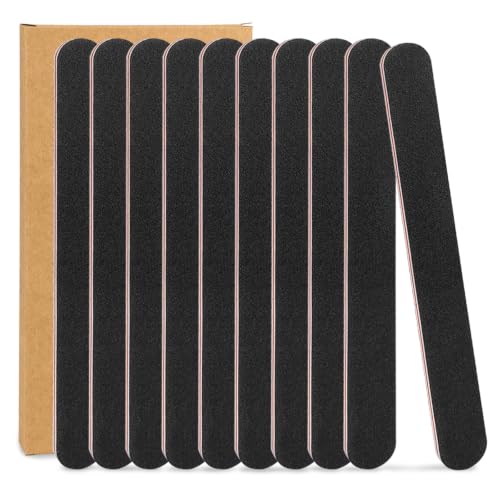
HeeYaa 100/180 Emery Boards brings the coarsest side among these simple double-sided boards, pairing 100 and 180 grit in a 10-file pack. Its 7.05-inch straight boards have a PP core and are described as reusable and cleanable. The 100-grit face is more suited to acrylic or thick nails than routine natural-nail edge shaping, so this set makes more sense for someone who works with both nail types. For natural nails alone, the absence of a finer 240-grit side makes this a less direct match than a finer-grit board.
Bottom line: Pick it when you also need a coarse side for acrylic or thick nails.
Gray 100/180 Emery Boards

Gray 100/180 Emery Boards offers 12 square, double-sided boards with 100 grit for acrylic or thick nails and 180 grit for refining natural-nail surfaces. The boards combine sandpaper, EVA and emery-board materials and are described as washable and reusable. Its 7.1-inch length gives it a slightly longer format than the 7-inch option, while the coarse 100-grit face remains the key difference. Natural-nail users who want a finer finishing face may prefer a board with 240 grit; this one is better suited to mixed routines that include thicker enhancements.
Bottom line: Choose it for a mixed routine that includes thick or acrylic nails.
Teenitor Assorted Files and Buffers

Teenitor Assorted Files and Buffers is the only multi-piece assortment here that combines files and buffers rather than supplying a stack of matching boards. Its set includes 150, 180 and 240-grit files, alongside other buffer grits, and the files are presented for shaping natural, gel and acrylic nails. At about 7 inches long, the boards are a familiar hand-held format. This set suits someone who wants several stages of filing and smoothing in one assortment; it is less straightforward if you only want identical emery boards for natural-nail edge shaping.
Bottom line: Pick this assortment if you want several filing and buffing grits.
Canvalite Half-Moon 180/240 Files

Canvalite Half-Moon 180/240 Files stands out for its half-moon shape, with a 180-grit face for shortening and shaping natural nails and a 240-grit face intended for weaker or thinner nails and prep. The pack contains 10 double-sided boards and is marketed for home or salon use. The two-grit pairing suits a natural-nail routine that needs both shaping and a finer side, while the curved outline differs from the straight boards in this set. The length is not available in the specifications, so confirm the size if board dimensions are important to your grip.
Bottom line: Choose it if you prefer a half-moon profile with a finer side.
How to choose a nail file for natural nails
For natural nails, favor a finer abrasive face for shaping rather than using a coarse side intended for acrylic or thick enhancements. Grit numbers run in reverse of coarseness: 240 grit is finer than 180 grit, and 100 grit is substantially coarser. A practical rule is to use the 240-grit side for delicate edge refinement and reserve 180 grit for shaping a sturdier free edge; avoid 100 grit on natural nail plates. Straight and half-moon boards can both shape an edge, so choose by how the profile sits in your hand and whether you want a simple board or a multi-grit assortment.
Board count matters mainly for keeping separate files available for different tasks, while a mixed kit adds buffers for smoothing. Do not treat a buffer as interchangeable with a file: file the free edge, and use a buffer only as its intended finishing tool.
Grit differences for natural nail filing
Grit determines how aggressively an abrasive removes material: lower numbers are coarser and higher numbers are finer. For natural nails, a 180/240 combination gives a shaping side and a finer side, while 100/180 combinations include a coarse face more appropriate to acrylic or thick nails. A simple choice rule is to pick a board with 240 grit if you want a fine finishing face; if your routine includes acrylic work, keep the coarse side away from the natural nail plate.
The table summarizes typical uses rather than prescribing a particular technique.
| Grit | Relative coarseness | Common role |
|---|---|---|
| 100 | Coarse | Acrylic or thick nail shaping |
| 180 | Medium | Free-edge shaping |
| 240 | Fine | Refining and gentle finishing |
Filing technique and nail safety
File natural nails gently in one direction, using light pressure at the free edge; aggressive back-and-forth sawing can encourage splitting and peeling. A fine face such as 240 grit is a sensible choice for thin or weak nails, while the 100-grit face found on some mixed-use boards is too coarse for routine natural-nail plate filing. Keep filing limited to the edge rather than thinning the nail surface.
Use a clean, dry file and do not share personal nail tools, especially if skin is broken or irritated. Washable boards can be rinsed as directed for cleanup, but reuse does not make a file sterile. Stop if filing causes pain, heat or visible damage, and let the edge grow out before resuming.
When to replace a nail file
Replace an emery board when its abrasive surface becomes smooth, clogged, or uneven, because a worn face can take longer to shape an edge and may tempt you to press harder. There is no single reliable calendar interval for every file: frequency depends on how often it is used and how quickly the abrasive wears. A board used only occasionally may last longer than one used for several manicures each week.
Washable, reusable boards can be cleaned, but rinsing does not restore worn grit. Keep separate files for natural nails and acrylic work so coarse residue or grit choices do not carry over to delicate edge shaping.
Frequently Asked Questions
What grit should I use on natural nails?
A 240-grit face is the finer choice for refining natural nails, while 180 grit is commonly used for free-edge shaping. Avoid using 100 grit on the natural nail plate because it is much coarser.
Is 180 grit too rough for natural nails?
180 grit is commonly used to shape the free edge of natural nails, but a lighter touch matters more as nails get thin or weak. For finer work, move to a 240-grit face rather than pressing harder.
Can I use a 100-grit file on natural nails?
A 100-grit face is coarse and is better suited to acrylic or thick nails than routine natural-nail shaping. Choose a 180- or 240-grit face for the natural nail edge instead.
Should I file natural nails when they are wet?
File natural nails when they are dry, since wet nails are softer and more prone to bending or tearing. Wait until after bathing or washing for the nail to dry fully before shaping.
How often should I replace an emery board?
Replace an emery board when its abrasive surface is smooth, clogged or uneven rather than by a fixed schedule. A frequently used file wears faster than one used only occasionally.