
Battery Monitor 12 Volt: Five Types Compared

For a 12-volt battery monitor, choose ANCEL BM200 Bluetooth Monitor if you want Bluetooth alerts and startup records; it is designed for automotive batteries and tracks cranking and charging voltage. Choose a panel display or shunt-based monitor instead if you need an at-a-glance reading or current and capacity data for a larger power system.
We earn a commission if you buy through links on this page. As an Amazon Associate I earn from qualifying purchases. Products are compared on manufacturer specifications, not hands-on testing.
- Best overall: ANCEL BM200 Bluetooth Monitor – Bluetooth monitoring includes abnormal-reading alerts and records cranking voltage and time.
- Best for a quick panel readout: DROK Waterproof Battery Monitor – The LCD shows voltage, capacity and remaining percentage on one screen.
- Best for shunt measurement: Renogy 500A Shunt Battery Monitor – Its shunt design measures voltage and current and supports systems up to 500A.
| Product | Best for | Battery voltage range | Current capacity | Monitoring method | Shop |
|---|---|---|---|---|---|
| ANCEL BM200 Bluetooth Monitor | Vehicle monitoring | 12V automotive | — | Bluetooth app | Check Price on Amazon |
| DROK Waterproof Battery Monitor | Panel readout | 8–100V | — | LCD voltage and capacity | Check Price on Amazon |
| Renogy 500A Shunt Battery Monitor | Power system tracking | 10–120V | Up to 500A | Shunt | Check Price on Amazon |
| SUPNOVA Waterproof Battery Monitor | Wet locations | 7–100V | — | Panel voltage and capacity | Check Price on Amazon |
| CGELE DC 100A Shunt Monitor | Multi-value display | 0–200V | 0–100A | Shunt | Check Price on Amazon |
12-Volt Battery Monitors Compared
Match the monitor’s measurement style and range to the battery system you need to watch.
ANCEL BM200 Bluetooth Monitor

Bluetooth alerts and automatic startup records set this monitor apart from panel meters. The BM200 is a 12V automotive battery tester for cars, RVs, motorcycles, trucks and boats; it records cranking voltage and duration, then monitors charging voltage after startup. Its app can alert you to abnormal readings and lets you review voltage history, so it suits owners who want checks between drives rather than only a local screen. The tradeoff is its automotive focus: buyers measuring current draw or amp-hour capacity in a standalone power bank should choose a shunt monitor instead.
Bottom line: Pick this for app alerts and battery checks between drives.
DROK Waterproof Battery Monitor

A single-screen display of voltage, capacity and remaining percentage distinguishes this panel monitor from the app-based option. The DROK measures systems from 8V to 100V and supports 12V through 72V battery setups, including lithium and lead-acid types. Its waterproof panel, reverse-polarity protection, power-loss saving and low-voltage alarm suit vehicle or marine installations that need a visible readout. The wire is 30 cm, so measure the panel-to-battery route before choosing it; a longer route may require another installation plan.
Bottom line: Choose this for a compact panel display with remaining-capacity percentage.
Renogy 500A Shunt Battery Monitor
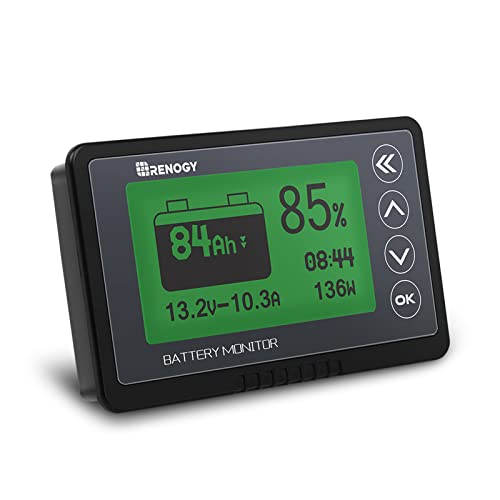
Shunt-based current measurement makes this monitor the choice for tracking a battery system beyond voltage alone. Renogy gives it a 10V–120V operating range, capacity up to 500A, a 20-foot shielded cable and programmable high- and low-voltage alarms. The maker specifies 1% measurement accuracy and compatibility with lead-acid, lithium iron phosphate, lithium-ion and nickel-metal hydride batteries; it supports 12V, 24V and 48V systems. Shunt installation requires routing the battery connection through the shunt, so this is less convenient than a simple panel voltage meter.
Bottom line: Choose this when current measurement and a shunt installation suit your system.
SUPNOVA Waterproof Battery Monitor

An IPX7-rated enclosure and included bracket distinguish this monitor for exposed installations. SUPNOVA measures voltage and remaining capacity across 7V–100V, supporting common 12V systems as well as higher-voltage battery setups. The feature set includes temperature and buzzer alarms, and the maker says the unit has reverse-connection protection. It fits users who want a rugged local display for a boat, motorcycle or golf cart. Unlike a shunt monitor, the function centers on voltage and capacity rather than current measurement, so it is not the pick for tracking amperage draw.
Bottom line: Pick this for a waterproof panel monitor with temperature and buzzer alarms.
CGELE DC 100A Shunt Monitor

Nine readings on one interface make this shunt meter different from monitors focused on battery percentage or vehicle alerts. It displays voltage, current, power, impedance, internal resistance, capacity, state of charge, energy and running time; its ranges include 0–200V and 0–100A. The press-terminal design avoids screw terminals, and the LCD has a backlight. This suits a user who wants several electrical measurements in a single display. Its current ceiling is 100A, so choose a higher-capacity shunt monitor if the system can draw more than that.
Bottom line: Choose this for a broad set of readings within a 100A limit.
How to choose a 12-volt battery monitor
Choose a monitor by the measurement you need: voltage-only checks, capacity estimates, or current tracking. A voltmeter reads electrical potential, while a shunt-based monitor measures current through a calibrated resistance and can calculate energy and state of charge. For a vehicle’s starting battery, cranking and charging voltage records can be more useful than a full power-system readout. For a solar or house battery, check that the monitor’s current rating exceeds the system’s maximum expected draw; leave margin rather than sizing exactly to the usual load.
Battery voltage alone is an imperfect state-of-charge gauge because voltage changes with load, charging and rest time. Let a battery rest with no charging or load before using a voltage chart, and use a monitor that tracks current when you need ongoing capacity estimates.
Voltage range and battery compatibility
Match the monitor’s supported voltage range to the battery bank’s nominal voltage and its charging voltage, not just the “12V” label. A nominal 12V lead-acid battery can rise above 12V while charging, so the monitor’s upper limit must cover the system’s actual operating voltage. Lithium batteries also have different voltage curves from lead-acid batteries, making a voltage-only percentage estimate less dependable.
Battery chemistry matters when setting capacity or alarms. Lead-acid batteries generally last longer when discharge is limited; a common planning rule is to avoid routinely using more than about half of a deep-cycle lead-acid battery’s rated capacity. Lithium systems have different limits, so use their battery-management-system guidance and set alarms to the battery maker’s voltage limits.
Panel meters and shunt monitors compared
Panel meters are convenient for local voltage and percentage checks, while shunt monitors provide current and energy readings useful for power systems. Use this comparison to choose the measurement style before deciding on installation.
| Monitor type | Best suited to | Main consideration |
|---|---|---|
| Panel voltage/capacity display | At-a-glance local checks | Percentage can be approximate |
| Shunt monitor | Current and energy tracking | Requires correct shunt wiring |
| Bluetooth vehicle monitor | Cranking and charging checks | App-based access |
Place a panel display where it can be read without reaching near moving parts or hot components. Bluetooth systems avoid a dedicated display at the mounting point, but their usefulness depends on phone access and a compatible app connection.
Safe installation and common mistakes
Disconnect the battery’s negative terminal before wiring a monitor, and reconnect it only after checking polarity and terminal security. A short circuit from a tool bridging battery terminals can cause burns or fire, so insulate tools and keep metal objects away from exposed connections. A shunt monitor must be wired so all relevant battery current passes through the shunt; bypass wiring can make readings wrong.
Use a fuse near the battery on any positive accessory lead sized to protect that wire, and avoid undersized wire on long runs. For panel units, measure the cutout and cable path before installation; for shunts, place the unit where it stays dry and its terminals remain accessible for inspection.
Frequently Asked Questions
Can a 12-volt monitor work with a 24-volt battery bank?
Some monitors support both 12V and 24V systems, but the voltage range must cover the bank’s charging voltage as well as its nominal voltage. Check compatibility with the battery chemistry too, especially when using a voltage-based capacity estimate.
Does battery voltage show an accurate charge percentage?
Voltage gives only an estimate, particularly while a battery is charging or under load. For a steadier voltage-based estimate, let a lead-acid battery rest without load or charging for several hours and consult a chart for its chemistry.
What does a shunt do in a battery monitor?
A shunt is a low-resistance measuring element that lets the monitor calculate current from a small voltage difference. Route every current path the monitor should track through the shunt; bypass wiring leads to incomplete readings.
Where should a battery monitor fuse go?
Put a fuse close to the battery on the monitor’s positive supply wire, with a rating appropriate for that wire and the device. The fuse helps protect the wire if it shorts; it does not make incorrect polarity or loose connections safe.
How often should battery monitor wiring be checked?
Inspect terminals and cable insulation at least every few months in a vehicle or marine installation, and sooner after vibration, water exposure or service work. Corrosion, looseness and chafing can cause unreliable readings or overheating.