
Auto Focus Reading Glasses: 4 Models Compared

For reading glasses advertised as auto focus, Auto Focus Smart Glasses, Silver 2-Pack is the clearest fit for most people because its two-pair pack is described for near-to-far viewing. Choose another style if you specifically want rimless frames or color-changing lenses; these features differ across the options.
Auto focus glasses claim to adjust lens focus as viewing distance changes, unlike ordinary reading glasses, which use fixed magnification.
We earn a commission if you buy through links on this page. As an Amazon Associate I earn from qualifying purchases. Products are compared on manufacturer specifications, not hands-on testing.
- Best overall: Auto Focus Smart Glasses, Silver 2-Pack – Two pairs are included, and the maker describes the lenses as shifting between near and far focus.
- Best for rimless style: ZOXVYL Rimless Auto Focus Readers, 2-Pack – The product is identified as rimless with a rectangular frame.
- Best for color-changing lenses: Auto Focus Smart Glasses, 3-Pack – Its title and details identify color-changing lenses and a frameless resin-and-PC structure.
| Product | Best for | Pack count | Frame style | Lens feature | Shop |
|---|---|---|---|---|---|
| Auto Focus Smart Glasses, Silver 2-Pack | Two-pair set | 2 pairs | — | Smart auto-focus lenses | Check Price on Amazon |
| ZOXVYL Rimless Auto Focus Readers, 2-Pack | Rimless frames | 2 pairs | Rimless rectangle | Photochromic; blue-light blocking | Check Price on Amazon |
| Color-Change Frameless Auto Focus Readers | Frameless design | — | Frameless resin and PC | Color change; up to 95% blue-light blocking | Check Price on Amazon |
| Auto Focus Smart Glasses, 3-Pack | Three-pair set | 3 pairs | — | 100°–700° adaptive smart lenses | Check Price on Amazon |
Auto focus reading glasses compared
Compare the pack sizes and lens and frame features, then consider what you should verify before relying on adjustable-focus claims.
Auto Focus Smart Glasses, Silver 2-Pack

Unlike the three-pair option, this set includes two pairs, and the maker says its smart lenses shift focus from near to far without manual tuning. The product is aimed at reading fine print, screen work and distance viewing, making it a broad-use choice if you want one advertised lens type for several tasks. The maker also claims the lenses block up to 95% of blue light. The key limitation is that the maker does not establish prescription strength or confirm how well the automatic focus works, so verify suitability for your vision needs before depending on it.
Bottom line: Choose this if you want two pairs advertised for near-to-far viewing.
ZOXVYL Rimless Auto Focus Readers, 2-Pack

The defining difference here is the rimless rectangular design, paired with a two-pack. The product is described as having non-prescription photochromic lenses and a blue-light-blocking coating, and the maker says the lenses adapt for close reading, computer use and distance viewing. That combination may suit someone who prefers a less visible frame and wants lenses advertised for changing light. Its limitation is that the auto focus claim is not accompanied by a measurable adjustment range in the specifications, so do not assume it can replace prescribed lenses or meet a particular correction need.
Bottom line: Choose this for a rimless rectangular look and photochromic lenses.
Color-Change Frameless Auto Focus Readers

This option stands apart for its frameless resin-and-PC structure and color-change lens feature. The product is described for reading and screen use, while the maker says its lenses automatically adapt between near and far viewing and block up to 95% of blue light. At 0.033 lb, the weight is about 0.53 oz.
Bottom line: Choose this if a frameless structure and color-change feature matter most.
Auto Focus Smart Glasses, 3-Pack
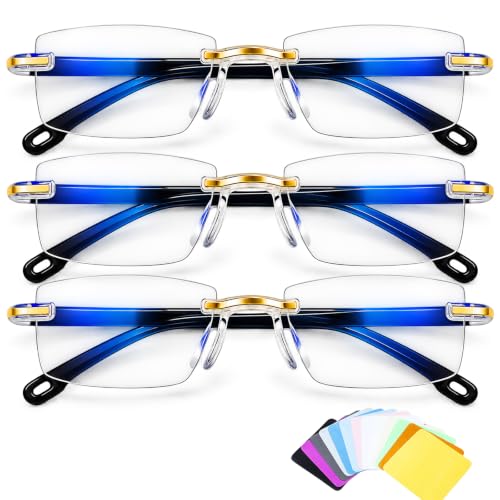
The three-pair pack is the main practical distinction from the two-pair sets. The maker claims its blue-coated lenses shift focus across a 100°–700° range and are intended for near-to-far tasks such as reading fine print, screen work and distance viewing. This may appeal to someone who wants multiple pairs for different locations. The advertised range should not be read as a prescription strength: the specifications do not explain its optical meaning or establish that the lenses suit a particular wearer. Verify the adjustment mechanism and compatibility with your vision needs before purchase.
Bottom line: Choose this if you want three pairs and the maker’s adaptive range.
How to choose auto focus reading glasses
Start by separating a focus claim from a defined prescription: ordinary readers have a fixed magnifying power, while products labeled auto focus claim to change focus as the viewing distance shifts. The four options here do not provide equivalent measurable adjustment details, so compare the concrete features—pack count, frame construction and lens description—before treating them as interchangeable. A practical rule is to choose a style and number of pairs only after confirming the seller or an eye-care professional can explain what the focus range means for your vision. If you need correction for astigmatism, a specific prescription, or distance vision, do not assume non-prescription smart readers provide it. Blue-light filtering is a lens feature, not proof of a medical benefit.
What auto focus means for reading glasses
Auto focus glasses are marketed as lenses that alter focus when you look from near objects to farther ones; conventional reading glasses instead magnify at a fixed strength. The distinction matters because a claimed adaptive range, such as the 100°–700° range attached to one option, is not the same as a standard reading-glasses prescription expressed in diopters. Ask for a clear explanation of the measurement and whether the lens is powered or non-prescription. For reference, over-the-counter reading glasses commonly use positive powers such as +1.00, +1.50 and +2.00 diopters, but the right strength depends on the wearer and task. Do not infer suitability for driving or distance correction from “near and far” marketing language.
Frame and lens fit considerations
Frame shape affects how securely glasses sit and how much of the lens remains in the line of sight. Rimless designs remove a surrounding rim, while frameless construction can describe a broader structure; neither term alone tells you the bridge width, temple length or lens height. The one-size-fits-most option still warrants a fit check if you know your measurements. Photochromic lenses are designed to darken in response to ultraviolet light, but car windshields can reduce the UV that reaches the lens, so they may not darken as much inside a vehicle. A light-changing feature should not be assumed to replace dedicated sunglasses or prescription eyewear.
Safe expectations for adjustable readers
Non-prescription readers are intended for near tasks and do not substitute for an eye examination or a prescription tailored to each eye. Sudden vision changes, persistent headaches or eye strain merit professional evaluation rather than stronger readers; routine comprehensive eye exams are generally recommended every one to two years for adults, with frequency adjusted for age and risk. Keep the glasses clean with a lens-safe cloth and avoid abrasive household paper that can scratch coatings. Before using any advertised auto focus pair for a safety-sensitive task, confirm that the lens gives stable, clear vision at the required distance. A focus claim alone is not evidence that a pair is suitable for driving, machinery or other tasks requiring precise distance vision.
Frequently Asked Questions
Are auto focus reading glasses the same as progressive lenses?
No; progressive lenses have a fixed prescription that changes gradually across different lens zones, while auto focus products claim the lens itself adjusts as viewing distance changes. Ask whether an advertised pair has a prescribed lens or a non-prescription adaptive design before treating it as a substitute.
What does 100°–700° mean on auto focus glasses?
That range is given as an adaptive-lens claim, but it is not expressed in the usual diopter notation for reading-glasses power. Ask the seller to define the measurement and whether it corresponds to a usable prescription range before relying on it.
Can non-prescription auto focus glasses correct astigmatism?
Non-prescription readers should not be assumed to correct astigmatism, which requires a prescription with cylinder and axis values. If you have astigmatism or unequal vision between eyes, ask an eye-care professional whether these glasses are appropriate.
Can I use auto focus reading glasses for driving?
Do not assume that reading glasses are suitable for driving, even when described for near and far use. Driving requires clear distance vision; use only eyewear confirmed to meet your prescription and local vision requirements.
How often should adults have an eye exam?
Many adults need a comprehensive eye exam every one to two years, though age, health conditions and existing vision problems can change that interval. An exam can also determine whether near blur needs readers, a prescription, or further evaluation.