
Car Ramps for Oil Changes: 4 Options Compared

For most oil changes, Ironton Poly Car Ramp Set is the strongest match because its pair is rated for 12,000 pounds and it lifts tires 8.5 inches. Choose a low profile alternative if your car’s front clearance is too low for a standard ramp approach.
Car ramps raise a vehicle’s tires to create underbody access; they are not a substitute for checking the vehicle’s weight and safely securing it before working underneath.
We earn a commission if you buy through links on this page. As an Amazon Associate I earn from qualifying purchases. Products are compared on manufacturer specifications, not hands-on testing.
- Best overall: Ironton Poly Car Ramp Set – An 8.5-inch lift and 12,000-pound pair rating suit a broad range of vehicles.
- Best for a grooved drive-up surface: MaxxHaul 50515 6.25-Inch Ramps – The ramp has a ridged traction surface and rubber base stops.
- Best for low-clearance cars: Amazon Basics Low Profile Ramps – Its tire platform lifts just 2.6 inches, with a 17.5-inch ramp length.
| Product | Best for | Lift height | Pair capacity | Shop |
|---|---|---|---|---|
| Ironton Poly Car Ramp Set | Higher capacity | 8.5 in | 12,000 lb | Check Price on Amazon |
| MaxxHaul 50515 6.25-Inch Ramps | Traction surface | 6.25 in | 6,500 lb | Check Price on Amazon |
| Amazon Basics Low Profile Ramps | Light handling | 8.1 in | 6,500 lb | Check Price on Amazon |
| VEVOR 6.7-Inch Lift Ramps | Higher vehicles | 6.7 in | 8,000 lb | Check Price on Amazon |
Car Ramps for Oil Changes Compared
Compare the useful lift, stated ramp capacity and width against your vehicle and garage setup.
Ironton Poly Car Ramp Set

Ironton Poly Car Ramp Set combines the highest pair capacity among these standard-height options with an 8.5-inch lift. The set uses high-impact poly with a honeycomb internal structure, and each ramp is rated for 6,000 pounds. Its 12-inch width gives tire placement room, while the 35.5-inch length means you still need enough clear floor space to approach the ramps straight on. The maker says the set is intended for cars, trucks, SUVs and vans, including heavier pickups. Check your vehicle’s actual axle load against the per-ramp rating; a high gross-vehicle rating alone does not confirm suitability.
Bottom line: Choose it if its per-ramp rating and approach fit your vehicle.
MaxxHaul 50515 6.25-Inch Ramps

MaxxHaul 50515 6.25-Inch Ramps has a lower 6.25-inch lift than Ironton Poly Car Ramp Set, which may suit drivers who want less elevation for routine underbody access. Its pair is rated for 6,500 pounds, with 3,250 pounds per ramp; do not treat the separate 13,000-pound GVW claim as the ramp-pair capacity. A ridged surface and rubber base stops are intended to aid traction and reduce shifting during positioning. The plastic construction keeps it distinct from metal ramps, but its lift is shorter than the 8.5-inch options. Verify the per-ramp load rating against the weight actually carried by each front tire.
Bottom line: Pick it if a 6.25-inch lift and grooved surface fit your needs.
Amazon Basics Low Profile Ramps
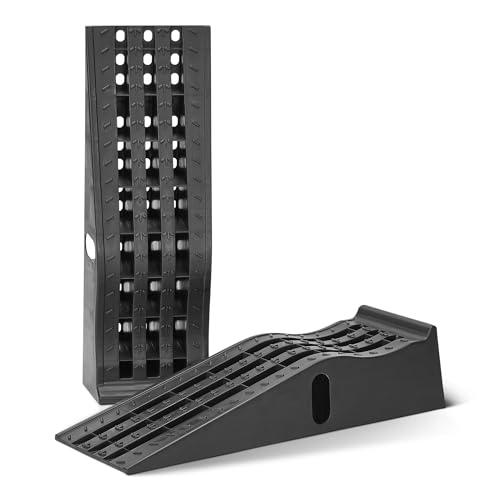
Amazon Basics Low Profile Ramps weighs about 9.24 pounds per ramp, making it lighter to move and position than the other standard-height sets here. Its pair capacity is 6,500 pounds, based on 3,250 pounds per ramp, and the dimensions are about 35.5 inches long by 12 inches wide. The 8.1-inch height is close to the taller 8.5-inch options, so it provides substantial elevation rather than an especially low approach. Rubber base stops and a textured surface are included. The maker describes the design as reinforced plastic; match the load to the per-ramp rating rather than relying only on a vehicle’s GVW.
Bottom line: Choose it if low ramp weight matters more than a higher pair rating.
VEVOR 6.7-Inch Lift Ramps

VEVOR 6.7-Inch Lift Ramps is aimed at higher-chassis vehicles, with a 6.7-inch lift and a 17-degree incline. Each ramp supports 4,000 pounds, making the pair capacity 8,000 pounds; its separate 16,000-pound GVW claim should not be substituted for that pair rating. The impact-resistant polypropylene construction is described by the maker as weather- and corrosion-resistant, and the ramps are stackable for storage. The 12-inch width and 35.8-inch length require space for a straight approach. The incline may not suit a low front bumper, so confirm clearance before driving onto it.
Bottom line: Pick it for a higher-clearance vehicle within its pair rating.
How to choose car ramps for oil changes
Choose ramps by the load on each tire, the lift you need, and the clearance at the front bumper. A pair rating must not be confused with a vehicle GVW claim: in these options, the per-ramp figures range from 3,250 to 6,000 pounds, while one option gives no load rating. For a low front end, start with the 2.6-inch lift option rather than assuming an 8-inch ramp will clear the bumper. Also measure available floor length; the standard-height sets are roughly 35.5 inches long, while the low profile set is 17.5 inches. Use a ramp only on a level, firm surface, and follow the vehicle maker’s instructions for raising and securing the vehicle.
Ramp height, approach and tire fit
Ramp height alone does not tell you whether the front of a car will clear the approach. Ramp length, incline, bumper shape and tire size all affect contact, so measure the lowest front point and approach slowly without anyone beneath the vehicle. The widths are 10 or 12 inches, but usable tire width and placement matter more than outside width; keep each tire centered and fully supported. If your car’s clearance is too low for a conventional ramp, a low profile ramp with a 2.6-inch lift may be a better starting point. Confirm your tire width against the ramp’s usable surface before driving up, especially with modified or unusually wide tires.
Ramp capacity and safe oil-change setup
Use the per-ramp rating as a limit for the load borne by that ramp, not just the vehicle’s advertised GVW. Vehicle weight distribution is not necessarily equal across the front tires, and cargo or modifications can change the load. Before driving up, place the ramps on level, solid ground, inspect them for cracks or damage, and keep the wheels aligned with the ramp tracks. Once positioned, set the parking brake and chock wheels remaining on the ground; never rely on a transmission setting alone. Do not get underneath a vehicle supported only by ramps if a ramp is shifting, damaged or not fully seated. Keep people clear while the vehicle moves onto the ramps.
Compare ramp types by the job
Standard-height ramps provide more lift, while low profile ramps prioritize a shallow approach. Plastic models vary in capacity and construction, so compare the per-ramp number rather than assuming similar dimensions mean similar load support.
| Ramp type | Lift range in these options | Pair capacity | Most relevant use |
|---|---|---|---|
| Standard-height poly/plastic | 6.25–8.5 in | 6,500–12,000 lb | Routine underbody access |
| Low profile | 2.6 in | — | Limited front clearance |
Choose the lowest lift that gives enough working room rather than maximizing height by default. The low profile set needs a confirmed capacity before use; its shallow rise does not remove the need for a secure, level setup.
Frequently Asked Questions
Can I change oil with only the front wheels on ramps?
Many front-engine oil changes can be performed with only the front wheels raised, but the vehicle maker’s procedure determines whether that position is appropriate. Use a level, firm surface, set the parking brake, and chock the wheels that remain on the ground.
How much clearance do car ramps add?
The lift figures in these options range from 2.6 to 8.5 inches. Choose based on both the access needed beneath the vehicle and whether the front bumper clears the ramp approach.
Should I use a pair rating or GVW to choose ramps?
Use the per-ramp rating and compare it with the load at each tire; do not treat a GVW claim as the pair capacity. Front axle load can differ from half of a vehicle’s total weight.
Do car ramps work on a sloped driveway?
No—use ramps on a level, solid surface rather than a sloped driveway. A slope can make a ramp or vehicle shift while driving onto the ramps or while raised.
Can I crawl under a car supported by ramps?
Only work underneath after confirming the ramps are undamaged, stable, correctly positioned and supporting the tires fully. Keep the vehicle on level, firm ground and never work below a vehicle if a ramp is shifting or improperly seated.