
Reciprocating Saw Blades for Bone: 3 Options Compared

For the broadest range of cuts, choose RIZAKA Meat and Bone Blades, 6-Pack: its six blades span 6, 9 and 12 inches and use three tooth patterns. Choose another set if you need a single blade length or a pack centered on 12-inch blades for larger cuts.
We earn a commission if you buy through links on this page. As an Amazon Associate I earn from qualifying purchases. Products are compared on manufacturer specifications, not hands-on testing.
- Best overall: RIZAKA Meat and Bone Blades, 6-Pack – Three blade lengths and 3, 6 and 8 TPI patterns cover different cut sizes.
- Best for large cuts: LEILUO 12-Inch Meat and Bone Blades, 5-Pack – The five-blade set uses 12-inch blades with a 3 TPI tooth pattern.
- Best for a 9-inch blade: Caliastro 9-Inch Stainless Blades, 5-Pack – The five-pack provides one 9-inch blade length for frozen meat and bone cutting.
| Product | Best for | Length | Tooth pattern | Pack count | Shop |
|---|---|---|---|---|---|
| RIZAKA Meat and Bone Blades, 6-Pack | Mixed cut sizes | 6, 9, 12 in | 3, 6, 8 TPI | 6 blades | Check Price on Amazon |
| LEILUO 12-Inch Meat and Bone Blades, 5-Pack | Large frozen cuts | 12 in | 3 TPI | 5 blades | Check Price on Amazon |
| Caliastro 9-Inch Stainless Blades, 5-Pack | One blade length | 9 in | — | 5 blades | Check Price on Amazon |
Reciprocating Saw Blades for Bone
Compare blade lengths and tooth spacing to match the cut and your saw setup.
RIZAKA Meat and Bone Blades, 6-Pack
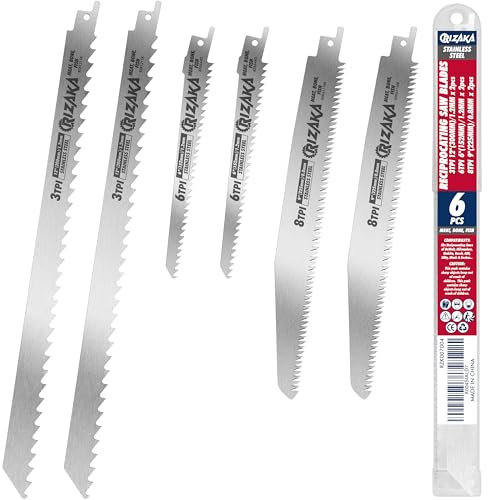
The three-length assortment is the most adaptable option here: it includes two 12-inch blades at 3 TPI, two 6-inch blades at 6 TPI and two 9-inch blades at 8 TPI. The maker describes the unpainted stainless steel as food-grade and rust-resistant, and positions the lengths for large frozen cuts, tighter work and fine trimming. Choose it if your butchering includes varied pieces and fish. Its limitation is that each length-and-tooth combination comes in a pair, so it is not a large supply of any one pattern.
Bottom line: Pick this set if you want different blade lengths and tooth patterns in one assortment.
LEILUO 12-Inch Meat and Bone Blades, 5-Pack

The 12-inch length and 3 TPI pattern distinguish this five-pack, which is aimed at larger carcasses and frozen cuts rather than short, fine work. The maker says the blades are uncoated stainless steel and have deep gullets; the 1/2-inch shank is designed for standard reciprocating saws. This set suits buyers who want several blades with one coarse tooth pattern. A fixed 12-inch length can be awkward in tight spaces, so a shorter blade may suit close or controlled trimming better.
Bottom line: Choose this pack for repeated large cuts where a 12-inch blade fits the work.
Caliastro 9-Inch Stainless Blades, 5-Pack

The consistent 9-inch length makes this five-pack a straightforward choice when a single blade size is preferred over a mixed assortment. The maker describes the blades as food-grade stainless steel without paint and says they are intended for frozen meat, fish and bone. Compatibility is claimed across major reciprocating saw brands, including DeWalt, Milwaukee and Makita. The specifications do not give a tooth count, so buyers who need to match blade coarseness to a particular cut should confirm the tooth pattern before ordering.
Bottom line: Pick this pack if 9 inches is the blade length you need and a five-pack suits your workload.
How to choose reciprocating saw blades for bone
Match tooth spacing and blade length to the cut: fewer teeth per inch (TPI) leave larger gaps for coarse cutting, while more TPI produce a finer tooth pattern. These options range from 3 to 8 TPI, with the 3 TPI blades assigned to large frozen cuts and the 8 TPI blades to fish and fine trimming. Use the shortest blade that clears the material without striking the work surface; for a confined cut, the 6-inch option is more manageable than a 12-inch blade. Keep a dedicated saw and blades for food work, and clean and sanitize food-contact surfaces after cutting. Do not use a blade if it is damaged, bent or contaminated.
Blade length and tooth pattern
Blade length controls reach, while TPI indicates how closely the teeth are spaced. The assortment spans 6, 9 and 12 inches and pairs those lengths with different tooth patterns; the other sets use a single length. This table helps match the configurations to the work type the maker associates with them.
| Work need | Blade configuration | Product |
|---|---|---|
| Large bones or frozen blocks | 12 in, 3 TPI | RIZAKA Meat and Bone Blades, 6-Pack or LEILUO 12-Inch Meat and Bone Blades, 5-Pack |
| Small portions or tight spaces | 6 in, 6 TPI | RIZAKA Meat and Bone Blades, 6-Pack |
| Fish or fine trimming | 9 in, 8 TPI | RIZAKA Meat and Bone Blades, 6-Pack |
| Single 9-inch blade length | 9 in, tooth pattern unknown | Caliastro 9-Inch Stainless Blades, 5-Pack |
Choose a 12-inch blade only when you need its reach and have room to control it; a longer blade is not automatically a better fit.
Reciprocating saw fit and food handling
A standard 1/2-inch reciprocating-saw shank is the interface identified for LEILUO 12-Inch Meat and Bone Blades, 5-Pack, and the maker of Caliastro 9-Inch Stainless Blades, 5-Pack and RIZAKA Meat and Bone Blades, 6-Pack claims compatibility with major saw brands. Check the saw manual for the accepted blade mount and use a blade intended for food cutting; a general-purpose wood or demolition blade is not a substitute. Food-grade or uncoated stainless steel claims do not remove the need to wash and sanitize the blade and work area after raw meat contact. Secure the material, keep hands clear of the blade path and avoid forcing the saw through bone, which can cause binding or loss of control.
Frequently Asked Questions
What does TPI mean on a bone-cutting saw blade?
TPI means teeth per inch, a measure of tooth spacing. The options here range from 3 TPI for coarse large-cut work to 8 TPI for finer trimming.
Is a 12-inch blade better for cutting bone?
A 12-inch blade offers more reach, but it is not automatically better for every cut. Use it for large frozen cuts when there is enough room to control the saw; a 6-inch blade is better suited to tight spaces.
Can I use the same saw for food and other materials?
Use a dedicated saw and blades for food work to avoid contamination from other materials. Clean and sanitize food-contact equipment after cutting raw meat.
How do I match blade length to a cut?
Choose a blade long enough to clear the material, but avoid extra length that makes a confined cut harder to control. These options include 6-, 9- and 12-inch blades.