
Best Gesture Sensing Remote Control Cars Compared

Gesture Sensing LED RC Car suits most kids because its gesture sensing and button controls come in a compact car about 5.5 inches long. Choose a larger stunt-focused option if flips, spins, or a wristband controller matter more than fitting into tight indoor spaces.
Gesture sensing RC cars use hand movements as driving inputs; traditional buttons offer a separate way to steer when that control style is easier.
We earn a commission if you buy through links on this page. As an Amazon Associate I earn from qualifying purchases. Products are compared on manufacturer specifications, not hands-on testing.
- Best overall: Gesture Sensing LED RC Car – Gesture and button controls pair with a compact 5.5-inch length.
- Best for 8-wheel stunts: NEXBOX 8-Wheel Stunt Car – Its eight-wheel design supports flips, double-sided driving, and 360-degree rotations.
- Best for three control methods: Gesture Sensing Twist Stunt Car – Gesture, wristband sensing, and a 2.4 GHz remote offer three ways to drive.
| Product | Best for | Length | Control options | Distinctive play feature | Shop |
|---|---|---|---|---|---|
| Gesture Sensing LED RC Car | Compact indoor play | 5.5 in | Gesture, buttons | Full-body LEDs | Check Price on Amazon |
| NEXBOX 8-Wheel Stunt Car | Eight-wheel stunts | 5.9 in | Gesture, remote | Flips and 360° turns | Check Price on Amazon |
| SOGAWEBB Black Spider Stunt Car | LED stunt play | 5.5 in | Gesture, buttons | Double-sided flips | Check Price on Amazon |
| Gesture Sensing Twist Stunt Car | Three control modes | 4.13 in | Gesture, wristband, remote | 30–50 m remote range | Check Price on Amazon |
| FDCTR Twist and Transform Stunt Car | Larger stunt runs | 9.8 in | Gesture watch, remote | Mist, lights, music | Check Price on Amazon |
Gesture Sensing Remote Control Cars
Compare each car’s size, control method, and stunt features against the space and style of play you have in mind.
Gesture Sensing LED RC Car

Gesture Sensing LED RC Car stands out for combining gesture sensing and button control in a compact body about 5.5 inches long. Its 2.4 GHz setup is described for driving on floors, sidewalks, driveways, short grass, and flat sandy areas, while full-body LEDs add visibility during play. The dual controls make it a practical fit for kids who want to try hand gestures but still have buttons available. Its small footprint is easier to accommodate indoors than a car nearly 10 inches long, but the compact size may be less appealing to shoppers prioritizing large stunt moves.
Bottom line: Choose this for a small car with both gesture and button controls.
NEXBOX 8-Wheel Stunt Car

NEXBOX 8-Wheel Stunt Car is the eight-wheel stunt choice, with a 5.9-inch length and a design made for double-sided driving, flips, climbing, and 360-degree rotations. The extra wheels and stunt focus distinguish it from compact cars centered on everyday driving and lights. Choose it for a child who wants to experiment with reversing after a roll or performing turns in an open play area.
Bottom line: Pick this for eight-wheel stunt play and double-sided driving.
SOGAWEBB Black Spider Stunt Car
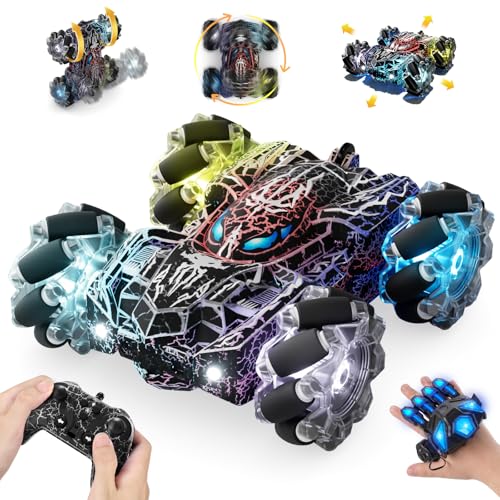
SOGAWEBB Black Spider Stunt Car brings a compact 5.5-inch length together with gesture and classic button controls, while its standout feature is double-sided stunt driving with spins, drifts, and flips. Full-body lights and headlights give it a more show-oriented look than a plain-bodied car. The flexible frame is described as bouncing back from crashes, making it a fit for energetic stunt sessions on a clear surface. Its width is about 5.9 inches, so leave more side-to-side room than the length alone suggests when planning a tight indoor course.
Bottom line: Choose this for a compact, lighted car focused on flips and spins.
Gesture Sensing Twist Stunt Car

Gesture Sensing Twist Stunt Car is the only option here whose features name three control methods: a 2.4 GHz remote, hand gestures, and wristband sensing. The remote’s range is 30–50 meters, while gesture driving is intended for close-range operation. It also supports drifting, quick turns, 360-degree spins, double-sided flips, and flexible movement. That combination suits a child who wants to switch between control styles and stunt actions. Its measurements are unusual in order, so check the car’s actual length and width if storage space or a narrow track is a deciding factor.
Bottom line: Pick this when three control methods and a remote range matter.
FDCTR Twist and Transform Stunt Car

FDCTR Twist and Transform Stunt Car is the largest by length at 9.8 inches, making it the option to consider when a child has room for broader runs rather than a very compact indoor car. Choose it for play that emphasizes visual effects alongside spins and movement. Its longer body calls for a more open floor or driveway than the roughly 5.5-inch choices, and the features do not establish a specific control range.
Bottom line: Choose this for a larger stunt car with mist, light, and music effects.
How to choose a gesture sensing RC car
Choose by control style and play space: gesture sensing responds to hand movements, while a button remote offers familiar steering. These cars range from about 5.5 to 9.8 inches long, and some add stunts such as flips, spins, or double-sided driving. For a short indoor course, a car no longer than 6 inches is easier to fit; reserve a longer model for a more open run. Clear cords, small objects, and breakables from the driving area before play. A 2.4 GHz radio frequency does not tell you the operating distance, so use a range only when the model provides one.
How much room stunt cars need
Plan for the stunt, not just the car’s footprint: spins, flips, and drifting need clear space around the vehicle. A car about 5.5 inches long can fit a tighter course than one nearly 10 inches long, but neither should run near stairs, roads, or people. Measure the narrowest passage in your play area and leave several inches of clearance on each side; open floor is better for practicing turns. Outdoor use also depends on the surface: flat sidewalks and driveways are more predictable than uneven ground, and short grass or sand can slow a small toy car. Keep play away from water and traffic.
Gesture control, remotes, and wristbands
Gesture sensing is a close-range way to steer, while a radio remote can provide more conventional directional control. Some cars combine gestures and buttons, and another offers gesture, wristband sensing, and a 2.4 GHz remote; the named remote range is 30–50 meters for one model. That distance applies to its remote, not automatically to gesture control. For younger or first-time drivers, dual controls provide a fallback if hand movements are hard to coordinate. Begin on a level, open surface and keep the controller close enough to see the car clearly. A child should use the toy under adult supervision, especially during stunt play.
Safe charging and play habits
Charge rechargeable toys on a hard, dry surface and keep the charging area clear of fabric, paper, and other clutter. Inspect the body and wheels before each run; stop using the car if a part is cracked or loose. Keep fingers, hair, and clothing away from moving wheels, and switch the car off before clearing a jam. For outdoor runs, choose a dry, flat area away from roads and water, since small RC cars are difficult for drivers to see.
Frequently Asked Questions
Are gesture sensing RC cars hard for beginners?
Gesture control can be less familiar than steering with buttons, so a car with both methods gives a beginner an alternative. Start on a clear, flat area and use the button remote if hand movements feel difficult to coordinate.
How much room does an RC stunt car need?
A roughly 5.5-inch car fits more easily into a short indoor course than a 9.8-inch car, but spins and flips need open space around the vehicle. Move breakable objects and trip hazards out of the driving area before play.
Can kids drive these cars outside?
Some models are described for sidewalks, driveways, short grass, or flat sandy ground, but surfaces and features vary by car. Use a flat, open area away from traffic, water, and people.
What does a 2.4 GHz remote range mean?
Frequency and control range are different specifications: 2.4 GHz identifies the radio band, while a distance figure estimates operating range. Only one car here gives a remote range, 30–50 meters, and gesture control is described as close-range.
How should I charge a gesture control car?
Use the USB charging setup as directed, and charge on a hard, clear surface where the car is visible. Do not leave a toy charging unattended or continue charging after it is fully charged.