
Alternatives for Safety Pins: 4 Options Compared

Decorative brooch pins are the closest alternative to safety pins for closing or adjusting clothing without sewing, while bulb and diaper pins offer different locking-pin styles. Choose a brooch for a visible clothing closure; for an everyday sharp fastener, a traditional safety pin may be a better fit.
We earn a commission if you buy through links on this page. As an Amazon Associate I earn from qualifying purchases. Products are compared on manufacturer specifications, not hands-on testing.
- Best overall: Pearl Crystal Brooch Pins, 24-Piece – Pearl and crystal details make these pins both a clothing fastener and an accessory.
- Best for style variety: Women’s Shirt Brooch Pins, 60-Piece – The 60-pin set includes three designs for mixing with different outfits.
- Best for crafts: Mixed-Color Bulb Pins, 200-Piece – The 200-piece set of small, colorful bulb pins suits tags, quilting and stitch marking.
| Product | Best for | Style | Pack count | Shop |
|---|---|---|---|---|
| Pearl Crystal Brooch Pins, 24-Piece | Decorative clothing fixes | Pearl and crystal brooch | 24 pins | Check Price on Amazon |
| Women’s Shirt Brooch Pins, 60-Piece | Style variety | Three decorative designs | 60 pins | Check Price on Amazon |
| Mixed-Color Bulb Pins, 200-Piece | Craft projects | Bulb-shaped locking pin | 200 pins | Check Price on Amazon |
| Black Plastic-Head Diaper Pins, 50-Piece | Diapers and blankets | Plastic-head locking pin | 50 pins | Check Price on Amazon |
Alternatives for Safety Pins
Match the fastener to the job: decorative pins can adjust clothing visibly, while locking pin styles suit crafts and fabric fastening.
Pearl Crystal Brooch Pins, 24-Piece

These pearl-and-crystal brooch pins offer a decorative alternative when a clothing closure can be visible. The 24-piece set uses alloy metal, faux pearls and crystals; the pins can also tighten loose clothing or decorate shirts, hats, scarves and bags. Choose them when appearance matters as much as holding fabric together. Their ornamental style is less suited to an inconspicuous repair, and the size is only identified as medium, so they may not suit every garment or fastening point.
Bottom line: Pick these when you want a clothing fastener that also looks like an accessory.
Women’s Shirt Brooch Pins, 60-Piece
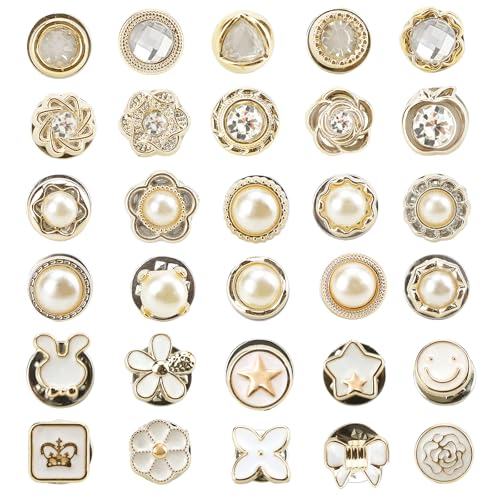
This 60-piece set stands out for variety: it includes 20 each of pearl, diamond and fresh-white designs. The gold- and silver-colored alloy, rhinestone and faux-pearl pins are reusable and intended as no-sew button replacements or clothing accents. At about 0.47 by 0.4 inches, they are compact choices for shirt, dress, bag or cardigan adjustments where a small decorative closure works. Their size and ornamental form make them a poor match for holding thick layers or replacing a large, hidden fastener.
Bottom line: Choose these for small, reusable clothing adjustments with several decorative looks.
Mixed-Color Bulb Pins, 200-Piece

Unlike the decorative brooches, these are small gourd-shaped locking pins intended for craft and fabric tasks rather than outfit decoration. The 200 mixed-color metal pins measure about 0.86 inches long by 0.39 inches wide, with a curved groove that covers the point when locked. They suit hanging tags, quilting, attaching ribbons and crochet stitch marking. Their compact size is a limitation for securing larger fabric bundles or making a prominent clothing closure.
Bottom line: Pick these for small craft jobs where a compact locking pin is useful.
Black Plastic-Head Diaper Pins, 50-Piece

These diaper pins provide a longer locking-pin option than the compact bulb pins, with a stainless-steel needle and ABS plastic head. Each measures about 2.2 inches, and the 50-piece set is intended for diapers as well as crafts, blankets, skirts and laundry. The head has a locking closure designed to hold fabric during tugging or laundering. The sharp needle still needs careful handling, and the black plastic-head style is more utilitarian than the decorative brooch options.
Bottom line: Choose these for diaper or blanket fastening when a longer locking pin suits the fabric.
How to Choose an Alternative for Safety Pins
Choose by whether the fastener needs to disappear, carry fabric tension or add decoration. Brooch-style pins are suitable when a visible closure is acceptable; a sewn-on snap or button is a better direction when you want a permanent, low-profile closure. For temporary craft fastening, a locking pin keeps its point covered when closed, while a clip avoids piercing fabric but can slip under tension. Use decorative pins on light clothing adjustments rather than assuming an ornament can hold thick or heavy layers. Keep any sharp pin closed and out of reach of children; a decorative head does not remove the sharp point.
Match Pin Size to the Fabric
Pin length and garment thickness should match: a short pin is easier to conceal on a single light layer, while multiple thick layers need more usable shaft length and a secure closure. For example, the small bulb pins here measure about 0.86 inches, while the diaper pins measure about 2.2 inches. Avoid forcing a pin through a seam, dense knit or delicate fabric, since punctures can leave holes or snag yarn. If you need a closure to withstand pulling, test it on an inconspicuous area first and use a sewn fastener when the fabric shifts or bears weight.
Fastener Types Compared
Fastener choice depends on visibility, fabric penetration and whether the closure is temporary or permanent. This guide compares the practical differences so you can choose a format for the task.
| Fastener type | Good fit | Main trade-off |
|---|---|---|
| Decorative brooch pin | Visible clothing adjustment | Ornamental and may not suit thick layers |
| Bulb pin | Small craft or tag task | Short reach |
| Diaper pin | Fabric fastening needing more length | Sharp point requires care |
| Sewn snap or button | Repeated, low-profile closure | Requires sewing |
Common Mistakes With Clothing Pins
A common mistake is treating a decorative brooch as a load-bearing fastener; small ornamental pins are better for light adjustments than heavy or moving fabric. Another is closing a sharp pin while fabric is bunched near its point, which can leave the tip exposed or catch skin. Keep the fabric flat, fasten the clasp fully and check that the pin does not pull the garment out of shape. For items worn by infants or small children, avoid loose sharp fasteners and choose an age-appropriate closure secured as intended; never leave an open pin within reach.
Frequently Asked Questions
Can a brooch pin replace a safety pin on a shirt?
A brooch pin can close or adjust a shirt when a visible decorative fastener is acceptable. Small brooches are better for light fabric adjustments than pulling together thick layers.
Are bulb pins different from regular safety pins?
Bulb pins use a rounded locking shape that covers the point when secured, and compact versions suit tasks such as stitch marking and tags. The 0.86-inch bulb pins here have less reach than 2.2-inch diaper pins.
What can I use instead of pins for a permanent clothing closure?
A sewn-on snap or button gives a permanent closure without a sharp pin left in the garment. Choose the fastener based on the fabric and closure placement, and reinforce thin or stretchy fabric as needed.
How do I keep a pin from damaging delicate fabric?
Avoid pushing a pin through a seam or tightly knitted area, where the point can snag yarn or leave a hole. Test on a hidden area first, and use a clip or sewn closure if piercing is unsuitable.