
Fitness Spring Chest Expander: 3 Options Compared

The Sunicon chest expander is the closest match for a traditional fitness spring chest expander, with five removable springs and a 13–66 lb resistance range. Choose another style if you need a multi-exercise unit, replacement springs, or an arm trainer with higher resistance.
We earn a commission if you buy through links on this page. As an Amazon Associate I earn from qualifying purchases. Products are compared on manufacturer specifications, not hands-on testing.
- Best overall: Sunicon 5-Spring Chest Expander – Five removable springs adjust resistance from 13 to 66 lb for chest, shoulder and arm training.
- Best for multi-exercise use: KAILIMENG 3-in-1 Exerciser – Includes five removable long springs, eight short springs, and attachments for grip and pedal-pull exercises.
| Product | Best for | Resistance | Spring count | Length | Shop |
|---|---|---|---|---|---|
| Sunicon 5-Spring Chest Expander | Adjustable chest training | 13–66 lb | 5 removable | 23.6 in | Check Price on Amazon |
| KAILIMENG 3-in-1 Exerciser | Multi-exercise workouts | 13–66 lb | 5 long springs | 27.2 in | Check Price on Amazon |
| Kisangel 5-Spring Chest Expander | Secure spring setup | — | 5 adjustable | 21.7 in | Check Price on Amazon |
Fitness spring chest expanders
Compare each option by its spring setup, resistance range and intended workout role.
Sunicon 5-Spring Chest Expander

Five removable springs and a 13–66 lb adjustment range make this a straightforward choice for chest, shoulder and arm strength work. Sunicon says the spring design provides lasting resistance and operates quietly, while its non-slip ergonomic handle is intended to support a secure grip. At 23.6 inches long and about 1.7 lb, the trainer is suited to compact home workouts or carrying between spaces. The product focuses on upper-body pulling rather than grip or pedal exercises, so choose a multi-use design if you want those additional movements.
Bottom line: Choose this if you want a traditional spring expander with adjustable resistance.
KAILIMENG 3-in-1 Exerciser

The 3-in-1 layout separates this exerciser from a dedicated chest expander: it combines a chest-and-arm pull with a hand grip strengthener and pedal-pull setup. Its five removable long springs adjust from 13 to 66 lb, and the package also has eight fixed short springs, removable handles and a foot pedal. The rubber handles are designed to reduce slipping during chest movements. At about 27.2 inches long, it is larger than the Sunicon unit; pick a simpler expander if you only need spring-based upper-body pulling and do not want extra attachments.
Bottom line: Choose this if you want chest pulling plus grip and pedal-pull options.
Kisangel 5-Spring Chest Expander
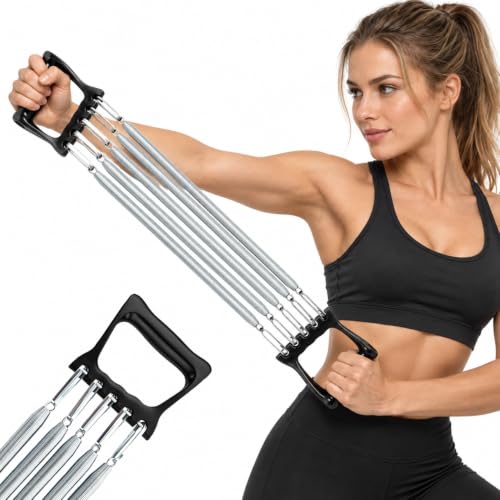
Secure hooks and safety buckles distinguish this five-spring expander, with a design focused on keeping removable springs connected during exercise. Kisangel uses galvanized carbon-steel springs and thickened plastic anti-slip handles; the product is intended for chest, arm, back and shoulder training. Its 21.7-inch length makes it the shortest of the full expander units with a length here.
Bottom line: Choose this if spring retention and a compact length matter more than a load range.
How to choose a spring chest expander
Start with the movement and resistance range, not the spring count alone: removable springs let you change load, while a fixed setup limits adjustment. Traditional chest expanders use handles connected by tension springs; pulling the handles apart loads the chest, shoulders and arms. For a measurable choice, pick a unit with a pound range when you need to progress by load, and select a multi-exercise model only if you will use its extra attachments. Spring count by itself is not a comparable measure of difficulty because spring tension can differ. Keep the movement controlled and avoid releasing a loaded spring suddenly; the stored tension can snap the handles back.
Chest expander types and fit
A straight spring expander, a twist arm trainer and replacement springs serve different purposes. The straight format is for pulling handles apart; a twister uses a different movement path, while replacement springs need to match existing equipment. Use this quick distinction to avoid buying a part when you need a complete trainer.
| Need | Type to choose | Check before choosing |
|---|---|---|
| Pull-apart chest work | Traditional spring expander | Resistance range and grip |
| Twisting arm movement | Twister arm trainer | Available load steps |
| Repair an existing unit | Replacement springs | Length, ends and load rating |
For replacement parts, matching the spring length alone is not enough: connector shape and the host trainer’s safe load capacity also matter. A 15-inch spring may not fit another model’s hooks.
Resistance and spring safety
Resistance labels can describe a full setup or an individual component, so identify what the number applies to before comparing products. The products here give ranges in pounds, a four-step 30–120 lb scale, or a 10 kg rating per replacement spring; do not treat those figures as interchangeable without checking whether they refer to the full device or one spring. A spring expander stores energy while extended. Inspect springs and attachment points for bends, corrosion or looseness before use, keep your face and others out of the recoil path, and stop if a hook shifts. Add or remove springs only when the unit is unloaded.
Common spring expander buying mistakes
The most common mismatch is choosing by a large maximum number without considering the lower starting load or the exercise style. A 30 lb minimum may be too much for a new user, while an unspecified range makes load progression difficult to plan. Another mistake is assuming all five-spring designs share the same spring force or hook dimensions; neither count nor overall length establishes compatibility. If buying replacement springs, verify connector fit and the equipment’s permitted load first. For a complete trainer, prioritize the motion you intend to repeat—pull-apart, twist or multi-attachment—then compare resistance and grip design.
Frequently Asked Questions
How does a spring chest expander work?
A spring chest expander resists as you pull its handles apart, loading the chest, shoulders and arms. The spring tension rises as the distance between handles increases, so use a controlled range rather than letting the springs snap back.
How many springs should I use for exercise?
Use only a spring setup you can control through the full movement; the KAILIMENG unit recommends attaching three to five of its long springs.
Can replacement springs fit any chest expander?
No; spring length, end fittings and the host unit’s load limit all affect compatibility. A 15-inch replacement spring should be checked against both the trainer hooks and its permitted load before installation.
Are twist arm trainers the same as chest expanders?
No; a twist arm trainer has a different movement pattern from a traditional pull-apart expander. The twister option here uses four resistance levels from 30 to 120 lb, while the pull-apart models use handles connected by tension springs.
How should I check a spring expander before using it?
Inspect the springs, handles and attachment points for corrosion, distortion or looseness before each session. Add or remove springs only when unloaded, and keep your face and bystanders outside the spring’s recoil path.