
Water Jug Dispenser Pump: 3 Electric Models Compared

For a water jug dispenser pump that fits 3-, 4- and 5-gallon bottles and has an automatic off switch, consider Cozy BlueWater Electric Pump. Choose Cozycharm Dual-Motor USB-C Pump if faster claimed flow matters more, or Myvision USB Rechargeable Pump if you want a battery runtime; check your jug’s opening and pump fit before ordering.
Electric pumps draw water through a tube and dispense it at the press of a button, without lifting or flipping a full bottle.
We earn a commission if you buy through links on this page. As an Amazon Associate I earn from qualifying purchases. Products are compared on manufacturer specifications, not hands-on testing.
- Best overall: Cozy BlueWater Electric Pump – Its name specifies 3-, 4- and 5-gallon compatibility and an automatic off switch.
- Best for faster flow: Cozycharm Dual-Motor USB-C Pump – The maker says it fills a 16-ounce cup in 9 seconds on a 5-gallon jug.
- Best for stated runtime: Myvision USB Rechargeable Pump – The maker says its 1200mAh battery runs 30–40 days or pumps about four to six 5-gallon bottles per charge.
| Product | Best for | Jug fit | Charging or battery | Distinct feature | Shop |
|---|---|---|---|---|---|
| Cozy BlueWater Electric Pump | Automatic shutoff | 3, 4 and 5 gal | USB rechargeable | Automatic off switch | Check Price on Amazon |
| Cozycharm Dual-Motor USB-C Pump | Faster claimed flow | 2–5 gal | USB-C charging | 16 oz in 9 sec* | Check Price on Amazon |
| Myvision USB Rechargeable Pump | Stated battery runtime | 3–5 gal | Rechargeable, 1200mAh | 30–40 days* | Check Price on Amazon |
Water jug dispenser pumps
These electric pumps differ in stated bottle compatibility, charging and operating claims.
Cozy BlueWater Electric Pump
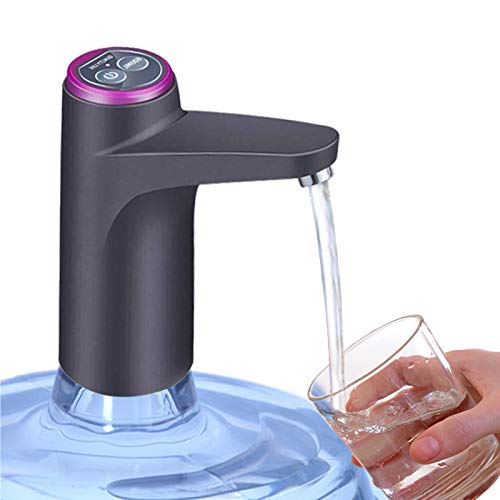
Among these pumps, Cozy BlueWater Electric Pump is the one whose name specifically calls out an automatic off switch and compatibility with 3-, 4- and 5-gallon bottles. Cozy says its one-touch pump avoids lifting or flipping a jug and uses a food-grade silicone tube with ABS plastic. That combination suits someone replacing a dispenser on several jug sizes who wants a simple button control. The dimensions are about 5.3 by 2.6 by 5.7 inches. Its material and fit do not establish whether it matches every jug opening, so check the neck fit before choosing it.
Bottom line: Pick this if automatic shutoff and compatibility across three jug sizes are your priorities.
Cozycharm Dual-Motor USB-C Pump

Cozycharm Dual-Motor USB-C Pump stands apart with two motors and a maker claim of filling a 16-ounce cup in 9 seconds on a 5-gallon jug. Its fit spans 2- to 5-gallon jugs, broader than the 3- to 5-gallon range named for Cozy BlueWater Electric Pump and Myvision USB Rechargeable Pump. The pump measures about 4.9 by 5.3 by 3.4 inches, and USB-C charging is called out in its name. This is a fit for buyers who prioritize the advertised flow rate and wider jug range. The 9-second figure is a maker claim tied to a 5-gallon jug, not a guarantee for every bottle or pour.
Bottom line: Choose this if the advertised cup-fill speed and 2-gallon compatibility matter.
Myvision USB Rechargeable Pump

Myvision USB Rechargeable Pump is the only one of these three with a battery capacity and runtime claim in its features: Myvision says the 1200mAh battery lasts 30–40 days, or about four to six 5-gallon bottles, per charge. The maker also identifies a food-grade silicone hose, 304 stainless steel and ABS plastic. Its compact stated dimensions are about 4.7 by 3.1 by 3.9 inches. This pump suits buyers who want an endurance estimate and those named materials. Runtime depends on use, and the claimed bottle count is not a substitute for checking whether the jug neck accepts the pump.
Bottom line: Pick this if the battery runtime and named construction materials guide your choice.
How to choose an electric water jug dispenser pump
Start with jug compatibility, then compare how each pump is powered and controlled. A US gallon holds 128 fluid ounces, so a 5-gallon jug contains 640 fluid ounces; the pump has to draw from the jug through a tube rather than relying on gravity alone. A wider claimed jug range can be useful when bottle sizes change, but the opening and neck still have to accept the pump securely. Button controls are common on electric models, while charging type and battery capacity affect how you keep the pump ready. If the jug opening is unfamiliar, measure its neck and verify fit before ordering. Treat advertised flow and runtime as maker claims, not universal results: bottle shape, battery charge and dispensing conditions can change the outcome.
Jug fit and bottle opening checks
Jug capacity does not by itself tell you whether a pump will mount securely; the neck style and opening diameter also matter. Bottles may use a crown-style top, a snap top or a screw top, and those closures are not interchangeable. A pump described as fitting a capacity range may still require a matching collar or adapter for the particular neck. Before choosing, identify the closure type and compare it with the pump’s specified fit. Keep the intake tube long enough to reach near the bottom while staying submerged as the water level falls; a tube that is too short can stop drawing water before the jug is empty. Avoid forcing a pump onto a mismatched opening, since a loose mount can wobble or leak.
Electric pumps versus manual pumps
Electric pumps use a powered motor to move water when activated, while manual pumps move water through repeated hand pressure and need no battery or outlet. Electric types suit people who want push-button dispensing; manual types can be more useful where charging is inconvenient. Neither type turns a jug into a cooler: water temperature remains that of the bottle and surroundings. Use this comparison to match the pump mechanism to the place and frequency of use.
| Type | Power | Consider it when |
|---|---|---|
| Electric pump | Rechargeable battery | You want button-operated dispensing |
| Manual pump | Hand pressure | You need operation without charging |
For an electric pump, plan a charging routine before the battery runs down; for a manual pump, check that the tube arrangement matches the jug height.
Cleaning and everyday use
Clean the water-contact parts regularly, especially the intake tube and spout, because damp surfaces can accumulate residue. A practical routine is to wash removable tubing and the spout with clean water and mild dish soap, rinse thoroughly, and let parts air-dry before reassembly; do not submerge an electric pump body unless its maker allows it. Replace or clean the jug area when changing bottles so the tube does not drag across a dirty surface. Keep the dispensing spout covered or protected between uses, and do not touch the tube end that goes into the water. If water flow slows, check first for a kinked or displaced tube and a low battery rather than pressing the switch repeatedly.
Frequently Asked Questions
How many ounces are in a five-gallon water jug?
A US five-gallon jug holds 640 fluid ounces because one US gallon is 128 fluid ounces. Actual water remaining can be less if the pump tube cannot reach the bottom.
Do electric water jug pumps fit every bottle opening?
No; capacity compatibility does not guarantee a match to every neck style or opening size. Identify whether your jug has a screw, snap or crown-style top, then confirm the pump’s fit and any required adapter.
How often should I clean a water jug pump?
A weekly wash is a reasonable routine for frequently used water-contact tubing and the spout, and clean them sooner if residue appears. Rinse away all soap and let washable pieces dry before putting the tube back in the jug.
Can an electric water jug pump work during a power outage?
A rechargeable pump can operate without a wall outlet while its battery has charge. A manual pump needs no electricity at all, so it is the simpler option when charging is not available.
Why does a water jug pump dispense slowly?
A kinked or lifted intake tube, a low battery or an empty jug can reduce flow. Straighten the tube and confirm it reaches the water before assuming the motor has failed.