
Base Camp Voyager Sling: Features and Fit Compared

The North Face Base Camp Voyager Sling suits buyers who want organized daily carry, and the Dark Sage version gives a 11-liter capacity that helps set expectations. Choose the black version if its dimensions matter more, or consider the alternative if you want a removable strap and four zippered compartments.
We earn a commission if you buy through links on this page. As an Amazon Associate I earn from qualifying purchases. Products are compared on manufacturer specifications, not hands-on testing.
- Best overall: The North Face Base Camp Voyager Sling, Black – The black version has an adjustable padded strap, a dedicated padded tablet pocket, and stated dimensions.
- Best for tablet fit: The North Face Base Camp Voyager Sling, Sage – Its dedicated sleeve measures 14.5 by 10 inches and the bag has an 11-liter capacity.
- Best for compartment access: ALPAKA Bravo Sling Max 8L – Four zippered compartments and a reversible, removable strap suit buyers who want modular carry.
| Product | Best for | Capacity | Tablet sleeve | Organization | Shop |
|---|---|---|---|---|---|
| The North Face Base Camp Voyager Sling, Black | Dimension-conscious carry | — | Padded pocket; size — | 1 internal zip, 2 small pockets | Check Price on Amazon |
| The North Face Base Camp Voyager Sling, Sage | Known tablet fit | 11 L | 14.5 × 10 in | 1 internal zip, 2 small pockets | Check Price on Amazon |
| ALPAKA Bravo Sling Max 8L | Modular compartments | 8 L | — | 4 zippered compartments | Check Price on Amazon |
Base Camp Voyager Sling and alternatives
Compare capacity, tablet storage, and pocket layouts to choose a sling that fits your everyday load.
The North Face Base Camp Voyager Sling, Black

The black colorway is the option with external dimensions: about 10.5 inches long, 15 inches wide, and 4.5 inches high. Its lightweight sling design has an adjustable padded shoulder strap with a phone pocket, a padded tablet pocket, one internal zip pocket, two small internal pockets, and an external zip pocket. A DWR finish and reflective accents are also included. Choose it if the dimensions and pocket layout suit your daily items.
Bottom line: Pick this version if its dimensions and layered pocket layout suit your carry.
The North Face Base Camp Voyager Sling, Sage

The sage version is the clearest choice when capacity and tablet fit are priorities: it has an 11-liter volume and a dedicated padded sleeve measuring 14.5 by 10 inches. The bag uses recycled 300D polyester with a TPU coating and non-PFC DWR finish. It also has an adjustable padded strap with a phone pocket, internal zip and small pockets, an external zip pocket, reflective accents, and external daisy-chain webbing. Choose it for a tablet that fits within the sleeve dimensions and a compact organized load. Its sleeve dimensions are the deciding fit limit.
Bottom line: Choose this version when the 11-liter capacity and measured tablet sleeve match your needs.
ALPAKA Bravo Sling Max 8L
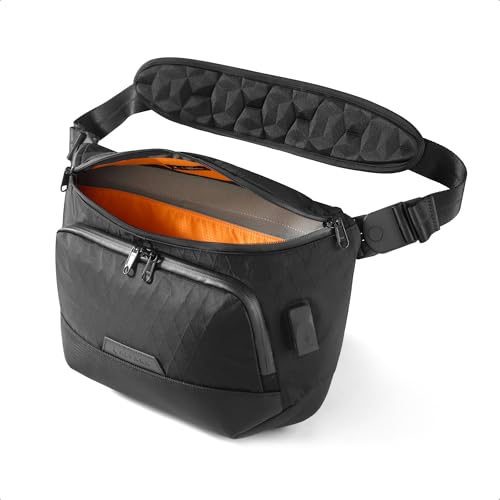
The Bravo Sling Max differs from the Base Camp Voyager by offering four separate zippered compartments and a removable, reversible padded strap. Its 8-liter capacity is smaller than the sage Voyager’s 11 liters, which can help buyers who want a more compact load. A front RFID-blocking pocket, lockable zippers, a USB charging port, luggage sleeve, and strap webbing compatible with ALPAKA HUB accessories are also included. Choose it if modular organization matters more than the Voyager’s dedicated tablet sleeve. The maker does not give a tablet-sleeve measurement, so verify device fit before choosing it for laptop or tablet carry.
Bottom line: Pick this alternative for a smaller capacity and removable, reversible strap.
How to choose a daily sling bag
Start with the load you carry, then compare capacity and compartment layout rather than judging by appearance. Capacity in liters indicates the bag’s total internal volume, not a guaranteed fit for a particular device; a sleeve measurement is the more useful check for tablets. A sling worn across the torso keeps contents accessible without taking a backpack off, but weight still rests mainly on one shoulder. If your regular load includes a laptop or heavy equipment, check the manufacturer’s carrying guidance and consider whether a two-strap pack distributes weight better. For a tablet, measure its width and height and leave a little clearance: do not rely on screen size alone, since bezels and cases add bulk.
Tablet fit and bag dimensions
Use the sleeve’s width and height as maximum fit clues, not the device’s diagonal screen measurement. A 14.5-by-10-inch sleeve should be compared with the tablet’s outside dimensions including its case; a snug sleeve can make removal difficult even when the bare device fits. Bag dimensions describe the exterior and do not establish usable internal space, since padding and seams occupy room. Measure your everyday items before selecting a one-size sling, especially if you carry a tablet, charger, and water bottle together. When the bag’s sleeve dimensions are absent, confirm the fit before ordering rather than inferring compatibility from the bag’s overall length or width.
Capacity and pocket layout compared
Capacity is useful for comparing overall volume, while pocket counts show how that space is divided. The table separates the two concerns so you can choose a capacity or a particular organization style without treating either as a universal advantage.
| Need | What to compare | Decision rule |
|---|---|---|
| Fit a tablet | Measured sleeve opening | Match device dimensions with case to sleeve dimensions |
| Carry a known load size | Capacity in liters | Choose a capacity closest to your packed essentials |
| Separate small items | Internal and external pockets | Prioritize dedicated pockets if frequent sorting matters |
A sling’s pocket count does not tell you the exact usable dimensions of each compartment. Keep bulky items in the main compartment and reserve small pockets for items that need separation.
Strap comfort and safe carrying
A padded, adjustable strap helps distribute contact across the shoulder, but it does not make an overloaded sling comfortable or safe. Keep the bag close to your torso and avoid packing dense items far from your body, where they can pull against the strap while walking. Reversible or removable straps add carry flexibility, while daisy-chain webbing can accept compatible attachments; neither feature increases the bag’s internal capacity. If the strap slips or causes numbness, loosen the load and reposition the bag rather than continuing to carry it that way. Check that clipped accessories are secure before moving, particularly when commuting through crowds.
Frequently Asked Questions
How do I measure a tablet for a sling sleeve?
Measure the device’s outside width and height with its case attached, then compare those numbers with the sleeve’s dimensions. Leave clearance for easy insertion; diagonal screen size alone does not show whether the device will fit.
Is an 11-liter sling big enough for commuting?
An 11-liter sling can suit a compact commute load such as a tablet, small accessories, and personal essentials. Bulky items compete for space, so compare your packed items with the bag’s internal shape rather than relying on capacity alone.
Can a sling bag replace a backpack for heavy gear?
A sling carries most of its load on one shoulder, unlike a two-strap backpack that spreads load across both shoulders. For dense daily gear, reduce the carried weight or choose a pack designed for more balanced load distribution.
What does a DWR finish do on a sling?
A durable water-repellent finish helps water bead on the fabric surface, but it is not the same as a waterproof construction. Keep electronics in protective cases during sustained rain or wet conditions.
How should I adjust a crossbody sling strap?
Adjust the strap so the bag sits close against your torso and does not swing freely while walking. Recheck the fit after loading it, because heavier contents can pull the strap and change where the bag rests.