
Best Rated Ceiling Fishing Rod Storage Racks Compared

For most anglers, Ghosthorn 4-Set Hardwood Rod Rack is the strongest fit because its four sets are described as holding up to 24 rods or combos and can be mounted overhead. Choose Ghosthorn TPR-Coated Rod Rack, 2-Pack for a smaller setup with TPR-coated hooks, or Homydom Steel Ceiling/Wall Rack if you prefer steel construction and an 8-rod capacity.
Ceiling-mounted racks keep rods off floor space, but ceiling joists and rod length determine whether the layout works.
We earn a commission if you buy through links on this page. As an Amazon Associate I earn from qualifying purchases. Products are compared on manufacturer specifications, not hands-on testing.
- Best overall: Ghosthorn 4-Set Hardwood Rod Rack – Four sets provide storage for up to 24 rods or combos, with wall or ceiling mounting.
- Best for cushioned hooks: Ghosthorn TPR-Coated Rod Rack, 2-Pack – TPR-coated hooks are intended to protect rods from scratches.
- Best for steel construction: Homydom Steel Ceiling/Wall Rack – PVC-coated steel holders accommodate up to 8 rods and reel combos.
| Product | Best for | Capacity | Material | Shop |
|---|---|---|---|---|
| Ghosthorn 4-Set Hardwood Rod Rack | Large collections | Up to 24 rods/combos | Solid hardwood | Check Price on Amazon |
| Ghosthorn TPR-Coated Rod Rack, 2-Pack | Cushioned contact | Up to 10 rods | TPR-coated hooks | Check Price on Amazon |
| Homydom Steel Ceiling/Wall Rack | Steel construction | Up to 8 rods/combos | PVC-coated steel | Check Price on Amazon |
| bruwaa PU-Padded Rod Holders, 2-Pack | Moist storage areas | Up to 10 rods | ABS with PU pads | Check Price on Amazon |
Ceiling Fishing Rod Storage Racks
Compare capacity, mounting choices and contact materials to match a rack to your space and rod collection.
Ghosthorn 4-Set Hardwood Rod Rack

For the largest capacity in this group, this four-set Ghosthorn rack holds up to 24 rods or combos and supports wall or ceiling mounting. The solid hardwood has a waterproof, moisture-resistant coating, and the sets can be arranged to suit the available storage area. It suits anglers organizing a substantial collection in a garage or similar space. The capacity is the maker’s claim, and the features do not explain how the 24-rod figure is divided across different rod or reel shapes, so allow room for wider setups.
Bottom line: Choose it when your priority is the highest capacity and a configurable wood rack.
Ghosthorn TPR-Coated Rod Rack, 2-Pack

Soft TPR-coated hooks distinguish this two-pack, which the maker says can hold up to 10 fishing rods. The hooks have a smooth, non-abrasive surface, and the holder can be installed on a ceiling, wall, garage or storage room. Its 17-inch length gives buyers a useful mounting dimension to plan around. This rack suits a smaller collection where cushioned contact matters.
Bottom line: Pick it for a smaller rod collection where soft-coated hooks are a priority.
Homydom Steel Ceiling/Wall Rack

Steel construction and a 8-rod-and-reel-combo capacity set this Homydom rack apart from the wood and molded-hook options. The high-impact steel has a PVC coating intended to protect rods from scratches, and the rack can be mounted on a wall or ceiling. At 16.9 inches high, it offers a defined vertical footprint for planning a garage or cabin storage spot. It suits buyers who want a steel holder for a modest group of combos. Its eight-rod capacity is the lowest here, so it is a poor match for a large collection.
Bottom line: Choose it for steel construction and a collection of up to eight combos.
bruwaa PU-Padded Rod Holders, 2-Pack
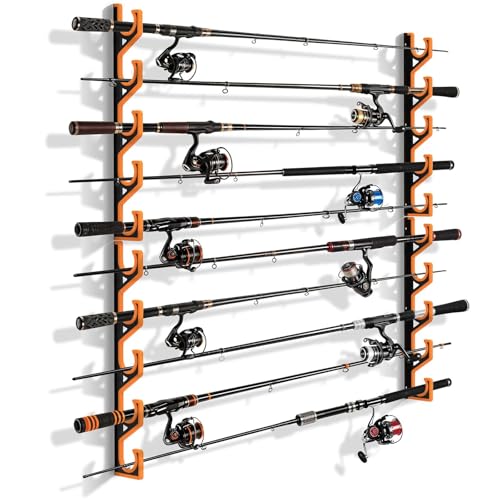
ABS construction with soft PU pads makes this pair distinct for buyers considering a damp garage or other humid storage area. The maker describes the ABS as waterproof, rust-proof and corrosion-resistant, and says the holders can be mounted horizontally on a wall or ceiling. The pair is sized 19.6 by 2.7 by 0.78 inches. This option suits anglers who want padded contact and a nonmetal holder.
Bottom line: Pick it for padded contact and a moisture-resistant ABS body.
How to choose a ceiling fishing rod rack
Choose first by capacity, then by how the holder contacts the rod. A rack’s advertised rod count is not a weight rating: reel size, rod spacing and handle shape can limit how many setups fit in practice. These four options span stated capacities of 8 to 24 rods or combos, so measure your collection rather than relying on a headline count alone. Soft TPR or PU contact surfaces are intended to reduce abrasion; coated steel and coated hardwood offer different structural materials. For overhead installation, locate framing before drilling and use fasteners suited to the ceiling material; drywall alone should not carry a loaded rack. Leave room to lift each rod out without striking ceiling fixtures or adjacent gear.
Ceiling mounting and clearance
Ceiling racks work best when their supports align with framing and the rods have a clear path in and out. Measure each rod from butt to tip, then reserve that length plus maneuvering room along the storage direction; the racks here do not specify a rod-length limit. Check the joist spacing against the mounting holes, and avoid suspending loaded holders from unsupported drywall. A ceiling mount can save wall space, but low overhead clearance or nearby doors and lights may make a wall position more practical. With less than a rod’s full length of unobstructed overhead run, choose another location or a shorter rod arrangement rather than forcing the fit.
Rod rack materials and protection
Soft liners and coatings protect rod contact points differently, so select based on the surface and storage environment. TPR and PU are soft materials placed where rods rest, while PVC coating covers the Homydom steel rack; the hardwood rack has a waterproof, moisture-resistant coating. The bruwaa maker describes its ABS body as waterproof and corrosion-resistant, but no rack material makes a poor mounting surface safe. Salt residue and damp gear can accelerate corrosion on exposed hardware, so dry rods before storage and inspect fasteners periodically. Avoid dragging rods through a loaded rack, since reel seats, guides and adjacent rods can rub even when the support surface is padded.
Safe overhead storage setup
Secure overhead storage starts with fastening into sound framing and keeping the load within the rack maker’s intended use. The products provide rod counts but no load ratings, so do not convert a rod count into a permissible weight. Position the rack away from walking paths, garage doors and ceiling-mounted equipment; a falling rod or loose fastener can injure someone or damage gear. Install paired supports in alignment so each rod rests evenly rather than twisting across the holders. Recheck fasteners after installation and whenever a rack shifts, loosens or shows damage. If the intended ceiling surface or framing cannot be confirmed, use a wall location anchored into studs instead.
Frequently Asked Questions
How far apart should ceiling rod holders be?
Set paired holders far enough apart to support the rod near its ends without allowing it to sag or pivot. Measure the longest rod you plan to store and test the spacing with one unloaded rod before filling the rack.
Can fishing rods be stored horizontally overhead?
Yes, horizontal storage is a common way to keep rods clear of floors, provided both supports are secure and aligned. Leave clearance for rod length and remove rods without scraping guides against neighboring gear.
Should fishing rods be stored with reels attached?
Many racks accommodate rod-and-reel combos, but a reel can make a setup heavier or wider than a bare rod. Confirm the holder spacing and clearance with the largest reel you intend to store, and do not treat rod capacity as a weight rating.
How do you keep stored fishing rods from getting damaged?
Keep rods separated so guides and reel handles do not rub against adjacent equipment. Wipe away water and salt residue before storage, and avoid forcing rods past one another in a crowded rack.
Can a ceiling rod rack be mounted in drywall?
A loaded ceiling rack should be fastened into framing, not supported by drywall alone. Locate the joists and use fasteners appropriate to the ceiling material; switch to a stud-anchored wall position if the framing cannot be found.