
Best Arboleaf Scale for Accuracy: 5 Models Compared

For the most detailed Arboleaf body-composition estimates, choose Arboleaf 8-Electrode Scale with Handle: its eight electrodes measure arms, legs, and trunk, though that setup does not prove greater accuracy. Arboleaf scales can track weight, but body-fat and muscle figures from bioelectrical impedance analysis (BIA) are estimates that shift with hydration and measurement conditions.
If you mainly want body weight, Arboleaf 4-Electrode Scale, White is the simpler option, with a 0.1 lb increment; choose another model if you want segmental readings or a handle display.
We earn a commission if you buy through links on this page. As an Amazon Associate I earn from qualifying purchases. Products are compared on manufacturer specifications, not hands-on testing.
- Best overall: Arboleaf 8-Electrode Scale with Handle – Eight hand-and-foot electrodes provide segmental readings, and the scale has a 400 lb capacity.
- Best for weight tracking: Arboleaf 4-Electrode Scale, White – Four electrodes and a 0.1 lb increment suit straightforward weight check-ins.
- Best for platform size: Arboleaf 8-Electrode Scale, Pure White – Its 12.2-inch square platform provides a broad standing surface.
| Product | Best for | Electrodes | Capacity | Platform size | Shop |
|---|---|---|---|---|---|
| Arboleaf 8-Electrode Scale with Handle | Segmental estimates | 8 | 400 lb | — | Check Price on Amazon |
| Arboleaf 8-Electrode Scale, Pure White | Wide platform | 8 | — | 12.2 x 12.2 in | Check Price on Amazon |
| Arboleaf Dual-Frequency 8-Electrode Scale | Quick screen checks | 8 | — | — | Check Price on Amazon |
| Arboleaf 8-Electrode Scale with Handle, Dark Blue | Trend sharing | 8 | — | 12 x 12 x 1 in | Check Price on Amazon |
| Arboleaf 4-Electrode Scale, White | Weight increments | 4 | 400 lb | 11.8 x 11.8 in | Check Price on Amazon |
Arboleaf scales for accuracy
Compare the electrode setup and display or platform details, while treating body-composition numbers as estimates rather than clinical measurements.
Arboleaf 8-Electrode Scale with Handle

For segmental body-composition readings, this model pairs four hand electrodes with four foot electrodes and dual-frequency BIA. The 5.3-inch handle display shows weight, BMI, body fat, muscle mass, body water, bone mass, and visceral fat after app setup; the app also supports standard and athlete modes. Its 400 lb capacity is a concrete limit to check against your needs. BIA figures are estimates, not direct measurements of body fat or muscle, and electrode count alone does not establish accuracy. It suits buyers who want more than weight alone; choose a simpler scale if you do not need handle readings or app setup.
Bottom line: Pick this if segmental readings and a handle display matter more than a basic weight-only routine.
Arboleaf 8-Electrode Scale, Pure White
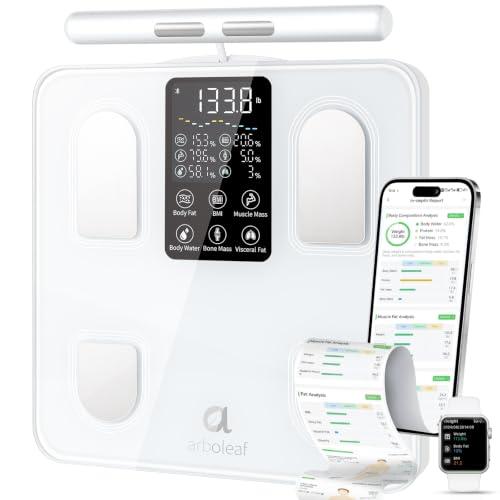
The 12.2-by-12.2-inch platform is the largest specified here, while eight electrodes collect readings from hands and feet. The scale cycles through seven measurements, and the app provides 50-plus metrics, including BMR and segmental analysis; the app also switches among lb, kg, st, and st:lb. This combination fits buyers who want a larger standing surface and detailed trend tracking. Consider a model with a capacity if that limit is decisive.
Bottom line: Choose this for its larger stated platform and broad app-based tracking.
Arboleaf Dual-Frequency 8-Electrode Scale
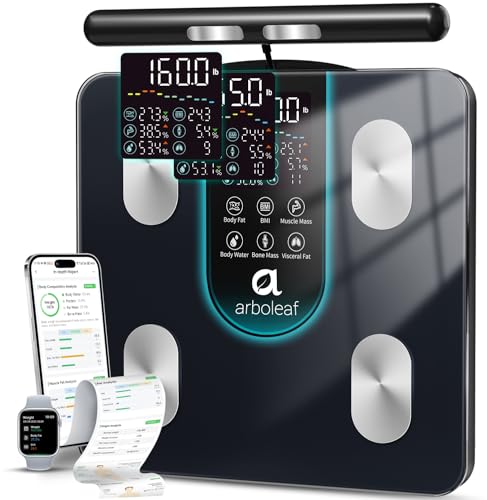
Quick checks without opening the app are the focus: this scale’s screen shows weight, BMI, body fat, muscle mass, body water, bone mass, and visceral fat. Its handle-and-foot electrode design uses dual-frequency BIA, while the app adds more than 50 metrics, trend charts, family profiles, syncing, and reports. It suits households that want a compact summary on the scale and deeper views in the app. The specifications do not give a capacity or platform measurement, so those limits matter if you need a specific fit. Screen convenience does not remove the need to interpret body-composition values as estimates.
Bottom line: Pick this for seven at-a-glance measurements plus app trends and family profiles.
Arboleaf 8-Electrode Scale with Handle, Dark Blue

Trend history, family profiles, and report sharing distinguish this 8-electrode, dual-frequency model. Its display shows seven key stats, and the Arboleaf app provides more than 50 metrics, including segmental fat and muscle views and BMR. The 12-by-12-inch platform is one inch smaller in each direction than the specified platform on Arboleaf 8-Electrode Scale, Pure White. This is a fit for buyers who want app-based household tracking and a known overall size.
Bottom line: Choose this for shared trend reports and a specified 12-inch square footprint.
Arboleaf 4-Electrode Scale, White

Unlike the eight-electrode models, this scale uses four electrodes and focuses on standard weight and app-based body metrics. The maker says readings go down to 0.1 lb; that increment describes display resolution, not proof that every measurement is accurate to 0.1 lb. It has a 400 lb capacity and an 11.8-inch square platform, plus Bluetooth syncing and 14 app metrics such as BMI, body fat, muscle mass, and body water. It suits buyers who want weight trends and a straightforward setup. Choose an eight-electrode model if segmental arm, leg, and trunk estimates are a priority.
Bottom line: Pick this for a simpler scale with a 0.1 lb increment and 400 lb capacity.
How accurate are Arboleaf body-fat scales
Arboleaf BIA readings are estimates, not direct measurements of body fat or muscle. BIA sends a small electrical current through the body and estimates composition from the resulting impedance; hydration, meals, exercise, and skin temperature can change that result. Eight hand-and-foot electrodes allow segmental estimates across arms, legs, and trunk, but more electrodes do not by themselves guarantee better accuracy. Treat body-fat and muscle figures as trends under consistent conditions, not as interchangeable with a clinical body-composition test. Weight is a separate measurement from the scale’s load sensors. A display increment such as 0.1 lb is resolution, not a guarantee that the weight reading is accurate within 0.1 lb.
How to get more consistent scale readings
Measure at the same time of day, ideally after using the bathroom and before eating, to reduce changes from food and fluid. Place the scale on a hard, level floor rather than carpet, and stand barefoot with dry feet on the electrodes for BIA readings. Avoid comparing a post-workout reading with a morning reading: exercise and sweating alter fluid distribution. For a useful trend, record readings under similar conditions and focus on changes over weeks rather than a single day. If weight is unexpectedly inconsistent, repeat the measurement on the same surface and check the scale’s zero reading before stepping on. Keep hands and feet positioned as the device requires so the electrode path is consistent.
Choose by electrode setup and display
Choose an eight-electrode model if you want hand-and-foot segmental estimates; choose a four-electrode model if weight and general app metrics are enough. A handle display makes key stats visible on the scale, while an app-centered setup may offer more trend views and sharing tools. Use this guide to match the feature to the decision you actually need; neither electrode count nor the number of app metrics establishes clinical accuracy.
| Need | Better fit | Reason |
|---|---|---|
| Segmental estimates | 8 electrodes | Hand and foot contacts include arms, legs, and trunk |
| Weight-focused routine | 4 electrodes | Fewer composition features to prioritize |
| Quick screen check | Handle display | Shows key stats without opening the app |
| App sharing | Model with report sharing | Supports household trends and reports |
Fit, capacity, and safe use
Check platform dimensions and weight capacity before choosing a scale: the specified examples span 11.8- to 12.2-inch square platforms, and two models specify a 400 lb limit. Leave enough flat floor space for the whole platform, and do not use a scale whose capacity is below the user’s weight. BIA scales use a small current through the body, so people with implanted electronic medical devices should follow their device manufacturer’s guidance and consult a clinician before using a body-composition mode. Do not rely on BIA estimates for medical decisions. For ongoing weight tracking, keep the scale in one location on a firm surface rather than moving it between floor types.
Frequently Asked Questions
Does eight-electrode BIA measure body fat directly?
No, BIA estimates body composition from electrical impedance rather than measuring fat directly. Hydration, recent meals, exercise, and temperature can shift the estimate, so compare readings taken under similar conditions.
How often should I weigh myself for a useful trend?
A daily or weekly schedule can both show a trend if the conditions stay consistent. Compare averages or multi-week direction rather than interpreting one day’s change, since meals and fluid can move scale weight temporarily.
Why does my body-fat reading change overnight?
Body-fat estimates can change as fluid distribution changes, even when body fat itself has not changed overnight. Weigh under similar conditions—such as morning, after using the bathroom, before eating—to make comparisons more meaningful.
Can I use a BIA scale with a pacemaker?
People with pacemakers or other implanted electronic medical devices should follow the device maker’s instructions and ask a clinician before using a BIA function. The body-composition mode passes a small electrical current through the body.
What does a 0.1 lb scale increment mean?
A 0.1 lb increment means the display changes in tenths of a pound. It is resolution, not proof that each reading is accurate to within 0.1 lb.