
Non Plastic K Cups: 4 Compostable Pods Compared

For a plant-based pod material claim and four roast choices, start with San Francisco Bay OneCup Variety Pack; the other options differ in roast, pack size, or how specifically they describe composting. Compostable does not necessarily mean every component is plastic-free, so if you require zero plastic throughout, confirm the pod and packaging materials before ordering.
We earn a commission if you buy through links on this page. As an Amazon Associate I earn from qualifying purchases. Products are compared on manufacturer specifications, not hands-on testing.
- Best overall: San Francisco Bay OneCup Variety Pack – Its pod and packaging are described as plant-based, and the pack includes four blends.
- Best for a larger pack: Happy Belly Dark Roast Pods – The 96-count pack is the largest option here.
- Best for organic roast: San Francisco Bay Organic Rainforest Blend – It combines a USDA Organic Rainforest Blend with an explicitly commercial composting claim.
| Product | Best for | Count | Roast | Composting claim | Shop |
|---|---|---|---|---|---|
| San Francisco Bay OneCup Variety Pack | Blend variety | 80 pods | Four blends | Commercially compostable | Check Price on Amazon |
| Happy Belly Dark Roast Pods | Dark roast stock-up | 96 pods | Dark roast | Compostable | Check Price on Amazon |
| San Francisco Bay Organic Rainforest Blend | Organic medium-dark | 80 pods | Medium-dark | Commercially compostable | Check Price on Amazon |
| The Organic Coffee Co. Breakfast Blend | Organic breakfast blend | 36 pods | Medium roast | Compostable | Check Price on Amazon |
Non Plastic K Cups Compared
Compare the pack size, roast selection, and composting wording to find the option that fits your priorities.
San Francisco Bay OneCup Variety Pack

San Francisco Bay OneCup Variety Pack is the only option here that explicitly describes both its pods and their bags as made from plant-based materials, and its four blends set it apart from the single-roast packs. The 80 pods include French Roast, Fog Chaser, Organic Rainforest Blend, and Breakfast Blend, with 100% Arabica coffee. The brand says the pods are designed for most single-serve machines, including K-Cup-style brewers. Choose it if variety and the plant-based materials matter most. Its composting claim is commercial, so it is not the clearest choice for someone seeking a home-composting claim.
Bottom line: Choose this if you want four blends and an explicit plant-based-material claim.
Happy Belly Dark Roast Pods

Happy Belly Dark Roast Pods has the largest pack at 96 pods and keeps the choice simple with a dark roast rather than a mixed assortment. The coffee is 100% Arabica and Rainforest Alliance Certified; the brand says the pods are compatible with K-Cup-style 1.0 and 2.0 brewers. It also flags possible brewing difficulty with five-punch K Supreme models, so verify brewer compatibility if you own one. The pod is called compostable, but the materials are not further identified here; buyers who need confirmation of every component’s material should check before choosing it.
Bottom line: Pick this for a 96-count dark roast pack, after checking compatibility with five-punch K Supreme brewers.
San Francisco Bay Organic Rainforest Blend
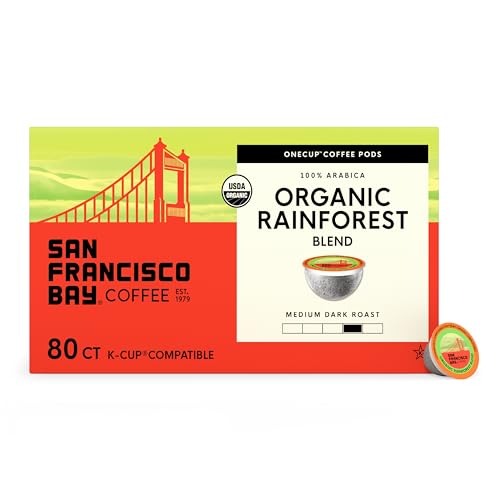
San Francisco Bay Organic Rainforest Blend is the single-blend choice for shoppers who want USDA Organic Rainforest Blend rather than a variety pack. Its medium-dark roast is described with creamy cocoa and brown sugar notes, and the coffee is 100% Arabica. The brand says the pods are designed for most single-serve machines, including K-Cup-style brewers, and identifies them as commercially compostable. The 80-count format is smaller than the 96-count option. If you want pod-material wording beyond the composting claim, confirm the construction before ordering.
Bottom line: Choose this for a single USDA Organic medium-dark roast with a commercial composting claim.
The Organic Coffee Co. Breakfast Blend

The Organic Coffee Co. Breakfast Blend is the smallest pack, with 36 medium-roast Breakfast Blend pods made from Central and South American beans. The product identifies the coffee as USDA Organic and says the pods work with most Keurig K-Cup 1.0 and 2.0 brewers, as well as Cuisinart and Bunn single-serve brewers. Its compostable claim makes it relevant to this search, but no composting setting is identified in the product wording. Choose it if you want a smaller organic breakfast blend pack; it is less suited to anyone prioritizing a clearly stated commercial-composting designation.
Bottom line: Pick this for a smaller pack of USDA Organic medium-roast breakfast coffee.
How to choose non plastic K cups
Start by separating a compostability claim from a verified material claim: the words are not interchangeable, and a product called compostable may not identify every component. San Francisco Bay OneCup Variety Pack is the clearest fit here for plant-based wording because its pod and bag materials are both described that way; the other options use compostability claims with less material specificity. Next, decide whether you prefer one roast or several, then match the pack count to how often you brew. For a single cup each day, 36 pods cover about five weeks, while an 80-count pack covers roughly eleven weeks. If zero plastic is a requirement, confirm the pod body, filter, seal, and outer packaging before choosing.
Commercially compostable versus compostable pods
A commercially compostable claim is not a promise that every compost facility accepts the pod. Facilities set their own accepted-material rules, and compostable packaging may need the controlled conditions of an industrial composting process rather than a backyard pile. San Francisco Bay OneCup Variety Pack and San Francisco Bay Organic Rainforest Blend explicitly say commercially compostable; Happy Belly Dark Roast Pods and The Organic Coffee Co. Breakfast Blend use compostable wording without naming a setting. Ask the local composting service whether it accepts coffee pods and their attached components. Do not put a pod in curbside recycling unless the local program accepts that specific format: small, mixed-material items can be rejected during sorting. Compostability and recyclability are separate disposal routes, not interchangeable labels.
Check K-Cup brewer fit before buying
Compatibility language matters because a K-Cup-style pod is intended for a particular single-serve brewer format, but compatibility can have exceptions. Happy Belly Dark Roast Pods specifically notes possible brewing difficulty in five-punch K Supreme models, while The Organic Coffee Co. Breakfast Blend names compatibility with most Keurig K-Cup 1.0 and 2.0 machines and Cuisinart and Bunn brewers. The other two say they fit most single-serve machines, including K-Cup-style brewers. Match the exact brewer model and pod format, especially if a machine has a multi-needle or specialized puncture system. If you have a five-punch K Supreme, choose a different option unless compatibility is confirmed.
Choose pack size and roast
Pack size is a useful way to avoid buying more coffee than you can use while it remains fresh. At one pod per day, 36 pods last about five weeks, 80 last about eleven weeks, and 96 last nearly fourteen weeks. Once opened, keep coffee pods sealed in their original packaging and away from heat, moisture, and strong odors to preserve aroma. Choose a single roast if you know your preference: Happy Belly Dark Roast Pods is dark, The Organic Coffee Co. Breakfast Blend is medium, and San Francisco Bay Organic Rainforest Blend is medium-dark; San Francisco Bay OneCup Variety Pack offers four blends instead. If more than one person brews coffee, a variety pack can make it easier to accommodate different roast preferences without committing to a single blend.
Frequently Asked Questions
Are compostable K-Cup pods completely plastic-free?
Not necessarily; a compostability claim alone does not identify every pod component. Confirm the pod body, filter, seal, and packaging materials if avoiding all plastic is essential.
Can commercially compostable coffee pods go in home compost?
A commercial-compostability claim does not establish home-compostability. Industrial facilities control conditions, and home piles may not reach the same sustained heat, so check the pod’s material claim and your local composting rules.
Will compostable pods work in every Keurig brewer?
No compatibility statement guarantees every model; Happy Belly Dark Roast Pods specifically warns of possible brewing difficulty with five-punch K Supreme machines. Check the precise brewer model and pod format before choosing.
How long do 80 coffee pods last?
At one pod per day, an 80-count pack lasts about 80 days, or just under 12 weeks. A two-cup daily routine uses the pack in about 40 days.
Can coffee pods go in curbside recycling?
Do not assume so, because local recycling programs accept different materials and small mixed-material pieces may not sort correctly. Use curbside recycling only when the local program confirms acceptance of that exact pod format.