
Carbon Fiber Bicycle Pedals: 3 Models Compared

For carbon fiber bicycle pedals, Carbon Fiber Flat Pedals 173 g comes first because its maker gives the lowest pair weight at 173 g and identifies a 9/16-inch thread. Choose Carbon Fiber MTB Pedals 195 g for its 101 × 85 mm platform, or Carbon Road/MTB Pedals 91 × 86 mm if its 91 × 86 mm size fits your preference.
We earn a commission if you buy through links on this page. As an Amazon Associate I earn from qualifying purchases. Products are compared on manufacturer specifications, not hands-on testing.
- Best overall: Carbon Fiber Flat Pedals 173 g – At 173 g per pair, this option is the lightest and specifies a 9/16-inch spindle thread.
- Best for a wider platform: Carbon Fiber MTB Pedals 195 g – The 101 × 85 mm platform is the largest dimensioned surface among these choices.
- Best for a compact platform: Carbon Road/MTB Pedals 91 × 86 mm – Its 91 × 86 mm platform measures about 3.58 × 3.39 inches.
| Product | Best for | Pair weight | Platform size | Spindle | Shop |
|---|---|---|---|---|---|
| Carbon Fiber Flat Pedals 173 g | Low pair weight | 173 g | 4.4 × 3.8 in | Titanium alloy | Check Price on Amazon |
| Carbon Fiber MTB Pedals 195 g | Wide platform | 195 g | 3.98 × 3.35 in | Titanium | Check Price on Amazon |
| Carbon Road/MTB Pedals 91 × 86 mm | Smaller platform | 181 g | 3.58 × 3.39 in | Titanium | Check Price on Amazon |
Carbon fiber bicycle pedals compared
Compare the three flat-pedal options by weight, platform dimensions and axle material.
Carbon Fiber Flat Pedals 173 g

At 173 g per pair, these pedals have the lowest weight among the three options. The carbon fiber composite body, titanium-alloy spindle and three sealed bearings suit riders who prioritize a light flat pedal for MTB, BMX or road use. The maker also specifies a 9/16-inch thread, a common bicycle pedal size.
Bottom line: Choose these if the 173 g pair weight and 9/16-inch thread match your priorities.
Carbon Fiber MTB Pedals 195 g

These are the only option with a clearly stated 101 × 85 mm platform, making their footprint easy to compare against shoe size and riding preference. The maker gives a pair weight of about 195 g, a titanium axle and three sealed bearings; anti-slip pins are intended to add grip on the wide platform. The product is presented for mountain, road, folding and commuting bikes. The trade-off is a greater stated weight than Carbon Fiber Flat Pedals 173 g, so riders focused on minimizing pedal mass may prefer the lighter pair.
Bottom line: Pick this pair if its 101 × 85 mm platform is your deciding fit factor.
Carbon Road/MTB Pedals 91 × 86 mm
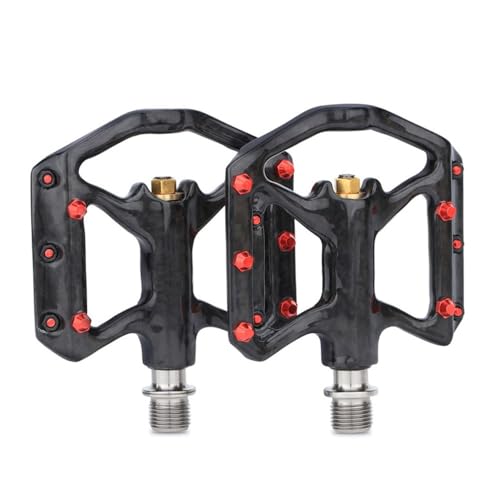
With a 91 × 86 mm platform and a weight of about 181 g per pair, these pedals offer a more compact footprint than Carbon Fiber MTB Pedals 195 g and weigh less than that pair. The construction combines a carbon fiber frame with a titanium shaft, and the maker identifies three bearings and anti-slip aluminum pins. MTB, road and BMX use are named. The product name also mentions Brompton, but the facts do not establish a specific folding-bike fit, so confirm compatibility if that is your intended use.
Bottom line: Choose this pair if you want the 91 × 86 mm footprint and its 181 g weight.
How to choose flat bicycle pedals
Flat pedals suit riders who want to place a regular shoe on the platform without clipping into a cleat. Compare platform width and length with the shoe’s sole: a larger platform spreads support, while a smaller one can feel less bulky. Pin placement and pin height affect how securely a shoe stays planted, so inspect those features alongside the body material. These three options all name carbon fiber bodies and titanium axles, but their weights range from 173 g to about 195 g per pair. If each gram matters more than foot support, use pair weight as the tiebreaker; otherwise prioritize a measured platform that supports your shoe.
Pedal thread and crank compatibility
Most adult bicycle cranks use a 9/16-inch pedal thread, while some youth and older bicycles use a 1/2-inch thread. The thread must match the crank; a pedal that starts at an angle can damage crank threads. Carbon Fiber Flat Pedals 173 g explicitly gives a 9/16-inch thread, while the other two products do not specify a thread size, so confirm that size before ordering either of them. Pedals also have left and right sides: the left pedal tightens counterclockwise, unlike the right pedal. Check the crank markings or product orientation before installation rather than forcing a resistant spindle.
Comparing pedal platform dimensions
Platform measurements help narrow fit, but they do not alone determine how a pedal feels; shoe width, pin position and sole shape also matter. Use the following measurements as length by width, converting the millimeter values to inches where supplied.
| Option | Platform length × width | Pair weight |
|---|---|---|
| Carbon Fiber Flat Pedals 173 g | 4.4 × 3.8 in | 173 g |
| Carbon Fiber MTB Pedals 195 g | 101 × 85 mm | 195 g |
| Carbon Road/MTB Pedals 91 × 86 mm | 91 × 86 mm | 181 g |
Dimensions in the table come from the specifications; the body size is not necessarily the usable standing area between pins. If a few millimeters determine whether a shoe is supported, compare actual contact area rather than relying only on the outer dimensions.
Carbon composite versus metal pedal bodies
Carbon fiber composite pedals use a polymer matrix reinforced with carbon fibers, while common metal flat pedals use aluminum alloy. Composite construction can reduce mass, but body shape and material alone do not establish impact resistance or service life. Titanium spindles are distinct from steel spindles: titanium is corrosion-resistant and lower density, while exact strength and durability depend on alloy and design. Bearings support spindle rotation; sealed bearings add barriers against water and grit, but seals do not make a pedal maintenance-free. After wet or muddy rides, remove grit and check for side-to-side spindle play, loose pins or cracks before riding again.
Frequently Asked Questions
What pedal thread size fits most adult bikes?
Most adult bicycle cranks use 9/16-inch pedal threads; some youth bikes use 1/2-inch threads. Match the spindle size to the crank, since a mismatch can damage the threads.
Are carbon fiber pedals suitable for mountain biking?
Carbon-composite flat pedals can be used for mountain biking when their design and fit suit the ride. Check the platform, pins and body condition after rock strikes, because impact damage can compromise a composite body.
How often should bicycle pedal bearings be checked?
Check for rough rotation or side-to-side play during routine bike maintenance and after muddy or wet rides. A bearing that feels gritty or a spindle that moves laterally needs inspection before further riding.
Do wide flat pedals improve shoe grip?
A wider platform can support more of a shoe sole, but width alone does not guarantee grip. Pin layout, pin height and the sole’s tread determine how securely the shoe stays planted.
Can I install bicycle pedals with a wrench?
Many pedals install with either a pedal wrench or a hex key, depending on spindle design. The left pedal uses a reverse thread and tightens counterclockwise; start both sides by hand to avoid cross-threading.