
Pressure Fryer for Home: 3 Models Compared

For home pressure frying, the PreAsion 16L 110V model is the most straightforward fit because it pairs a countertop design with 110V power and pressure-release safeguards. Choose a different model if you need a wattage or 220V operation; pressure fryers cook food in hot oil inside a sealed, pressurized vessel.
Pressure fryers require more careful handling than ordinary countertop fryers: confirm that the model’s voltage matches your outlet, and never open the lid while the vessel is pressurized.
We earn a commission if you buy through links on this page. As an Amazon Associate I earn from qualifying purchases. Products are compared on manufacturer specifications, not hands-on testing.
- Best overall: PreAsion 16L 110V Pressure Fryer – Countertop format, 110V operation and an automatic overpressure release feature.
- Best for stated power: BEILOCKERY 16L 110V Pressure Fryer – Specifies 110V, 2,400W and an operating pressure of 8 PSI.
- Best for 220V kitchens: PreAsion 16L 220V Pressure Fryer – Specifies 220V operation and 3,000W power.
| Product | Best for | Voltage | Power | Temperature range | Shop |
|---|---|---|---|---|---|
| PreAsion 16L 110V Pressure Fryer | 110V home kitchens | 110V | — | 32–392°F | Check Price on Amazon |
| BEILOCKERY 16L 110V Pressure Fryer | Power-specific choice | 110V | 2,400W | 122–392°F | Check Price on Amazon |
| PreAsion 16L 220V Pressure Fryer | 220V kitchens | 220V | 3,000W | 32–392°F | Check Price on Amazon |
Home Pressure Fryers
Compare electrical requirements, heat controls and pressure safeguards before choosing a countertop pressure fryer.
PreAsion 16L 110V Pressure Fryer

The PreAsion 16L model is the only one here that combines a countertop design with 110V power, which may suit kitchens set up for standard household outlets. Its maker describes an elastic-beam support that releases pressure during overpressure and a thermostat adjustable from 0–200°C. The round basket is said to hold 3–5 chickens, and the unit is made from 304 stainless steel.
Choose it if the voltage matches your kitchen and its footprint fits your counter. The power draw is not provided, so confirm electrical compatibility before ordering, especially if the fryer will share a circuit with other high-wattage appliances.
Bottom line: Choose this if you want a countertop pressure fryer for a compatible 110V kitchen.
BEILOCKERY 16L 110V Pressure Fryer
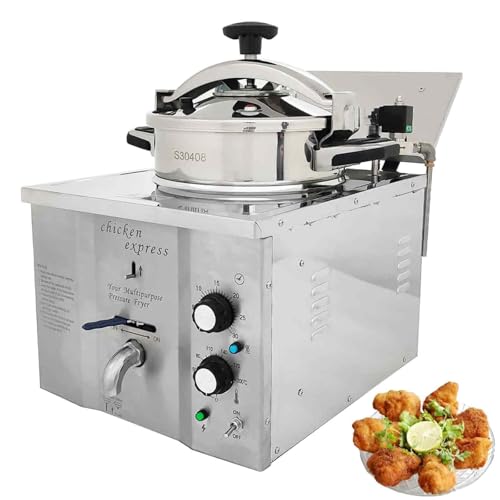
The BEILOCKERY model stands apart by giving a specific operating pressure and wattage: its maker says it runs at 8 PSI and 2,400W on 110V. It has an approximately 16L capacity, a ceramic heater and a temperature range of 50–200°C. A pressure gauge and lid-mounted relief valve are included, and the body is stainless steel.
This model suits buyers who want those operating figures stated before selecting a fryer. Its 8 PSI figure is a maker claim, not a general pressure-frying target; verify that your kitchen circuit can support 2,400W, since a high load can trip a shared circuit.
Bottom line: Choose this if the 8 PSI and 2,400W specifications suit your setup.
PreAsion 16L 220V Pressure Fryer

The 220V PreAsion model differs from the other two by specifying 3,000W and 220V operation, so its electrical compatibility is the key choice factor. Its maker describes a pressure-responsive elastic beam, thermal overload protection and an adjustable 0–200°C temperature control. The exterior dimensions are 19.69 inches long, 9.65 inches wide and 20.47 inches high.
Choose it only if your kitchen has a compatible 220V connection and enough counter space.
Bottom line: Choose this if your kitchen supports 220V and you want its specified 3,000W power.
How pressure frying works at home
Pressure frying cooks food in hot oil inside a sealed vessel, where trapped steam raises pressure and changes cooking conditions compared with an open fryer. Unlike ordinary countertop fryers, pressure fryers need a lid that locks until pressure is released; never force the lid open or bypass a safety mechanism. A pressure gauge shows vessel pressure on models equipped with one, while a relief valve provides a separate route for excess pressure. Keep the fryer on a stable, heat-resistant surface, and leave room around the appliance for ventilation and safe handling. Do not use a pressure fryer as a substitute for a standard pressure cooker: the cooking medium is hot oil, and the operating instructions and fill limits are specific to the appliance.
Choosing a voltage and circuit
Match the fryer’s voltage to a dedicated compatible outlet before comparing capacity or controls. A 2,400W appliance at 110V draws about 21.8A, more than a typical 15A or 20A household branch circuit can support continuously; a 3,000W appliance at 220V draws about 13.6A, though the correct circuit and plug still matter. For a simple decision rule, do not use a model if its required voltage or current exceeds the rating of the outlet or circuit. Have an electrician verify an unfamiliar 220V installation rather than relying on an adapter. Wattage, plug type, and circuit requirements are different checks: voltage matching alone does not establish that a circuit can safely carry the load.
Capacity, oil fill and batch size
Oil-tank capacity and food capacity measure different things, so a 16L oil tank does not mean 16L of food fits in the basket. Keep oil between the appliance’s minimum and maximum marks, because food releases moisture and hot oil can foam or rise during cooking. Avoid crowding the basket: a crowded load cools the oil more sharply and can cook unevenly, while the fryer’s specified maximum load is the limit to follow. Plan portions around basket dimensions and food size rather than the tank volume; whole chickens need more vertical and lateral clearance than cut pieces. Where a model gives a batch estimate, treat it as a starting point and stay within its load and fill markings.
Pressure fryer safety and placement
Hot oil and stored pressure make countertop pressure fryers higher-risk than open fryers. Set the unit on a level, heat-resistant surface away from children, pets, cabinets and water; leave clear space around the lid and pressure outlet so escaping steam cannot strike a person or surface. Use the lid lock, pressure gauge and relief features as designed, and stop if a gauge or valve appears damaged or obstructed. Let the fryer depressurize fully before opening, and do not move it while it contains hot oil. Measure the footprint and overhead clearance before setup, then keep cords away from hot surfaces and walkways. For cleaning, wait until oil is cool, and never immerse an electric heating assembly in water.
Frequently Asked Questions
Can a pressure fryer run from a standard household outlet?
Some models are specified for 110V, but voltage alone does not confirm circuit suitability. A 2,400W load at 110V draws about 22A, so check the appliance requirements and circuit rating before use.
Why does pressure frying need a sealed lid?
A sealed vessel holds steam pressure generated as moisture leaves the food, which changes the cooking environment compared with open deep frying. Never force the lid open while pressure remains; wait for pressure to release fully according to the appliance’s directions.
How much oil should go in a pressure fryer?
Use the fryer’s marked minimum and maximum oil levels rather than filling by guesswork. Hot oil can expand and foam as food is added, so avoid exceeding the maximum line and leave room for bubbling.
What does an 8 PSI pressure rating mean?
PSI means pounds per square inch, a measure of pressure above the surrounding air when stated as gauge pressure. The 8 PSI figure is the maker’s claim for one model; compare it only with equipment ratings that use the same pressure convention.
How should I plan counter space for a pressure fryer?
Measure the appliance footprint and leave clearance around hot surfaces and any steam or pressure-release outlet. One model here measures 19.69 inches long by 9.65 inches wide by 20.47 inches high; confirm your own counter and overhead clearance before use.