
Best Fogger to Kill Bees: 5 Products Compared by Fit

For carpenter bee tunnels or ground-nesting yellowjacket holes, Spectracide Carpenter Bee & Yellowjacket Foam is the closest fit because its foam is applied directly into those sites. It is an expanding foam aerosol, not a room fogger; for indoor space treatment, choose a product labeled for the insect and area instead.
None of these products is a general-purpose fogger specifically for killing bees, so identify the pest and nest location before choosing.
We earn a commission if you buy through links on this page. As an Amazon Associate I earn from qualifying purchases. Products are compared on manufacturer specifications, not hands-on testing.
- Best overall: Spectracide Carpenter Bee & Yellowjacket Foam – Expanding foam is designed for direct application to carpenter bee tunnels and yellowjacket holes.
- Best for broad spray use: BioAdvanced Carpenter Ant & Termite Killer Plus – The ready-to-use gallon spray includes a pump-style sprayer and lists carpenter bees for localized control.
- Best for wasps in spaces: BASF PT Pro-Control Plus Fogger – The space-treatment fogger lists wasps among its targets.
| Product | Best for | Application | Target bees or wasps | Container size | Shop |
|---|---|---|---|---|---|
| Spectracide Carpenter Bee & Yellowjacket Foam | Bee tunnel treatment | Expanding foam aerosol | Carpenter bees; yellowjackets | 16 oz | Check Price on Amazon |
| BioAdvanced Carpenter Ant & Termite Killer Plus | Localized bee control | Ready-to-use pump spray | Carpenter bees, localized control | 1 gal | Check Price on Amazon |
| Raid MAX Indoor Fogger | Indoor room fogging | Total-release fogger | No bee target stated | 6.3 oz; 2-pack | Check Price on Amazon |
| BASF PT Pro-Control Plus Fogger | Space wasp treatment | Total-release aerosol | Wasps; bees not stated | 6 oz | Check Price on Amazon |
| Revenge Spider & Ground Bee Killer Dust | Ground bee areas | Puffer dust | Bees; ground bee in name | 10 oz | Check Price on Amazon |
Bee Foggers and Targeted Treatments
Match each product to the pest and treatment area: a space fogger is not interchangeable with a direct nest treatment.
Spectracide Carpenter Bee & Yellowjacket Foam

Spectracide Carpenter Bee & Yellowjacket Foam is the closest match for carpenter bee tunnels and ground-nesting yellowjacket holes because its expanding foam is directed into those sites rather than released as a room fog. The can holds 16 ounces and includes an extension tube for hard-to-reach areas. The maker says it kills on contact and advises treating yellowjackets when activity is low, early in the morning or late in the evening. This is a focused treatment, not a broad indoor space product, so it does not suit someone seeking a whole-room fogger.
Bottom line: Choose this for direct treatment of carpenter bee tunnels or observed yellowjacket holes.
BioAdvanced Carpenter Ant & Termite Killer Plus

Unlike Spectracide Carpenter Bee & Yellowjacket Foam, BioAdvanced Carpenter Ant & Termite Killer Plus is a ready-to-use liquid spray for localized control, supplied in a 1-gallon bottle with a pump-style sprayer and adjustable nozzle. Carpenter bees are among the targets, alongside carpenter ants, termites and other pests. The maker describes contact killing and broad pest control, but the bee claim is specifically limited to localized control. This is not a fogger or a tunnel-expanding foam; choose it only when a pump spray fits the treatment area and label directions.
Bottom line: Pick this when you need ready-to-use spray for localized carpenter bee control.
Raid MAX Indoor Fogger

Raid MAX Indoor Fogger is a total-release indoor fogger, unlike the direct-application products, and the target list names mosquitoes, ants, roaches, spiders, fleas and other insects but not bees. The maker says one fogger treats up to 7,000 cubic feet, equivalent to a 25-by-35-foot room with an 8-foot ceiling, and describes delayed release to allow time to leave. It may suit an indoor pest in a large space, but it is not a bee-targeted choice. Match the can count to the room volume and follow the label’s evacuation and re-entry directions.
Bottom line: Use it for labeled indoor pests, not as a bee-targeted treatment.
BASF PT Pro-Control Plus Fogger
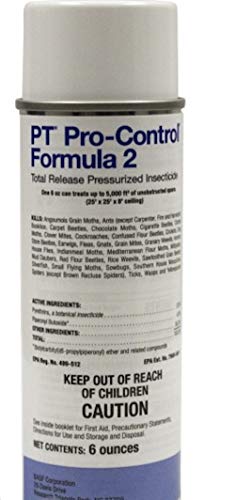
BASF PT Pro-Control Plus Fogger is a total-release space-treatment aerosol that lists wasps among its targets, making it more relevant to flying stinging pests than a fogger whose target list omits them. The 6-ounce can is intended for residential and commercial settings, including food-handling areas, restaurants and animal housing. The maker says it provides quick knockdown and specifies room-temperature use with shaking before application. Wasps are not bees, however, and this product is not a direct treatment for a bee tunnel or nest entrance; use only for pests and locations permitted by its label.
Bottom line: Consider this for labeled wasp space treatment, not a bee nest.
Revenge Spider & Ground Bee Killer Dust

Revenge Spider & Ground Bee Killer Dust differs from the aerosol and pump sprays by applying dust with a puffer, and its name specifically identifies ground bees. The 10-ounce ready-to-use container is intended for indoor and outdoor areas such as porches, decks, eaves and cracks; its target list also includes wasps, hornets and several crawling insects. The product is not a fogger, so it does not disperse treatment through a room. It is the closer match when the target is a ground bee and dust application suits the site; confirm that the insect is a ground bee before treatment.
Bottom line: Choose this for labeled ground bee areas where dust application is suitable.
Choose a bee treatment by nest location
Start with the nest site: a tunnel, a hole in the ground and a room require different application methods. Carpenter bees use wood galleries, while yellowjackets commonly use ground nests; neither is the same target as a room-flying insect. Direct aerosols or dust are designed for a particular site, whereas total-release foggers treat an enclosed air volume. For a product that states a room capacity, calculate room volume as length × width × ceiling height and do not exceed the label coverage. If the nest is inside a wall or roof void, avoid injecting an indoor fogger into the cavity; use only a product whose label covers that site and pest. Correct identification matters because confusing bees with wasps can lead to the wrong treatment.
Fogger, foam, spray and dust compared
A total-release fogger disperses aerosol into an enclosed space; foam, pump spray and puffer dust are applied to a target surface or opening. Fog does not guarantee that material reaches a hidden nest passage, and it is not a substitute for a treatment labeled for that nest. Compare the treatment form with the target rather than choosing solely by the word “fogger.”
This guide separates common formats by the job they fit.
| Format | Typical use | Decision rule |
|---|---|---|
| Total-release fogger | Enclosed room, listed pests | Use only when label covers pest and room volume |
| Expanding foam | Specific tunnel or ground opening | Choose when treatment must reach a named opening |
| Pump spray | Localized surface application | Use where directed spray is suitable |
| Puffer dust | Targeted dry application | Choose only for a labeled pest and site |
For a bee nest in a cavity or a large colony, do not assume a room fogger will control it; a licensed pest professional can identify the species and suitable treatment.
Use foggers safely indoors
Total-release foggers can expose people and animals to pesticide mist, so evacuate the treated area for the full label-specified time and ventilate as directed before returning. Remove or protect food, dishes, toys and exposed surfaces according to the product label, and extinguish pilot lights or other ignition sources when required; aerosol propellants can be flammable. Never use more cans than the label allows for a room, because exceeding its volume limit increases exposure and residue without ensuring nest control. Keep children and pets out during treatment and re-entry ventilation. Do not use a fogger in a small enclosed space such as a closet unless its directions explicitly permit that use.
Confirm the insect before treating
Carpenter bees, ground bees and yellowjackets are different insects, and “bee” alone is not enough to choose a treatment. Carpenter bees make round holes in wood; yellowjackets may enter a single ground opening and can defend the nest aggressively. Observe from a safe distance rather than blocking an entrance or approaching a busy nest. If you have a severe sting allergy, a nest near a doorway, or uncertainty about the species, do not attempt a close application; seek qualified pest-control help. Confirm the target species and permitted treatment site on the label before using any pesticide.
Frequently Asked Questions
Can a room fogger kill a bee nest?
A room fogger is intended for enclosed spaces and pests named on its label, not automatically for a hidden bee nest. Nest galleries and ground burrows may not receive an effective dose from airborne fog, so use a method labeled for the identified pest and site.
How much room can one fogger cover?
Coverage is product-specific and measured by room volume, not floor area alone. One fogger in this group is stated to cover up to 7,000 cubic feet; measure length × width × ceiling height and follow its label limit.
When are yellowjackets least active?
The guidance for the targeted foam product says early morning or late evening, when yellowjacket activity is low. Keep away from the nest opening and follow the product label’s protective and application directions.
Are ground bees and carpenter bees treated the same way?
No; ground bees nest in soil while carpenter bees bore into wood, so the treatment site and appropriate application method differ. Identify the insect before treating, and select only a product labeled for that pest and location.
How long should people stay out after fogging?
Re-entry timing depends on the fogger label, so use its evacuation and ventilation interval rather than a general estimate. Keep people and pets out until that interval is complete and the space has been ventilated as directed.