
Best Rebounder for Volleyball: 4 Nets Compared

7×4 FT Volleyball Rebounder, 5-Angle suits most volleyball players because its five rebound angles and adjustable net tension let you tailor returns for different drills. Choose 7×5 FT Volleyball Rebounder instead if you want a wider 7-by-5-foot surface; the other options measure 7 by 4 feet.
A volleyball rebounder is a framed net that returns the ball so you can practice without a partner. Set it on a stable surface with enough clear space for the ball to travel and for safe movement.
We earn a commission if you buy through links on this page. As an Amazon Associate I earn from qualifying purchases. Products are compared on manufacturer specifications, not hands-on testing.
- Best overall: 7×4 FT Volleyball Rebounder, 5-Angle – Five angle settings and 24 adjustable elastic cords allow changes to both return direction and tension.
- Best for wider coverage: 7×5 FT Volleyball Rebounder – Its 7-by-5-foot surface is one foot wider than the 7-by-4-foot alternatives.
- Best for weather-resistant netting: Apex Sports 7×4 FT Rebounder – The product features knotless, UV-resistant HDPE netting and a powder-coated steel frame.
| Product | Best for | Surface size | Angle adjustment | Distinctive feature | Shop |
|---|---|---|---|---|---|
| 7×4 FT Volleyball Rebounder, 5-Angle | Tunable returns | 7 × 4 ft | 5 angles | 24 adjustable cords | Check Price on Amazon |
| 7×5 FT Volleyball Rebounder | Wider practice area | 7 × 5 ft | Adjustable | Wider 5-ft surface | Check Price on Amazon |
| Apex Sports 7×4 FT Rebounder | UV-resistant netting | 7 × 4 ft | Adjustable | Knotless UV-resistant HDPE | Check Price on Amazon |
| 7×4 FT Multi-Sport Rebounder | Multi-sport practice | 7 × 4 ft | Adjustable targets | High-elasticity net | Check Price on Amazon |
Volleyball Rebounders Compared
Compare the practice surface and rebound controls to find a setup that fits your drills and available space.
7×4 FT Volleyball Rebounder, 5-Angle
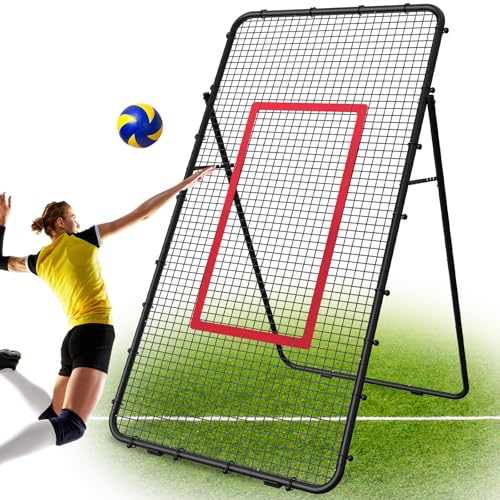
7×4 FT Volleyball Rebounder, 5-Angle stands out for combining five rebound angles with 24 independent elastic cords that adjust net tension. The 7-by-4-foot frame is designed for passing, setting and spiking practice, and the product features a powder-coated metal frame and HDPE netting. Its four ground stakes are intended to help secure it outdoors. This is a strong match for players who want to alter both return direction and firmness without changing equipment. The surface is narrower than 7×5 FT Volleyball Rebounder at 7 by 4 feet, so players who prioritize a larger target may prefer that wider option.
Bottom line: Pick this if you want to adjust both rebound angle and net tension.
7×5 FT Volleyball Rebounder

7×5 FT Volleyball Rebounder provides the widest practice surface at 7 by 5 feet, giving it an extra foot of width compared with the 7-by-4-foot choices. Its angle-adjustable frame is intended for practicing serves, passes and spikes, and the product is described as lightweight and strong. The larger target can suit players who want more room for varied returns.
Bottom line: Choose this when extra surface width matters more than specified tension controls.
Apex Sports 7×4 FT Rebounder

Apex Sports 7×4 FT Rebounder pairs a 7-by-4-foot surface with knotless, UV-resistant HDPE netting and a powder-coated steel frame. The adjustable angle is intended to let players vary the return for different volleyball practice scenarios. Its 28-square-foot surface matches the dimensions, making it a standard-sized choice among these options. This option suits buyers who value the net material and frame finish alongside angle changes.
Bottom line: Choose this for knotless UV-resistant netting and an adjustable steel-frame setup.
7×4 FT Multi-Sport Rebounder
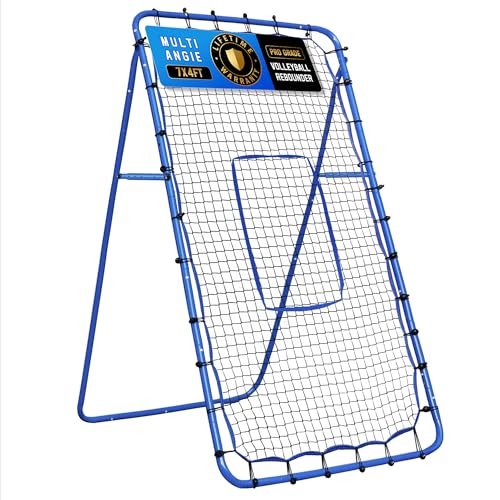
7×4 FT Multi-Sport Rebounder is the multi-sport option, with a 7-by-4-foot steel frame, high-elasticity net and adjustable targets. Its features include angle changes for volleyball practice as well as training applications for lacrosse, baseball and softball. That range may suit households or practice groups using one rebounder across several sports. The volleyball-specific controls are less defined than 7×4 FT Volleyball Rebounder, 5-Angle’s five angles and tension-adjustable cords, and the product text focuses heavily on other sports. Choose it when cross-sport flexibility matters more than detailed volleyball tuning.
Bottom line: Pick this when the rebounder will serve volleyball and other sports.
How to Choose a Volleyball Rebounder
Start with the control you need: angle adjustment changes where the ball returns, while net tension changes how firmly it rebounds. A 7-by-4-foot surface covers 28 square feet; a 7-by-5-foot surface covers 35 square feet, so the wider option gives more horizontal target area. If you need to alter rebound firmness as well as direction, choose a model with explicit tension adjustment. If your priority is a wider target, favor the 5-foot-wide surface. Compare the frame footprint with your available practice area, leaving space in front and to the sides for the ball and player movement. Volleyballs are typically about 8.2 inches in diameter, so a net’s frame dimensions alone do not determine how difficult a drill will feel.
Volleyball Rebounder Sizes and Fit
A 7-by-4-foot rebounder has a 28-square-foot face, while a 7-by-5-foot model has 35 square feet; that extra foot of width can help keep off-center returns on target. Measure the practice spot before choosing: include the frame’s base, not just the net face, and leave a clear approach and retrieval zone. For solo passing drills, position the frame so the return comes back into a safe playing area rather than toward windows, walkways or other people. Volleyballs used in regulation play are about 8.2 inches across and 9.2 to 9.9 ounces, but rebounders may also be used with lighter training balls. Pick a net angle and distance that make controlled contacts possible before moving to harder hits.
Adjustable Angles and Net Tension
Angle and tension solve different training problems: angle changes the return trajectory, while cord tension affects the firmness of the rebound. A shallow or steeper frame position can change whether a return rises for a set or comes back lower for passing practice. Make one adjustment at a time so you can identify what changes the ball path. A five-angle model gives named position-count specificity, while an option with unspecified positions still offers adjustable angle. For beginners, start with controlled passes and an easier return rather than full-power spikes. Move farther back or increase hit speed only when you can maintain control and keep the practice area clear.
Set Up a Rebounder Safely
Secure the frame on level ground and use any stakes before hitting hard; an unstable rebounder can shift or tip when a ball strikes the net. Keep children and bystanders outside the ball’s return path, and do not aim volleys toward people, glass or hard obstacles. Outdoors, stop practice if gusts move the frame or net, since a broad net can catch wind. Check the frame connections and elastic cords before each session, and replace damaged or stretched parts rather than relying on them under impact. Allow enough room to move and land without stepping onto the frame base, especially during approach and spiking drills.
Frequently Asked Questions
How much space do I need for a volleyball rebounder?
Plan for more than the net face: a 7-by-4-foot surface is 28 square feet, but the frame base and ball-return zone also need room. Leave a clear approach and retrieval area, and keep the return path away from people and breakable objects.
Can I practice volleyball alone with a rebounder?
Yes, a rebounder returns the ball for solo passing, setting or hitting drills. Start with controlled contacts and adjust the angle so returns stay within a clear practice area.
Does rebounder net tension change the ball return?
Yes, tension affects rebound firmness, while angle mainly changes the ball’s direction. Adjust one control at a time and begin with gentle contacts before using harder hits.
Is a wider volleyball rebounder easier to use?
A wider surface gives more horizontal target area, not necessarily an easier or more predictable return. For example, a 7-by-5-foot face is 35 square feet compared with 28 square feet for a 7-by-4-foot face.
Should I anchor a volleyball rebounder outdoors?
Yes, secure the frame on level ground and use its ground stakes when supplied, especially before hard hits. Stop if wind shifts the frame or net, and keep people clear of the ball path.