
Cat6 Cable Crimping Tools Compared by Connector Fit

For a Cat6 cable crimping tool, Cable Matters All-In-One Cat 8 Tool is the strongest fit if you use shielded pass-through connectors, because it supports Cat5 through Cat8 shielded connectors.
A crimping tool attaches modular plugs to prepared cable ends; connector and cable compatibility matters as much as the tool itself.
We earn a commission if you buy through links on this page. As an Amazon Associate I earn from qualifying purchases. Products are compared on manufacturer specifications, not hands-on testing.
- Best overall: Cable Matters All-In-One Cat 8 Tool – Supports shielded pass-through connectors across Cat5, Cat6, Cat6A, Cat7, and Cat8.
- Best for included connectors: Solsop Pass-Through RJ45 Kit – Includes 50 Cat6 pass-through connectors, 50 boots, and a tester.
- Best for a compact kit: RJ45 Pass-Through Crimper and Tester Kit – Combines a crimper, stripper, tester, and 20 pass-through connectors in a 5.3-inch tool.
| Product | Best for | Connector support | Tester included | Tool length | Shop |
|---|---|---|---|---|---|
| Cable Matters All-In-One Cat 8 Tool | Shielded plugs | Cat5–Cat8 shielded pass-through | No | 5.2 in | Check Price on Amazon |
| Solsop Pass-Through RJ45 Kit | Bulk connectors | Cat5–Cat7; shielded and unshielded | Yes; up to 300 m claimed | 11 in | Check Price on Amazon |
| RJ45 Pass-Through Crimper and Tester Kit | Compact kit | Cat5e–Cat6A; shielded included | Yes; 9V battery not included | 5.3 in | Check Price on Amazon |
| Mini Pass-Through RJ45 Crimper | Small tool size | Cat5–Cat6A; shielded and unshielded | No | 5.2 in | Check Price on Amazon |
Cat6 Cable Crimping Tools
Compare connector compatibility and kit contents before matching a crimper to your cable and plugs.
Cable Matters All-In-One Cat 8 Tool
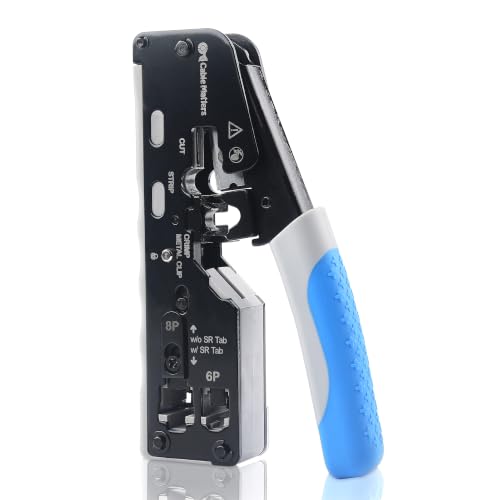
Cable Matters All-In-One Cat 8 Tool is the clearest match for shielded pass-through connectors, with compatibility spanning Cat5, Cat6, Cat6A, Cat7, and Cat8. The tool combines a cutter, stripper, and crimper, and also supports RJ11 and RJ12 connectors. It suits cable builders who already have compatible plugs and want one tool for several Ethernet categories. The tradeoff is that the package details do not identify a tester or included connectors, so it is a poor fit if you need those accessories in the same kit.
Bottom line: Choose this tool if your priority is crimping shielded pass-through plugs across multiple cable categories.
Solsop Pass-Through RJ45 Kit

Solsop Pass-Through RJ45 Kit stands out for its 50 Cat6 pass-through connectors and 50 connector boots, a larger included supply than the other kits. It supports shielded and unshielded modular plugs and includes a tester for RJ45, RJ11, and RJ12 cables; the maker says the tester’s range reaches 300 m. This kit suits projects with many cable ends to terminate. The 11-inch length makes it less compact than the 5.2-inch alternatives, so it may be awkward to carry for jobs where tool size matters.
Bottom line: Choose it when you want a substantial supply of Cat6 pass-through plugs and boots in the kit.
RJ45 Pass-Through Crimper and Tester Kit

RJ45 Pass-Through Crimper and Tester Kit pairs a 5.3-inch crimper with a wire stripper, a cable tester, 20 Cat6 pass-through connectors, and 20 connector covers. Its plug support includes Cat5e, Cat6, and Cat6A 8P8C connectors, including shielded types, with an exception for AMP connectors. The kit suits users who want to start with a smaller supply of plugs and check basic cable wiring. The tester needs a 9V battery that is not included, and the connector exception is important if your installation uses AMP plugs.
Bottom line: Pick this kit for a compact tool and starter quantity of Cat6 pass-through plugs.
Mini Pass-Through RJ45 Crimper

Mini Pass-Through RJ45 Crimper is a mini-format option at about 5.2 inches long, with support for Cat5, Cat5e, Cat6, and Cat6A RJ45 plugs, both pass-through and non-pass-through, shielded and unshielded. It also handles 6-position telephone connectors and combines stripping, crimping, and cutting. This is a useful fit if your work spans Ethernet and telephone terminations but you do not need a bundled tester or connectors. The limitation is the lack of those kit extras, so plan to supply compatible plugs and a way to check wiring separately.
Bottom line: Choose it for a compact all-in-one tool that also accommodates telephone connectors.
How to match Cat6 plugs to cable
Match the plug to the cable construction before choosing a crimper: solid-conductor cable and stranded patch cable can require different plug contacts. Check the plug’s conductor gauge range, insulation diameter, and whether it is shielded; Cat6 printed on both cable and plug alone does not establish a fit. Shielded cable needs compatible shielded plugs and a continuous bonding path through the installation. For a small job, make a sample termination and confirm the conductors seat fully and the plug locks before repeating the work. Keep pair twists close to the contact points; excessive untwisting can worsen crosstalk performance even when the color order is correct.
Pass-through and standard RJ45 plugs
Pass-through plugs let conductors extend through the front of the connector so excess wire can be trimmed during crimping; standard plugs require conductors to be cut to length before insertion. Use a tool whose blade and crimp mechanism are designed for the plug style, since a pass-through tool may not terminate a conventional plug properly. Wire the same T568A or T568B scheme at both ends for a straight-through cable; mixing schemes creates a crossover. The practical choice is simple: if your plugs have conductors protruding through the nose, choose a pass-through-compatible tool; otherwise, verify support for standard plugs. Follow the plug maker’s wiring layout when arranging the pairs.
What a cable tester can and cannot confirm
A basic cable tester can check continuity and wire-map faults such as opens, shorts, and crossed conductors, but it does not certify Cat6 bandwidth or signal performance. Cat6 is rated for 250 MHz, and a link can pass a simple wire map while still failing performance requirements because of poor terminations or installation conditions. A basic tester is useful after crimping each end: verify all eight conductors map in the intended order before installing the cable. For installations requiring standards compliance, a certification tester measures additional transmission properties; the included tester in a kit should not be treated as a substitute unless it explicitly performs that certification.
Cat6 cable length and routing limits
A typical Cat6 channel is limited to 100 m (328 ft), including up to 90 m (295 ft) of permanent cable and 10 m (33 ft) total patch cords. That length budget is separate from a crimp tool’s reach or a basic tester’s advertised range. Cat6 can support 10GBASE-T over shorter distances, commonly up to 55 m (180 ft) depending on crosstalk and installation conditions; do not assume a full 100 m 10-gigabit link. Avoid sharp bends, crushing staples, and tight cable bundles, which can harm performance. If a run approaches 100 m, keep patch-cord lengths in the calculation and consider a network switch or another designed link segment rather than extending it with couplers.
Frequently Asked Questions
Can any RJ45 crimper terminate Cat6 cable?
No; the crimper must match the RJ45 plug style and the plug must match the cable’s conductor type and size. Confirm support for pass-through versus standard plugs and shielded versus unshielded connectors before terminating.
What is the difference between Cat6 and Cat6A plugs?
Cat6A connectors are designed for Cat6A cable dimensions and performance, which may differ from Cat6 cable. Match the connector to the cable gauge and outer diameter, and use a tool that explicitly supports that connector style.
Does a basic cable tester certify Cat6 performance?
No; a basic wire-map tester checks conductor continuity and order, not Cat6 transmission performance at 250 MHz. Certification requires equipment that measures the required performance parameters.
How long can a Cat6 Ethernet cable run?
A standard Cat6 channel can be up to 100 m (328 ft), with up to 90 m (295 ft) of fixed cabling and 10 m (33 ft) total for patch cords. 10GBASE-T over Cat6 is typically limited to shorter runs, up to 55 m (180 ft) depending on installation conditions.
Should both ends use T568A or T568B wiring?
For a straight-through cable, use the same scheme at both ends: T568A-to-T568A or T568B-to-T568B. Mixing A and B makes a crossover cable, so confirm the intended wiring before crimping.