
Air Compressor Regulator Replacement: 3 Options Compared

For a general air compressor regulator replacement, Primefit CR1401G Air Regulator is the clearest match because it regulates downstream pressure up to 150 PSI and specifies 1/4-inch NPT ports.
We earn a commission if you buy through links on this page. As an Amazon Associate I earn from qualifying purchases. Products are compared on manufacturer specifications, not hands-on testing.
- Best overall: Primefit CR1401G Air Regulator – Provides 1/4-inch NPT ports, up to 150 PSI output and a 60 SCFM flow at 100 PSI.
- Best for dual gauges: Dreyoo 4-Port Regulator with Two Gauges – Includes two gauges and 1/4-inch NPT inlet/outlet ports, plus a 1/8-inch NPT gauge port.
| Product | Best for | Port or fit | Max output pressure | Shop |
|---|---|---|---|---|
| Primefit CR1401G Air Regulator | General replacement | 1/4-inch NPT | 150 PSI | Check Price on Amazon |
| Dreyoo 4-Port Regulator with Two Gauges | Dual gauge setup | 1/4-inch NPT; 1/8-inch gauge ports | 150 PSI adjustable | Check Price on Amazon |
| Qolekog 1/4-Inch NPT Regulator | Spray gun adjustment | 1/4-inch FNPT | 150 PSI operating pressure | Check Price on Amazon |
Air compressor regulator replacements
Match the replacement to your compressor’s connection type and required downstream pressure before choosing a configuration.
Primefit CR1401G Air Regulator
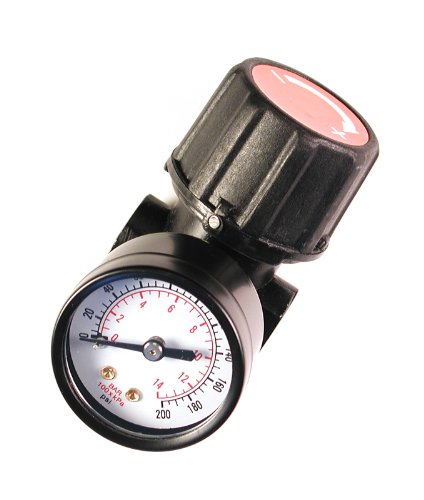
For a general-purpose replacement, this regulator gives the clearest combination of connection, pressure and flow specifications. Its 1/4-inch NPT ports support common threaded pneumatic setups, while the maker gives a 200 PSI maximum inlet and 150 PSI maximum output. The steel-protected gauge and composite knob are useful for routine shop adjustment.
The maker specifies 60 SCFM at 100 PSI. Confirm flow needs and thread compatibility before replacing a regulator; the unit also has a directional flow path, which must match the installation orientation.
Bottom line: Choose this for a general replacement when your system uses 1/4-inch NPT and the flow direction can be matched.
Dreyoo 4-Port Regulator with Two Gauges

Unlike the single-gauge alternatives, this assembly includes two gauges, both showing the same regulated output pressure. Its four-port layout uses 1/4-inch NPT inlet and outlet ports with 1/8-inch NPT gauge ports, so it suits a replacement where those connection sizes are already present.
The maker identifies Craftsman, DeWalt and DeVilbiss compressor compatibility and gives a 0–150 PSI adjustable range. The extra gauge ports do not provide separate pressure readings; choose another configuration if you need gauges to monitor different points in the system.
Bottom line: Pick this when the named compressor compatibility and two same-reading gauges fit your replacement setup.
Qolekog 1/4-Inch NPT Regulator

For spray-gun adjustment, this regulator is specifically described for air compressor replacement and air pressure adjustment at the gun. It uses 1/4-inch FNPT threads and has an operating range of 0–150 PSI, with a maker-specified flow of 60 SCFM at 100 PSI.
Its appeal is a straightforward threaded regulator rather than the dual-gauge arrangement of Dreyoo 4-Port Regulator with Two Gauges.
Bottom line: Choose this for a 1/4-inch FNPT replacement or spray-gun pressure adjustment.
How to choose an air compressor regulator replacement
Match the port thread, pressure requirement and flow capacity before comparing convenience features. NPT is a tapered pipe thread; BSP is a different thread system, and a G1/4 BSP connection should not be treated as interchangeable with 1/4-inch NPT. A mismatch can prevent a proper seal or damage threads.
Use the compressor outlet or removed regulator as the reference, and check whether the replacement’s inlet and outlet are the same size. If the tool requires more than 60 SCFM at 100 PSI, neither regulator with that stated flow rating is an established match. Keep regulator output within the tool’s rated pressure, not just the compressor’s maximum pressure.
Pressure range and flow capacity
A regulator reduces supply pressure to a controlled downstream setting; it does not raise pressure above what the compressor supplies. The compared 1/4-inch NPT models give a maximum or operating output of 150 PSI, while one also specifies a maximum inlet of 200 PSI. These limits describe different sides of the regulator and should not be confused.
Flow capacity matters when a tool consumes air continuously: a regulator’s pressure may sag if the tool demand exceeds available flow. For a regulator rated at 60 SCFM at 100 PSI, check the tool’s air consumption at its working pressure rather than relying only on the regulator’s maximum PSI. Leave headroom for hose and fitting losses in demanding setups.
Regulator types and replacement fit
General-purpose inline regulators use pipe-thread connections, while model-specific replacements are keyed to a compressor part number. A part-number match can be more useful than a broad brand claim, but port count and thread size still need to match the removed component. Gauge ports are separate from air inlet and outlet ports.
The table separates general adjustment needs from a named replacement fit. Use it as a screening guide, then confirm the old part’s thread and layout.
| Need | Match to look for | Example fit |
|---|---|---|
| General pressure control | 1/4-inch NPT connections | Inline regulator |
| Two same-output readings | Separate gauge ports | Dual-gauge assembly |
| Known compressor part | Matching part number and ports | AB-9051116 replacement |
Installation checks and safe use
Install a regulator with the airflow direction aligned to its inlet and outlet; a reversed directional regulator may not control pressure correctly. The Primefit unit can be configured for right-to-left or left-to-right flow, but the setup must match the intended direction. Depressurize and disconnect the compressor before removing a pressurized fitting.
After fitting a replacement, set pressure with the downstream tool disconnected or in the condition specified by the tool maker, then confirm the reading under operating demand. Never exceed the lowest pressure rating among the compressor, hose, fittings and tool. Use the compressor manual and component markings for the correct thread seal and assembly method.
Frequently Asked Questions
Can I use a BSP regulator on an NPT compressor?
No, G1/4 BSP and 1/4-inch NPT are different thread standards and should not be assumed to seal together. Match the compressor port standard or use a properly specified adapter.
What does a 150 PSI regulator output limit mean?
The regulator can control downstream pressure only up to its maximum output, not above it. Set pressure to the pneumatic tool’s rating, even if the compressor supply is higher.
Why does a regulator need an airflow direction?
A directional regulator has an inlet-to-outlet path that must face the correct way for control. Confirm the flow arrow or port orientation and allow for either right-to-left or left-to-right installation only when the model supports it.
How do I know whether 60 SCFM is enough?
Compare the regulator’s 60 SCFM at 100 PSI rating with the tool’s air consumption at its operating pressure. Continuous-use tools need adequate compressor and regulator flow, with allowance for pressure drop through hoses and fittings.
Do two gauges show two different pressures?
On the dual-gauge assembly described here, both gauges display the same regulated output pressure. Separate gauges do not imply separate pressure zones unless the plumbing provides them.