
Alien Draft Seal: 3 Length Options Compared

Choose an Alien Draft Seal option by measuring the combined length of the gaps you want to cover: the three choices provide 16, 49, or 98 feet of tape. The wider 49- and 98-foot options are 1.4 inches across, while the 16-foot choice is 1.3 inches wide. Alien Draft Seal 16-Foot Set, Alien Draft Seal 49-Foot Set, and Alien Draft Seal 98-Foot Set are the same general peel-and-stick flexible seal in different quantities, so choose another type of weatherstripping if the gap is too large for a thin adhesive flap to bridge.
We earn a commission if you buy through links on this page. As an Amazon Associate I earn from qualifying purchases. Products are compared on manufacturer specifications, not hands-on testing.
- For 49 feet: Alien Draft Seal 49-Foot Set – Three 1.4-inch-wide rolls provide a midrange total length for several seams.
- For 16 feet: Alien Draft Seal 16-Foot Set – Three 1.3-inch-wide rolls suit a smaller area or limited number of gaps.
- For 98 feet: Alien Draft Seal 98-Foot Set – Six 1.4-inch-wide rolls provide the most combined tape length.
| Product | Best for | Width | Combined length | Rolls | Shop |
|---|---|---|---|---|---|
| Alien Draft Seal 49-Foot Set | Medium coverage | 1.4 in | 49 ft | 3 | Check Price on Amazon |
| Alien Draft Seal 16-Foot Set | Small coverage | 1.3 in | 16 ft | 3 | Check Price on Amazon |
| Alien Draft Seal 98-Foot Set | Large coverage | 1.4 in | 98 ft | 6 | Check Price on Amazon |
Alien Draft Seal Options
Compare the width and total tape length against the seams you plan to cover.
Alien Draft Seal 49-Foot Set
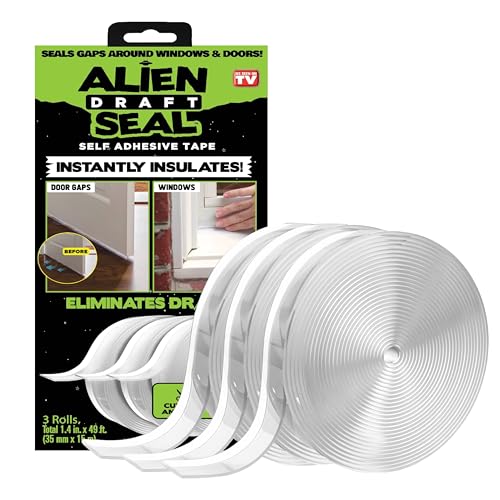
For a middle-sized project, this set combines three rolls into 49 feet of transparent, 1.4-inch-wide flexible tape. The maker says the adhesive-backed flap is intended to seal gaps around doors and windows and to help block cold air; the tape can be measured and cut to length. Its total coverage is more than the 16-foot option but less than the 98-foot set, which makes estimating the perimeter important before choosing. A thin flap is not a substitute for repairing a damaged frame or filling a gap too wide for the strip to bridge.
Bottom line: Choose this set when your measured seams need around 49 feet of 1.4-inch tape.
Alien Draft Seal 16-Foot Set

For a smaller repair, this set supplies three rolls totaling 16 feet, and each roll is 1.3 inches wide. The maker describes it as transparent, flexible adhesive tape for door and window gaps, with pieces cut to the needed length. Its shorter total coverage can suit a few limited seams without leaving as much unused tape as the larger bundles. The width is also slightly narrower than the other two options, so measure the surface you intend to cover and make sure the flap can span the gap without obstructing the door or window’s movement.
Bottom line: Choose this set for a short run of gaps where 1.3 inches of tape is sufficient.
Alien Draft Seal 98-Foot Set

For multiple rooms or longer runs, this set has six rolls with 98 feet of combined tape, each 1.4 inches wide. The maker says the transparent silicone seal is flexible and intended for gaps around doors and windows; the adhesive-backed material can be cut to fit. It offers twice the total length of the 49-foot set at the same width, making it the largest coverage option here. Buyers working on just one short seam may have substantial tape left over, and the strip still needs a clean, compatible surface to adhere well.
Bottom line: Choose this set when your measured project needs close to 98 feet of 1.4-inch tape.
How to choose an Alien Draft Seal length
Measure the total length of every gap before choosing a roll set. Measure each side of a window or door separately, add the lengths, and include a little extra for corners, trimming, and mistakes; a 10% allowance is a practical planning margin rather than a product specification. A typical single entry door is about 36 inches wide and 80 inches tall, so sealing its two sides and top takes about 13 feet before any bottom gap is included. Match that sum to the 16-, 49-, or 98-foot option, not to the roll count alone. The amount of tape needed depends on which edges actually have a gap.
Where adhesive flap weatherstripping fits
Adhesive flap weatherstripping is intended for narrow, relatively even gaps along a door or window edge; it is not a rigid threshold or a filler for a large opening. First close the door or window and inspect the gap around its perimeter, because frame alignment and uneven surfaces can leave different clearances at the top and bottom. A useful decision rule is to choose this style only when the flap can reach the opposing surface without preventing the door or window from closing. For a large or irregular opening, repair the frame or use a weatherstrip profile designed for that clearance rather than stacking layers of thin tape.
Preparing surfaces for draft-seal tape
Adhesive weatherstripping holds best on a clean, dry, smooth surface; dust, oil, loose paint, and moisture can weaken contact. Clean the intended strip path, let it dry fully, then measure and cut sections before removing the backing so alignment is easier. Apply even pressure along the full length, especially at the ends and corners, where lifting can start. Avoid stretching a flexible strip during installation because tension can pull it back or open a seam later. Keep the adhesive off moving hardware and confirm that the sash or door closes freely before finishing the whole perimeter.
Common weatherstripping fit mistakes
Covering the wrong edge is a common mistake: a door may have a gap at its sides and top but need a threshold solution at the floor. Check the complete perimeter with the door or window closed, and note where daylight or a draft is actually present before measuring. Another mistake is applying tape over loose or deteriorated paint; the adhesive can only hold as securely as the surface underneath. Do not use a thin flap to conceal damaged wood, a warped frame, or a gap broad enough that the strip cannot bridge it. After installation, reopen and close the unit to check for rubbing, binding, or a seal that has peeled away.
Frequently Asked Questions
How much Alien Draft Seal tape does one door need?
A typical 36-by-80-inch entry door has about 13 feet along its two sides and top, before including the bottom. Measure only the edges with gaps, since not every door needs tape on all four sides.
Can adhesive draft-seal tape go on a wet frame?
No; the surface should be clean and dry when applying adhesive tape. Let a damp frame dry completely, since moisture can interfere with adhesion.
Should weatherstripping cover the bottom of a door?
Only if the strip is intended for that edge and does not interfere with the floor or threshold. A bottom sweep or threshold seal is often a better fit for a floor-level gap than a thin side flap.
How do I keep a door from sticking after weatherstripping?
Choose a strip that bridges the gap without being compressed so much that it blocks closure. Test the door after applying a short section, then check that it latches and moves freely before covering the full edge.
Can I apply draft seal tape over peeling paint?
No; loose paint can detach along with the adhesive. Remove unstable paint and prepare a sound, clean, dry surface before applying the tape.