
Aluminum Sulphate for Plants: 5 Soil Conditioners Compared

For general acid-loving shrubs, Aluminum Sulfate, 5 lb is a straightforward pick because it is a 5-pound fertilizer-grade aluminum sulfate product labeled for several common garden plants. Choose another option if you need a larger package or want a product whose label specifically cautions against use on pink or white hydrangeas.
Aluminum sulfate is a soil acidifier: it can lower soil pH, but the amount needed depends on the soil and should be guided by a soil test.
We earn a commission if you buy through links on this page. As an Amazon Associate I earn from qualifying purchases. Products are compared on manufacturer specifications, not hands-on testing.
- Best overall: Aluminum Sulfate, 5 lb – A 5-pound package is labeled for hydrangeas and a broad range of acid-loving shrubs.
- Best for larger gardens: Hi-Yield Aluminum Sulfate, 10 lb – The 10-pound package suits gardeners treating a larger area, with application rates directed to its label.
- Best for a smaller package: Fertilome 32175 Aluminum Sulfate, 4 lb – The 4-pound conditioner is labeled for acid-soil plants including azaleas, gardenias, and blueberries.
| Product | Best for | Package size | Intended plants | Application notes | Shop |
|---|---|---|---|---|---|
| Aluminum Sulfate, 5 lb | General garden use | 5 lb | Acid-loving shrubs | Broadcast; rinse foliage | Check Price on Amazon |
| Southern Ag Aluminum Sulfate, 5 lb | Shrub beds | 5 lb | Acid-loving shrubs | Broadcast; rinse foliage | Check Price on Amazon |
| Hi-Yield Aluminum Sulfate, 10 lb | Larger garden areas | 10 lb | Acid-loving plants; hydrangeas | Follow label rates | Check Price on Amazon |
| Hoffman Blue Magic Aluminum Sulfate | Hydrangea color | — | Hydrangeas; acid-loving plants | — | Check Price on Amazon |
| Fertilome 32175 Aluminum Sulfate, 4 lb | Smaller package | 4 lb | Acid-loving plants; hydrangeas | — | Check Price on Amazon |
Aluminum sulphate for plants
Compare package sizes and plant guidance, then choose based on your soil test and the label’s application directions.
Aluminum Sulfate, 5 lb

For a broad range of acid-loving shrubs, this 5-pound fertilizer-grade aluminum sulfate is labeled for hydrangeas, rhododendrons, blueberries, dogwoods, holly, gardenias, camellias, and azaleas. The maker says it lowers soil pH and corrects high alkalinity; the product contains 9% metallic aluminum. Its directions call for even broadcasting, keeping granules off foliage, and watering afterward. This fits a gardener who wants one package for several shrub types. The main limitation is that it is not for spray application, so it is not the choice for someone seeking a foliar treatment.
Bottom line: Choose this for a 5-pound dry soil treatment across several acid-loving shrubs.
Southern Ag Aluminum Sulfate, 5 lb

Southern Ag’s 5-pound package has the same plant coverage and application approach as another 5-pound option here: hydrangeas, blueberries, azaleas, rhododendrons, and other shrubs, with granules broadcast evenly and watered in. The maker says it lowers soil pH and corrects high alkalinity; its fertilizer-grade material contains 9% metallic aluminum. That makes it a fit for gardeners comparing package size and labeled uses rather than seeking a different formulation. The limitation is important for anyone planning to spray: this product is specifically not for spray application, and foliage should be washed off after broadcasting.
Bottom line: Choose this when its five-pound size and shrub-use label match your bed.
Hi-Yield Aluminum Sulfate, 10 lb

The 10-pound Hi-Yield package is the largest size among these choices, which may suit a larger planting area or repeated label-directed treatments. The maker says it creates acidic soil conditions for azaleas, gardenias, camellias, rhododendrons, and other acid-loving plants, and notes its use for maintaining blue hydrangea color. Its label says application rates vary by application type and dimensions, so a gardener should use those directions rather than assume one rate fits every bed. The maker cautions against use on white or pink hydrangeas unless blue color is desired. This is less convenient if only a small amount is needed.
Bottom line: Choose this for a larger area when its hydrangea color guidance fits your plants.
Hoffman Blue Magic Aluminum Sulfate
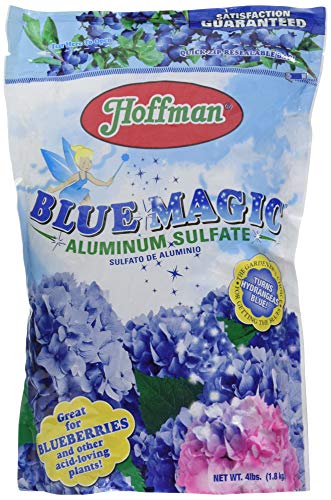
Hoffman Blue Magic is positioned specifically around blue hydrangea flowers, while also naming a wide set of acid-loving plants including azaleas, rhododendrons, holly, camellias, gardenias, magnolias, and blueberries. The maker calls it an acidifying soil conditioner and says it keeps hydrangea flowers blue. That focus may appeal to gardeners whose main goal is hydrangea color rather than selecting by package weight. Hydrangea color also depends on cultivar and soil conditions, so this product alone cannot guarantee blue blooms. Confirm the package size and application directions before buying, then use a soil test to guide acidification.
Bottom line: Choose this if blue hydrangea color is your main stated goal.
Fertilome 32175 Aluminum Sulfate, 4 lb

Fertilome offers a 4-pound package, smaller than the 5- and 10-pound choices here. The maker says the conditioner helps create acidic soil conditions and intensifies blue hydrangea color; named plants include azaleas, gardenias, camellias, rhododendrons, and blueberries. That makes the package size useful for a more limited planting area, provided the amount matches the label’s directions. A limitation for buyers is that the plant-use claims do not give an application method here, so confirm the package label’s directions before applying it.
Bottom line: Choose this if a four-pound package matches the area you plan to treat.
How to choose aluminum sulphate for plants
A soil test should decide whether aluminum sulfate belongs in a garden bed, because it lowers soil pH and excess acidification can damage roots. Many acid-loving plants grow well around pH 5.0 to 6.0, while blueberries commonly prefer about pH 4.5 to 5.5. Soil texture changes how much amendment is needed: clay and organic-rich soils generally resist pH change more than sandy soils. Use the test recommendation for the specific bed rather than applying one rate everywhere. If the pH is already in the plant’s suitable range, skip the amendment.
| Garden goal | Decision rule |
|---|---|
| Acid-loving shrubs | Match labeled plant uses and soil-test need |
| Blue hydrangeas | Check cultivar and soil conditions |
| Large area | Match package weight to label rate |
Hydrangea color is not determined by soil pH alone: cultivar and available aluminum also matter. White hydrangeas do not turn blue, and some pink cultivars may not shift as expected, so color goals should not replace a soil test.
Applying aluminum sulfate safely
Granular aluminum sulfate is generally applied to soil, not sprayed onto leaves; one of the 5-pound products here explicitly says it is not for spray application. Broadcast evenly only at the label rate, keep granules off foliage, and water afterward. Rinse granules from leaves if they land there, since concentrated salts can injure foliage. Wear gloves and eye protection when handling garden amendments, and keep products away from children and pets. Never mix an application rate from one package with another product’s directions.
Aluminum sulfate changes soil chemistry, so repeated applications without testing can push pH too low and increase aluminum availability. For a bed with pH already below the target range, do not add more acidifier. Recheck soil after the amendment has had time to react rather than making a second application immediately.
Choosing a package size and plant fit
Package weight is a useful buying distinction only after the treatment area and label rate are known: these options include 4-, 5-, and 10-pound containers, while one option’s package weight is not clear from the specifications. A 10-pound container is more material than a 4-pound container, but it does not establish how much ground either will cover. Coverage depends on the application rate and bed dimensions, so measure the area and use the product’s own directions.
Plant coverage also differs: some choices name broad groups such as azaleas, camellias, rhododendrons, and blueberries, while another emphasizes blue hydrangeas. Before ordering, confirm the package size and application directions when either is not clear on the container. Choose by the plants named for the product and the soil-test recommendation, not by hydrangea color claims alone.
Hydrangea color and soil acidity
Blue hydrangea flowers generally require a suitable cultivar, acidic soil, and available aluminum; a common soil pH range associated with blue blooms is about 5.2 to 5.5. Pink flowers are associated with less acidic conditions, but cultivar differences can limit color changes. White hydrangeas generally remain white rather than turning blue, so an acidifier is not a color treatment for every variety.
For a blue-flower goal, first confirm the cultivar can change color and test soil pH; if the reading is already near 5.2 to 5.5, further acidification may be unnecessary or harmful. The product guidance varies: some products say they intensify blue color, while one cautions against use on pink or white hydrangeas unless blue is desired. Follow the chosen product’s label rate and avoid assuming that more product means bluer flowers.
Frequently Asked Questions
How quickly does aluminum sulfate lower soil pH?
Aluminum sulfate can act faster than elemental sulfur because it dissolves and reacts in moist soil, but the pH change depends on soil texture and buffering. Retest after the product has been watered in and had time to react rather than repeating an application immediately.
Can aluminum sulfate make every hydrangea blue?
No; flower color depends on cultivar as well as soil conditions. Blue color is generally associated with acidic soil around pH 5.2 to 5.5 and available aluminum, while white cultivars do not turn blue.
Should aluminum sulfate be applied to dry leaves?
Keep granules off foliage and water after broadcasting, as the applicable product directions specify. Avoid spraying a granular soil product, and rinse any granules from leaves to reduce the chance of foliage injury.
Can aluminum sulfate harm plants if overapplied?
Yes; excessive acidification can stress roots, and very low pH can make aluminum more available at levels harmful to plants. Use a soil test to guide the amount and retest before adding more.