
Antenna for Baofeng UV-5R: 4 Whips Compared

For most UV-5R owners, Baofeng 18.8-Inch Foldable Antenna is the clearest fit because it names the UV-5R and combines 144/430 MHz operation with a foldable 18.8-inch whip. Choose a shorter option if antenna length matters more, or a flexible design if you expect the whip to bend during outdoor use.
These are replacement handheld-radio antennas; confirm that your radio uses the SMA-Female antenna connection before ordering.
We earn a commission if you buy through links on this page. As an Amazon Associate I earn from qualifying purchases. Products are compared on manufacturer specifications, not hands-on testing.
- Best overall: Baofeng 18.8-Inch Foldable Antenna – It explicitly fits the UV-5R and offers dual-band operation in a foldable 18.8-inch design.
- Best for a lighter setup: Baofeng 15.3-Inch Flexible Antenna – Its maker describes a lightweight 15.3-inch flexible whip.
- Best for a spring base: Baofeng 18.5-Inch Spring-Base Antenna – It pairs an 18.5-inch whip with a spring-loaded base.
| Product | Best for | Length | Design | Shop |
|---|---|---|---|---|
| Baofeng 18.8-Inch Foldable Antenna | Foldable dual-band whip | 18.8 in | Foldable | Check Price on Amazon |
| Baofeng 18.5-Inch Spring-Base Antenna | Spring-base flexibility | 18.5 in | Flexible, spring-loaded base | Check Price on Amazon |
| LUITON 15.6-Inch Whip Antenna | Shorter listed length | 15.6 in | Flexible whip | Check Price on Amazon |
| Baofeng 15.3-Inch Flexible Antenna | Lightweight flexible whip | 15.3 in | Flexible whip | Check Price on Amazon |
Antennas for the Baofeng UV-5R
Compare connector fit, whip length and design before choosing a replacement antenna.
Baofeng 18.8-Inch Foldable Antenna

The foldable design is the distinguishing feature of this 18.8-inch antenna, which names the UV-5R among its compatible radios. Its maker specifies 144/430 MHz operation, an SMA-Female connector and 2.15 dBi gain. The foldable format suits owners who want a long whip that can be bent for storage or movement. Its length may be inconvenient in confined spaces, and the compatibility list cannot replace checking the connector on your particular radio.
Bottom line: Pick this if you want a foldable, explicitly UV-5R-compatible dual-band whip.
Baofeng 18.5-Inch Spring-Base Antenna

The spring-loaded base distinguishes this 18.5-inch antenna from the foldable and shorter alternatives. Its maker gives a 2.15 dBi gain figure and identifies VHF 144 MHz and UHF 430 MHz operation, with UV-5R compatibility and an SMA-Female connector. The flexible whip and spring base may suit outdoor use where the antenna can be bumped or bent. At nearly 19 inches, it can be awkward in a vehicle cabin or under low obstructions.
Bottom line: Choose it if a spring-loaded base matters more than compactness.
LUITON 15.6-Inch Whip Antenna
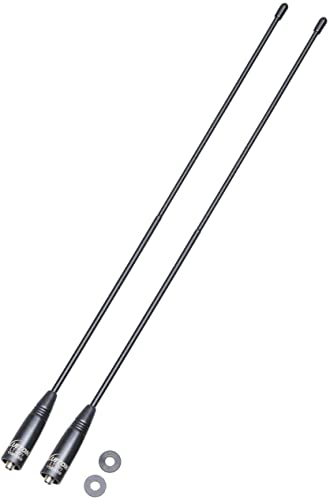
The 15.6-inch length makes this a shorter listed whip than the 18.5- and 18.8-inch choices. Its maker names the UV-5R and several other Baofeng radios as compatible, and identifies 144/430 MHz operation and an SMA-Female connector. The maker also describes a rugged, flexible design, making it a fit for buyers seeking a less lengthy antenna. Connector gender still needs to match the radio; SMA connectors can look similar while differing in pin configuration.
Bottom line: Choose it if you prefer a shorter listed whip and your connector matches.
Baofeng 15.3-Inch Flexible Antenna

The maker emphasizes a lightweight flexible build on this 15.3-inch antenna, shorter than the other choices. The compatibility list includes the UV-5R and UV-5R Mini, and the antenna is identified as dual-band 144/430 MHz with an SMA-Female connector. A flexible whip can suit an outdoor handheld setup where the tip may encounter impacts. The features do not give a gain figure, so buyers comparing gain values should focus on products that supply one rather than assume performance from length alone.
Bottom line: Pick it for a short, lightweight flexible option, after checking the connector.
How to choose a UV-5R antenna
Start with the connector, then choose length and handling style. The products here identify SMA-Female connections; SMA and reverse-polarity SMA can appear similar, so verify the radio’s connector pin arrangement before buying. For frequency coverage, the dual-band antennas specify 144/430 MHz, corresponding to VHF and UHF amateur-radio bands. A whip’s length alone does not establish range: antenna design, surroundings, radio power, and obstacles all affect communication. Choose a shorter whip when carrying space is tight; choose a flexible or foldable design if the antenna may be knocked or need to bend. For a radio used on licensed amateur frequencies, transmit only within the privileges of your license.
| Need | Choose by |
|---|---|
| Less length | 15.3- or 15.6-inch option |
| Flexible handling | Flexible or spring-base design |
| Fold-away storage | Foldable design |
What antenna length means
Length is a practical size comparison, not a guaranteed range ranking. A free-space quarter wavelength is about 19.5 inches at 144 MHz and about 6.5 inches at 430 MHz, so a dual-band handheld antenna generally uses design features to serve both bands in one physical whip. These products span 15.3 to 18.8 inches, but the longest one is not automatically the best choice for every location. With less than 20 inches of overhead clearance, a long whip may strike a ceiling, branches, or a vehicle interior; choose a shorter or bendable option if that interference is likely. Keep a handheld antenna upright when practical, since changing its orientation and nearby structures can affect the signal.
Connector fit and compatibility
Connector fit is the first compatibility check because an antenna designed for the wrong SMA variant will not attach correctly. These products identify SMA-Female connectors and name the UV-5R among compatible radios, but radio variants and accessories can differ. Inspect the radio’s connector rather than relying only on a broad compatibility list, especially if it has been modified or uses an adapter. A snug mechanical fit matters; do not force a connector that resists threading, as cross-threading can damage the radio. Also distinguish connector fit from frequency fit: the connector lets the parts mate, while the 144/430 MHz range identifies the intended operating bands.
Using and caring for a handheld whip
Keep the antenna clear of avoidable obstructions and hold it upright when transmitting where practical; a body, metal structure, or vehicle can alter the radio path. Do not transmit with a damaged or loose antenna connection, and use the radio within its maker’s operating instructions and applicable radio-license privileges. Flexible and foldable construction can accommodate bending, but it does not make a whip indestructible: avoid sharp kinks and check the base and connector after impacts. If storing a long antenna, fold or position it without forcing the base. A compact option is often easier around low ceilings or vehicle interiors, while a longer whip needs more clearance.
Frequently Asked Questions
Will any SMA-Female antenna fit a UV-5R?
Not necessarily; the radio and antenna connector pin arrangements must match. Check the radio’s connector variant before ordering, since visually similar SMA types may not mate correctly.
Does a longer UV-5R antenna always reach farther?
No; length alone does not determine communication distance. Terrain, buildings, antenna orientation, radio power, and the antenna’s design also affect the signal.
Why do handheld antennas cover two bands at different lengths?
A quarter wavelength is roughly 19.5 inches at 144 MHz and 6.5 inches at 430 MHz. Dual-band handheld antennas use a design that supports both bands without requiring two separate whips.
How much clearance does an 18-inch antenna need?
Plan for about 19 inches of vertical space for an 18.5- to 18.8-inch whip, plus room for the radio and movement. If the antenna will hit a ceiling or vehicle interior, consider a shorter or flexible option.
Can I transmit on any frequency with this antenna?
No; an antenna’s frequency range does not grant permission to transmit. Use only frequencies and operating privileges authorized by your radio license and applicable rules.