
Backpack With Chest Rig: 3 Modular Options Compared

For a backpack with chest rig, Lancer Tactical 1000D Nylon QD Chest Rig Combo is the clearest match because its front buckles let you switch between backpack and chest rig wear. Choose CLTAC 2-in-1 Chest Pack and Hydration Backpack or Blue Quartz 3-in-1 Hydration Backpack instead if you want a modular hydration setup with a larger or detachable front storage arrangement.
We earn a commission if you buy through links on this page. As an Amazon Associate I earn from qualifying purchases. Products are compared on manufacturer specifications, not hands-on testing.
- Best overall: Lancer Tactical 1000D Nylon QD Chest Rig Combo – Front attachment buckles support backpack or chest rig wear, and the pack measures 11 by 17 by 4 inches.
- Best for hydration capacity: CLTAC 2-in-1 Chest Pack and Hydration Backpack – The modular chest pack and backpack come with a 2.5-liter bladder.
- Best for removable waist storage: Blue Quartz 3-in-1 Hydration Backpack – Its 3-in-1 setup includes a detachable waist pack and a 2-liter bladder.
| Product | Best for | Configuration | Hydration capacity | Dimensions | Shop |
|---|---|---|---|---|---|
| Lancer Tactical 1000D Nylon QD Chest Rig Combo | Gear-focused carry | Backpack and chest rig | 1-liter bladder compatible | 11 × 17 × 4 in. | Check Price on Amazon |
| CLTAC 2-in-1 Chest Pack and Hydration Backpack | Larger water supply | Separate chest pack and backpack | 2.5-liter bladder included | 17 × 10 × 10 in. | Check Price on Amazon |
| Blue Quartz 3-in-1 Hydration Backpack | Removable waist pack | Backpack, chest pack, waist pack | 2-liter bladder included | — | Check Price on Amazon |
Backpacks With Chest Rigs
Compare how each modular setup carries gear and handles hydration before choosing a configuration.
Lancer Tactical 1000D Nylon QD Chest Rig Combo

Unlike the hydration-focused options, this combo emphasizes gear carry and a quick change between backpack and chest rig wear. Front attachment buckles provide the conversion, while four rows of MOLLE, two surface pockets and a hook-and-loop panel give you places for accessories and patches. The 11-by-17-by-4-inch dimensions make its shape easier to compare with your available storage space. It accommodates a 1-liter hydration bladder, but the product is described as compatible rather than including one, so it suits buyers who already have a bladder or do not need one.
Bottom line: Choose this setup if switching between backpack and chest rig wear matters more than having a larger bladder included.
CLTAC 2-in-1 Chest Pack and Hydration Backpack

Among these options, this one pairs a separate MOLLE chest pack with a dedicated hydration backpack and includes the largest bladder. The two units can be worn separately or connected with quick-release buckles, and the pack has an insulated bladder sleeve. Its one-size format measures 17 by 10 by 10 inches and weighs 1.5 pounds. The 2.5-liter capacity is useful when you want more water than the 2-liter setup offers, but buyers who do not need hydration may prefer a gear-focused rig without a bladder.
Bottom line: Pick this if you want a convertible chest pack and hydration backpack system with a 2.5-liter bladder.
Blue Quartz 3-in-1 Hydration Backpack
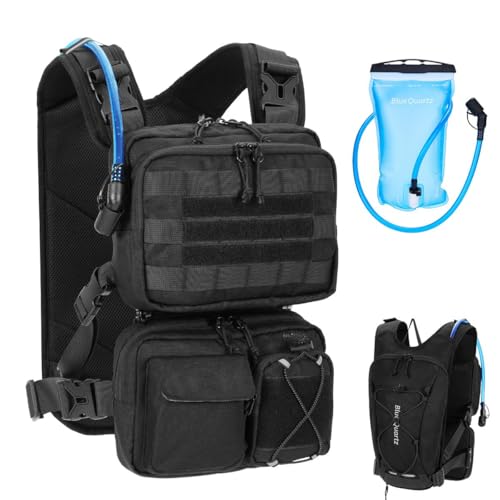
This is the only option here that adds a detachable waist pack to its backpack and chest pack arrangement. The lower pouch zips off for standalone waist-bag use, while upper chest storage keeps small items close at hand. A dedicated rear compartment holds the included 2-liter bladder for hands-free drinking. It suits buyers who value the extra waist-carry mode over published size measurements.
Bottom line: Choose this if a detachable waist pack is more useful to you than known pack dimensions.
How to choose a backpack with chest rig
Start with the carrying mode you will use most: a connected backpack-and-front-rig setup, a quick-detach rig, or a modular system that separates into smaller bags. A chest rig keeps frequently used gear on the front of the torso; a backpack shifts bulk to the back. Check the pack’s dimensions against your torso and the space where you will store it. For a rig with MOLLE, count the rows and confirm that the pouches you intend to attach use compatible webbing; MOLLE-style attachments commonly use 1-inch webbing spacing. A larger bladder also means more water weight: water weighs about 2.2 pounds per liter, before counting the bladder and pack.
Chest rig and hydration pack configurations
Choose the configuration that matches what you need to carry, not just the number of pieces in the name. A chest pack plus hydration backpack can separate into two units, while a 3-in-1 design adds a waist-carry option. A gear-focused backpack and chest rig can prioritize MOLLE attachment space and surface pockets instead. The table compares the primary arrangements and water capacity; compatibility does not mean a bladder is included.
| Need | Configuration to consider | Water capacity |
|---|---|---|
| Switch between backpack and chest rig | Quick-detach backpack and rig | 1-liter bladder compatible |
| Carry more water in a modular set | Separate chest pack and hydration backpack | 2.5-liter bladder included |
| Use a waist bag separately | Backpack, chest pack and detachable waist pack | 2-liter bladder included |
When your route requires more water than the pack’s bladder capacity, plan an additional refill rather than overfilling a bladder beyond its rated capacity.
How to fit a chest rig without excess movement
Adjust shoulder and side straps so the front panel stays centered when you move, then check that buckles remain accessible and do not press uncomfortably against your body. A useful decision rule is to keep the heaviest items close to your torso and distribute weight between front and back; an overloaded front panel can pull the harness forward. Test the intended load with the pack secured before a long outing, and tighten or reposition straps if the pack shifts during brisk walking. The products here have different sizing information, so use the measurements where available and check torso fit when choosing a one-size or size-labeled model.
Hydration bladder care and safe use
Rinse a hydration bladder after each use, especially after filling it with anything other than plain water, and let the reservoir and tube dry fully before storage to limit trapped moisture. Clean the bite valve and tube as well as the reservoir; narrow tubing can retain residue even when the bladder looks clean. Keep the bladder sealed and check the tube connection for leaks before placing it inside a pack. For outings in freezing conditions, water in the tube can freeze before the larger reservoir; insulating or draining the exposed tube helps reduce that risk. Use only the capacity the bladder is designed to hold, and do not assume a compatible pack includes a reservoir.
Frequently Asked Questions
How much does water add to a hydration pack?
Water adds about 2.2 pounds per liter, so a full 2-liter bladder adds roughly 4.4 pounds before the bladder and pack are counted. Include that weight when deciding how much gear to carry.
How often should I clean a hydration bladder?
Rinse the bladder after each use and dry it completely before storage. Clean the tube and bite valve too, since moisture and residue can remain in those narrow parts.
Can a chest rig attach to any backpack?
No; attachment depends on compatible buckles or webbing and matching attachment points. Check the connection style and spacing before combining separate pieces, because MOLLE-style webbing commonly uses 1-inch spacing.
How do I keep a chest rig from bouncing?
Adjust shoulder and side straps until the front panel stays centered during brisk walking. Keep heavier items close to your torso and reduce or redistribute the load if the front pulls away from your body.
Will a hydration tube freeze in cold weather?
The exposed tube can freeze before the reservoir because it holds less water and is more exposed to cold air. Insulating or draining the tube can reduce the chance of a blockage.