
Battery for Heated Jacket: 5 Packs Compared by Fit

For most heated jackets, MOSILA 30,000mAh Dual-Voltage Pack is the most flexible pick because it supports both 5V and 7.4V heating elements; confirm your jacket’s voltage and connector first. Choose a 5V USB pack such as CHHID 10,000mAh 5V Pack or Two 10,000mAh 5V USB Packs if your jacket specifically uses USB power, and choose a 7.4V DC model only when its plug and rating match.
We earn a commission if you buy through links on this page. As an Amazon Associate I earn from qualifying purchases. Products are compared on manufacturer specifications, not hands-on testing.
- Best overall: MOSILA 30,000mAh Dual-Voltage Pack – Supports 5V and 7.4V heating elements and has both DC and USB outputs.
- Best for a spare: Two 10,000mAh 5V USB Packs – The set includes two 10,000mAh packs, but they are 5V USB models.
- Best for 7.4V DC: THEKUKU 30,000mAh 7.4V Pack – Offers a 7.4V DC output alongside a 5V USB-A port.
| Product | Best for | Capacity | Output | Pack count | Shop |
|---|---|---|---|---|---|
| MOSILA 30,000mAh Dual-Voltage Pack | Mixed voltage garments | 30,000mAh | 5V / 7.4V DC and USB | 1 | Check Price on Amazon |
| MOSILA 30,000mAh 7.4V DC Pack | 7.4V DC garments | 30,000mAh | 7.4V DC; USB / Type-C | 1 | Check Price on Amazon |
| THEKUKU 30,000mAh 7.4V Pack | Dual-port 7.4V use | 30,000mAh | 7.4V DC; 5V USB-A | 1 | Check Price on Amazon |
| CHHID 10,000mAh 5V Pack | Compact 5V USB use | 10,000mAh | 5V USB; dual output | 1 | Check Price on Amazon |
| Two 10,000mAh 5V USB Packs | Two-pack rotation | 10,000mAh each | 5V USB | 2 | Check Price on Amazon |
Battery Packs for Heated Jackets
Match the pack’s voltage and connector to your jacket before weighing capacity or runtime claims.
MOSILA 30,000mAh Dual-Voltage Pack

Support for both 5V and 7.4V heating elements makes this the broadest fit among these packs. The MOSILA has DC and USB outputs, a battery-level display, and a claimed 8–16 hours of vest runtime. It can also power compatible phones or tablets. Choose it when your garment accepts one of those two voltages and its connector matches the DC port. The runtime is a maker claim, not a guarantee; heat setting and garment load affect how long a charge lasts, so buyers needing a fixed duration should verify against their jacket’s requirements.
Bottom line: Pick this if your jacket uses 5V or 7.4V and its connector fits.
MOSILA 30,000mAh 7.4V DC Pack
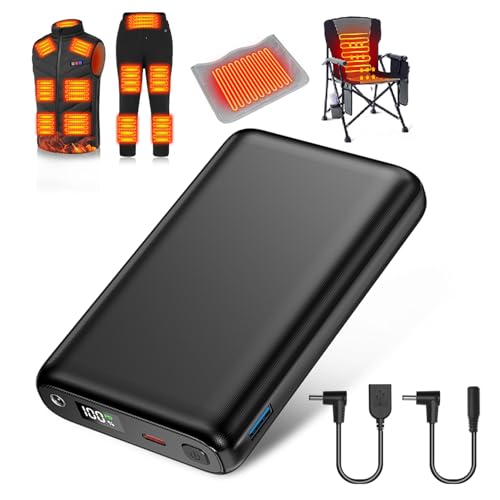
This MOSILA is the option specifically identified as a 7.4V DC pack, with USB and Type-C outputs for compatible devices. Its digital display shows remaining charge as a percentage, and the pack is intended for heated jackets, coats, and vests. Select it only if your garment calls for 7.4V and the DC connector fits; a similar-looking plug does not establish electrical compatibility. Although the capacity is 30,000mAh, the specifications do not provide a jacket runtime, so this choice is strongest for buyers prioritizing the voltage and display rather than a particular number of heating hours.
Bottom line: Choose this for a 7.4V jacket that accepts its DC connector.
THEKUKU 30,000mAh 7.4V Pack

THEKUKU pairs a 7.4V DC output with a 5V USB-A output, making it useful when you need a garment connection and a separate standard USB output. The maker claims 4–14 hours of heat, but that span is broad and should not substitute for matching the pack to the jacket’s power input. It is described for heated clothing and seats as well as other devices. Pick it when your jacket uses 7.4V DC and you value the second output; buyers who need a precisely sized pack should note that its dimensions are given as 1 inch on each side.
Bottom line: Pick this for a compatible 7.4V jacket and a second USB output.
CHHID 10,000mAh 5V Pack
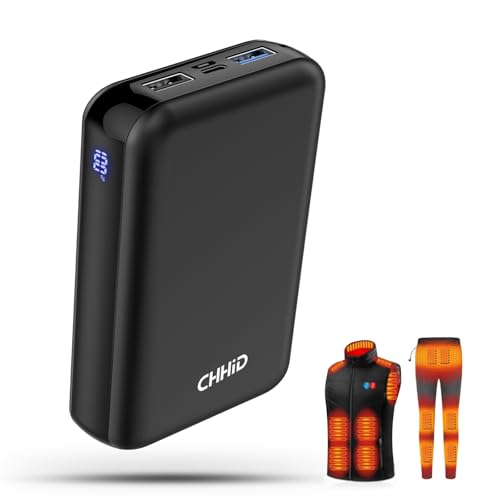
It has two output ports and an LED display, and the maker claims about 5–6 hours powering heated clothing. This suits a jacket designed for 5V USB input, particularly when portability matters more than a higher stated capacity. Its 5V output is the key limitation: it is not a substitute for a jacket battery requiring 7.4V DC.
Bottom line: Choose this for a 5V USB jacket when compact size matters.
Two 10,000mAh 5V USB Packs
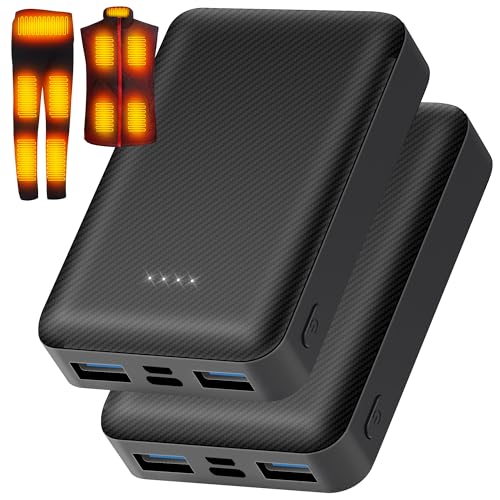
This is the only two-pack here: each battery is 10,000mAh and uses a 5V USB output. The maker claims 3–10 hours of heating depending on setting, including 3 hours on high, 5 on medium, and 10 on low. Two packs can provide a charged spare, but they do not make a 7.4V jacket compatible; the maker explicitly excludes 7.4V heated items and DC-port garments. Choose this set for compatible 5V USB clothing when rotating packs is useful, and skip it if your jacket specifies a different voltage or connector.
Bottom line: Pick this set for compatible 5V garments when a spare is useful.
How to Choose a Battery for a Heated Jacket
Match voltage and connector before comparing capacity: a jacket requiring 7.4V DC should not be connected to a 5V USB pack. Read the garment label or manual for its input voltage, connector type, and any required current rating; a plug that physically fits can still supply the wrong power. Then compare capacity and runtime, keeping in mind that milliamp-hours alone do not predict heating time across packs with different voltages. Heat setting and the garment’s power draw also change runtime. If your jacket accepts both 5V and 7.4V, a dual-voltage pack can cover more use cases, but the exact output port must still match.
5V USB and 7.4V DC Packs Compared
5V USB and 7.4V DC batteries serve different garment inputs, so choose by the jacket’s rating rather than treating either as a universal standard. The table separates those two common options; use it as a first filter, then verify the required plug and current in the garment manual. A pack that lists both outputs can be more flexible, but only for garments compatible with one of those listed outputs. Never infer compatibility from capacity or brand alone.
| Jacket input | Battery output to match | Key check |
|---|---|---|
| 5V USB | 5V USB output | USB cable and current requirement |
| 7.4V DC | 7.4V DC output | Connector and current requirement |
| Either, as specified by garment | Exact matching output | Use only an allowed input |
What Battery Capacity and Runtime Mean
Capacity in mAh is useful for comparing packs at the same voltage, but it is not a direct heating-time promise. A jacket’s draw and its selected heat level determine how quickly stored energy is used, which is why maker runtime claims can span several hours. Treat runtime figures as estimates for the particular product and test condition, not as a universal result for every jacket. If a long outing depends on uninterrupted heat, carry a compatible charged spare rather than assuming a high mAh number guarantees a specific duration. Compare the complete output specification, not capacity in isolation.
Safe Battery Use With Heated Clothing
Use only the voltage and connector specified for your heated jacket; a mismatched supply can damage electronics or create an unsafe condition. Inspect the pack, cable, and port before use, and stop using any battery that is swollen, leaking, unusually hot, or physically damaged. Keep batteries away from water and direct heat, and do not cover a charging pack with clothing or bedding. Recharge with a compatible input and store the battery dry. For air travel, check the battery’s watt-hour rating and current airline rules; mAh by itself is not enough to determine whether a pack meets a limit.
Frequently Asked Questions
Can I use a 5V battery with a 7.4V heated jacket?
No, use the voltage specified for the jacket. A 5V USB pack does not match a 7.4V DC input, even if an adapter makes the connector fit.
Does a higher mAh rating mean more jacket heat?
A higher mAh rating can mean more stored charge when comparing packs at the same voltage, but it does not by itself establish heat output. The jacket’s draw and heat setting affect runtime.
How long does a battery pack heat a jacket?
Runtime depends on the battery, jacket draw, and heat setting; the products here make claims ranging from about 3 to 16 hours. Treat each maker’s range as an estimate for its use, not a guarantee for every jacket.
Can I leave a heated jacket battery charging overnight?
Do not charge a battery unattended or covered; charge it on a dry, clear surface away from heat and combustible materials. Stop charging if the pack or cable becomes unusually hot or damaged.
How do I check whether the battery plug fits?
Compare the jacket’s specified connector with the battery’s DC plug dimensions and polarity, not just its shape. Confirm the jacket’s voltage and current requirements as well, since a matching plug alone does not ensure compatibility.