
Bed Divider for Co Sleeping: 4 Options Compared

The JZHLLA triangular separator is the closest match for adults who want a compact divider between two sides of a shared bed. Choose a rail or foam bumper instead when the goal is a barrier along a child’s sleeping area, not a privacy divider between adults.
“Co-sleeping” can mean adults sharing a bed or a parent sleeping near an infant, so the right product depends on who will use it and what the barrier is meant to do.
We earn a commission if you buy through links on this page. As an Amazon Associate I earn from qualifying purchases. Products are compared on manufacturer specifications, not hands-on testing.
- Best overall: JZHLLA Large Triangular Bed Divider – Its 24 × 15 × 8-inch triangular shape is designed to separate two adult sleeping zones.
- Best for a long middle rail: BAIIBIHEP 67-Inch Mesh Bed Rail – Its 67-inch mesh panel is made to create separate sleeping zones and has a removable washable cover.
- Best for a low foam barrier: YENING 52-Inch Foam Bed Bumper – The 52 × 6 × 5.5-inch foam bumper fits under a fitted sheet and is intended for children’s beds.
| Product | Best for | Length | Height | Type | Shop |
|---|---|---|---|---|---|
| JZHLLA Large Triangular Bed Divider | Adult sleep zones | 24 in | 8 in | Triangular separator | Check Price on Amazon |
| BAIIBIHEP 67-Inch Mesh Bed Rail | Long central rail | 67 in | 15.75 in | Mesh guardrail | Check Price on Amazon |
| YENING 52-Inch Foam Bed Bumper | Child bed edge | 52 in | 5.5 in | Foam bumper | Check Price on Amazon |
| BG-BABYGO 72.8-Inch Adjustable Bed Rail | Adjustable child rail | 72.8 in | 18.9–29.1 in | Foldable rail | Check Price on Amazon |
Bed Dividers for Co Sleeping
Match the barrier to the job: separating adult sleep zones calls for a different shape than guarding a child’s bed edge.
JZHLLA Large Triangular Bed Divider

Unlike a long rail or foam bumper, this triangular separator is sized to sit between two adult sleeping areas. It measures 24 × 15 × 8 inches, and the maker says its shape is intended to divide a double bed into two zones while taking up little bed space. The compact footprint suits people who want a central boundary without running a barrier along the mattress edge. Its limitation is its short 24-inch length: people needing a barrier across most of the bed should consider a longer rail instead.
Bottom line: Choose this for a compact divider between adult sleeping zones.
BAIIBIHEP 67-Inch Mesh Bed Rail
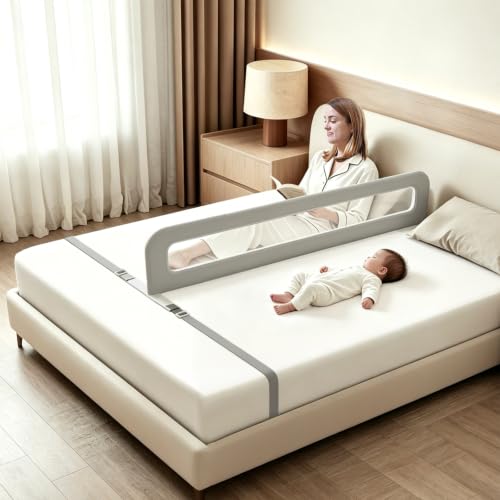
This model stands out for its 67-inch mesh panel and removable, washable cover, rather than the compact shape of an adult separator. The maker describes it as a middle-bed guardrail that can create separate sleeping zones and can be combined with other bedside rails for a more enclosed arrangement. Its mesh-and-sponge construction may suit households looking for a soft-covered rail. At 15.75 inches high, it is a more substantial barrier than a low foam bumper; buyers should distinguish that rail function from a narrow adult bed divider.
Bottom line: Pick this when you want a long, covered rail between sleeping areas.
YENING 52-Inch Foam Bed Bumper

Unlike the central separators, this 52-inch foam bumper is intended to sit beneath a fitted sheet along a child’s bed edge. It measures 6 inches wide and 5.5 inches high, and the maker says its non-slip base works better on cotton sheets. The foam carries a CertiPUR-US certification, and the maker says it installs under a fitted sheet. This is a partial match for co-sleeping adults: it is a child bed bumper, not a broad divider for two adult sleep zones. Do not use it on a top bunk or loft bed.
Bottom line: Choose this for a child’s bed edge, not an adult center divider.
BG-BABYGO 72.8-Inch Adjustable Bed Rail

This rail differs from the other options through its long coverage and adjustable height, making it a child bed-edge guard rather than a compact adult separator. The maker says its dual folding buttons let each side fold independently and its height adjusts from 18.9 to 29.1 inches to accommodate mattresses 3.9 to 11.8 inches thick. Its 72.8-inch length suits shoppers who need a long guard section. That length and height make it less suited to creating a discreet boundary between adults sharing a bed.
Bottom line: Pick this when adjustable height and long child-bed coverage matter.
Choose a Divider by Its Job
Start with the barrier’s job: a center divider separates sleep zones, while a bed rail or bumper guards a mattress edge. Center dividers are typically short or full-length separators placed between sleepers; edge guards run along the side where someone could roll off. A 24-inch separator is a compact boundary, whereas a 67-inch rail spans much more of a mattress. If your goal is to separate two adult sleepers, choose a center divider; if your goal is to guard a child’s bed edge, choose an edge rail or bumper. Do not treat a soft bumper as a structural restraint.
| Need | Choose | Check |
|---|---|---|
| Adult separation | Center divider | Length and placement |
| Child bed edge | Rail or bumper | Mattress fit and gaps |
Check Mattress Fit and Coverage
Measure the mattress and decide how much of its length needs a barrier before choosing a size. Common U.S. mattress dimensions are 54 × 75 inches for full, 60 × 80 inches for queen, and 76 × 80 inches for king. A 52-inch bumper covers less than a full mattress’s 75-inch length, while a 72.8-inch rail still does not cover an entire 80-inch queen or king side. For an edge guard, leave the entry point accessible and verify that the rail fits the mattress thickness. For a center divider, make sure its footprint does not crowd either sleeper.
Keep Infant Sleep Separate From Adult Bed Barriers
An adult bed divider or child rail is not a substitute for an infant’s separate sleep surface. The American Academy of Pediatrics recommends room-sharing without bed-sharing; infants should sleep on a firm, flat surface in a crib, bassinet, or play yard, without loose bedding or soft objects. Adult mattresses, foam bumpers, and rail gaps can create hazards for an infant, so do not use these products to create an infant sleep space. If the intended sleeper is a baby, prioritize an approved separate sleep surface rather than a shared-bed divider.
Install Rails Without Creating Gaps
Bed rails need a close fit against the mattress because gaps between a rail and mattress can trap a person. Before use, check that the rail is secure, the mattress sits as intended, and no opening appears at either end or underneath the barrier. Keep an adult bed rail distinct from a toddler rail: a product intended for one age group is not automatically suitable for another. A foam bumper that sits beneath a fitted sheet is not interchangeable with a framed rail, and the YENING bumper explicitly should not be used on top bunks or loft beds. Recheck fit whenever bedding or mattress setup changes.
Frequently Asked Questions
How long should a bed divider be?
Choose a length that covers the zone you need without blocking access to the bed. A 24-inch separator creates a compact center boundary, while a 67-inch rail covers considerably more of a mattress; compare that with common 75-inch full and 80-inch queen or king lengths.
Can adults use a bed rail as a divider?
Some rails are marketed for adult bed separation, but rails and compact center dividers do different jobs. A middle rail can form a long boundary, while a short triangular separator takes up less mattress length; choose based on the coverage you need.
Are bed bumpers safe for infants?
No—soft bumpers are not a safe infant sleep surface or substitute for a crib, bassinet, or play yard. The American Academy of Pediatrics recommends room-sharing without bed-sharing and a firm, flat infant sleep surface without soft objects.
How do I prevent a gap beside a bed rail?
Fit the rail closely to the mattress and inspect the full length, ends, and underside for openings before use. Recheck after changing the mattress or bedding, because a rail that shifts or leaves a gap can create an entrapment hazard.
Can foam bumpers go on bunk beds?
The YENING bumper should not be used on top bunks or loft beds. For any bunk, use only a guard designed for that bunk setup and keep the required guardrails in place.