
Best 3 Bank Marine Battery Charger: 3 Models Compared

For most boat owners, 10X3 30A Marine Charger is the best 3-bank marine battery charger here because it supplies 10 amps per bank and has an IP68 rating. Choose 12V 30A Smart Marine Charger if its force mode for batteries below 1 volt is the deciding feature, or NOCO GEN5X3 15A Charger if 5 amps per bank suits your charging needs.
A 3-bank charger has separate outputs for charging multiple batteries, so match each bank’s mode to its battery chemistry and voltage.
We earn a commission if you buy through links on this page. As an Amazon Associate I earn from qualifying purchases. Products are compared on manufacturer specifications, not hands-on testing.
- Best overall: 10X3 30A Marine Charger – Provides 10 amps per bank and has an IP68 waterproof rating.
- Best for low-voltage batteries: 12V 30A Smart Marine Charger – Its force mode is designed to charge batteries below 1 volt.
- Best for lower output: NOCO GEN5X3 15A Charger – Supplies 5 amps per bank and offers selectable 12V, AGM, lithium and repair modes.
| Product | Best for | Total output | Output per bank | Charging modes | Shop |
|---|---|---|---|---|---|
| 10X3 30A Marine Charger | 10A per bank | 30 A | 10 A | SLA/AGM, lithium, calcium | Check Price on Amazon |
| 12V 30A Smart Marine Charger | Force mode | 30 A | 10 A | SLA/AGM, Li-ion, calcium | Check Price on Amazon |
| NOCO GEN5X3 15A Charger | Lower output | 15 A | 5 A | 12V, AGM, lithium, repair | Check Price on Amazon |
Best 3 Bank Marine Battery Chargers
Compare total and per-bank output, then check that the modes match your battery chemistry.
10X3 30A Marine Charger

The 10X3 stands out with an IP68 waterproof rating and 10 amps available to each bank. It supports 12V lead-acid and lithium batteries, with separate mode selection for SLA/AGM, lithium and calcium batteries. The maker also says it can remain connected onboard 24/7 and includes overcharge and temperature protection, plus diagnostics for conditions such as reverse connection and over-temperature.
This is a fit for boaters who want 10 amps per battery and need separate mode choices. Its modes do not include the named repair mode available on the other 10-amp option.
Bottom line: Choose this if 10 amps per bank and an IP68 rating are your priorities.
12V 30A Smart Marine Charger

The 12V 30A charger’s distinguishing feature is force mode, which the maker says can charge batteries whose voltage has fallen below 1 volt. It supplies 10 amps to each of three banks and supports 12V SLA/AGM, lithium-ion and calcium batteries. Each bank can be controlled independently, so separate batteries can be charged at the same time.
Consider it if recovering a very low-voltage battery is important. The modes are narrower than the options on NOCO GEN5X3 15A Charger, which also names a 12V mode and a lithium mode; check that this charger’s specific battery modes suit your batteries.
Bottom line: Pick this if the force mode for batteries below 1 volt matters most.
NOCO GEN5X3 15A Charger
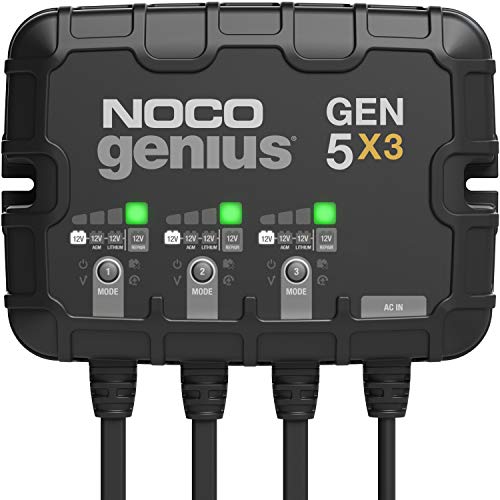
The NOCO GEN5X3 is the lower-output choice, with 5 amps per bank rather than the 10 amps offered by the other two chargers. It has selectable 12V, AGM, lithium and repair modes for each bank, and its IP68 rating is specified for the onboard marine charger. The maker also describes temperature compensation that adjusts charging based on ambient temperature.
Choose it when 5 amps per battery is appropriate for your charging needs and the additional mode choices are useful. It supplies half the per-bank current of the other two options, so it may be a slower match for batteries that call for more charging current.
Bottom line: Choose this when 5 amps per bank and its mode selection fit your setup.
How to choose a 3-bank marine battery charger
Start with battery voltage, chemistry and the output needed at each bank. These three chargers are for 12V batteries, but their outputs range from 5 to 10 amps per bank; total output alone does not show how much current each battery receives. A common lead-acid charging guideline is about 10% of battery capacity in amp-hours, so a 100Ah battery is often paired with roughly 10A of charging current. Treat that as a starting point, not a universal limit: battery makers may specify a different maximum or recommended rate. For lithium batteries, confirm the battery’s charging requirements and use a compatible lithium mode. With batteries of different chemistries, independent bank settings matter because each battery needs its corresponding mode.
What three charging banks mean for a boat
Three banks provide separate charging outputs for three batteries; they do not mean each battery receives the charger’s full total output. A 30A, three-bank charger rated 10A per bank divides its output across those three channels, while a 15A model rated 5A per bank supplies less current to each. Common boat layouts use separate starting and house batteries, with a third battery for another starting or house circuit. Map which battery connects to each output before installation, and confirm the wiring and bank arrangement in the charger’s manual. A charger’s bank count does not itself establish that it can charge a 24V or 36V battery bank; the models here are specified for 12V batteries.
Use this comparison to match the charger output and modes to the batteries connected at each bank.
| Need | What to look for |
|---|---|
| Higher per-bank current | 10A per bank |
| Lower per-bank current | 5A per bank |
| Multiple battery chemistries | Independent mode selection for each bank |
Waterproof ratings and onboard installation
IP68 is an enclosure ingress-protection rating, but the exact test depth and duration depend on the manufacturer’s conditions. It should not be read as permission to submerge a charger or expose its connections to water. Of these choices, 10X3 30A Marine Charger and NOCO GEN5X3 15A Charger specify IP68; 12V 30A Smart Marine Charger is described as waterproof without an IP rating in its product name and features. Mount marine chargers where their wiring and terminals can be kept secure and where heat can dissipate. Follow the charger’s installation requirements and the boat’s electrical practices, especially around battery terminals and shore-power connections. Disconnect shore power before working on electrical wiring, and avoid connecting a charger to a battery with damaged or leaking casing.
How to match charging modes to battery chemistry
Use the bank mode that matches the battery label, not merely the battery’s role as a starter or deep-cycle battery. AGM is a lead-acid battery type, while lithium batteries use a different charging profile; calcium is also named as a separate selectable mode on the two 10A-per-bank models. A wrong mode can apply an unsuitable charging profile, so verify chemistry and voltage before connecting each bank. For mixed battery types, independent bank selection lets you choose different modes for separate outputs. If a battery is deeply discharged, normal charging may not begin; 12V 30A Smart Marine Charger specifically describes a force mode for batteries below 1 volt, but that feature is not a substitute for checking the battery maker’s safe charging limits.
Frequently Asked Questions
How many amps does each bank receive?
Each bank receives the per-bank rating, not the charger’s entire total output. These options supply either 5 amps or 10 amps per bank, so use the individual rating when matching the charger to battery capacity.
Can one charger charge different battery types?
A charger with independently selectable bank modes can use different settings for separate batteries. Confirm that each battery’s chemistry and voltage match a mode offered for its own bank.
Does IP68 mean a charger can be submerged?
No; an IP68 rating does not mean a charger should be submerged during normal use. Ingress-test conditions vary, so keep connections protected and follow the manufacturer’s mounting and exposure instructions.
What does force mode do on a battery charger?
Force mode is intended to attempt charging a battery with very low voltage; the force-mode model here specifies batteries below 1 volt. Check the battery manufacturer’s limits before trying to charge a deeply discharged battery.
Is a three-bank charger suitable for 24V batteries?
The chargers compared here are specified for 12V batteries, not a 24V battery bank. Check the charger’s voltage compatibility and the boat’s wiring before connecting multiple batteries in series.