
Best 3 Inch Speakers: 5 Options Compared by Use

The Sanyun SW208 suits most people looking for 3 inch speakers because it is a powered stereo pair with Bluetooth 5.0, USB and 3.5mm AUX inputs. Choose a bare driver instead if you are building a speaker cabinet or replacing a driver, since those need an enclosure and supporting audio components.
We earn a commission if you buy through links on this page. As an Amazon Associate I earn from qualifying purchases. Products are compared on manufacturer specifications, not hands-on testing.
- Best overall: Sanyun SW208 3-Inch Active Pair – Powered stereo pair with Bluetooth 5.0, USB and 3.5mm AUX inputs.
- Best for passive cubes: Pyle 3-Inch Mini Cube Pair – Pair of 3-inch passive bookshelf speakers with 8-ohm impedance.
- Best for DIY builds: Dayton Audio PC83-8 Driver – Full-range poly cone driver for simple speaker designs.
| Product | Best for | Format | Power | Impedance | Shop |
|---|---|---|---|---|---|
| Sanyun SW208 3-Inch Active Pair | Desktop stereo | Active stereo pair | 60W (30W x 2) | — | Check Price on Amazon |
| Pyle 3-Inch Mini Cube Pair | Passive home audio | Passive speaker pair | 100W peak | 8 ohms | Check Price on Amazon |
| Dayton Audio PC83-8 Driver | DIY speaker builds | Full-range driver | — | 8 ohms | Check Price on Amazon |
| Gikfun 3-Inch 4-Ohm Driver Pair | Arduino projects | Full-range driver pair | 20W rated | 4 ohms | Check Price on Amazon |
| Shutao 3-Inch 8-Ohm Driver Pair | Compact DIY builds | Full-range driver pair | 10W rated | 8 ohms | Check Price on Amazon |
3 Inch Speakers Compared
Choose a complete speaker pair for immediate system use or individual drivers for a custom build.
Sanyun SW208 3-Inch Active Pair
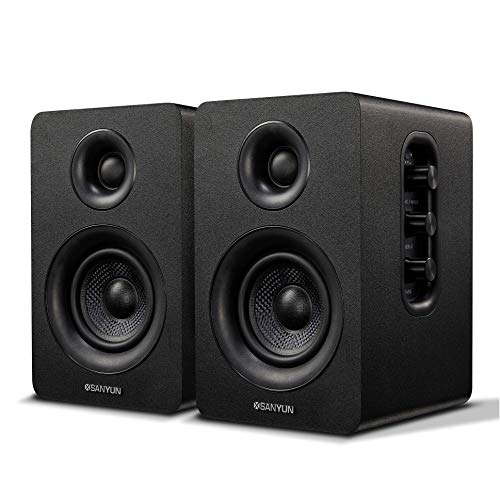
Unlike the individual drivers and passive pair here, the Sanyun SW208 is an active stereo set with Bluetooth 5.0, USB and 3.5mm AUX inputs. Its 3-inch carbon fiber speaker units are paired with a built-in 24-bit DAC, so it is suited to a desktop or monitor setup that needs multiple connection options without a separate amplifier. The maker describes the sound as having warm mids and deep low frequencies; treat those as maker claims rather than guaranteed results. The main limitation is the unspecified impedance, which matters if you are matching it to other components.
Bottom line: Pick this for a powered desktop stereo setup with several input choices.
Pyle 3-Inch Mini Cube Pair
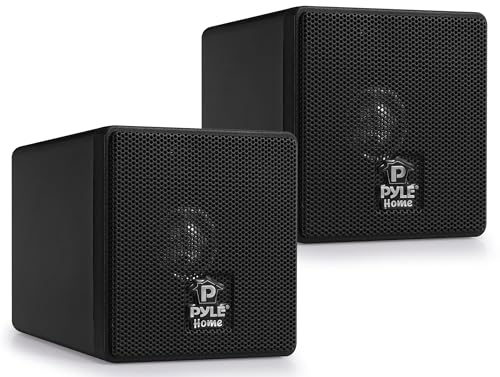
The Pyle set stands out as a pair of passive cube speakers rather than a powered system or bare driver. Each uses a 3-inch paper cone, and the pair has 8-ohm impedance; an amplifier or receiver and speaker wire are required. Video shielding is a relevant feature for placement near older CRT displays. The 100-watt figure is peak power handling, not a continuous rating, so it should not be compared directly with rated-power figures on individual drivers. This is a fit for buyers who already have amplification and want compact cubes for a home stereo or cinema setup.
Bottom line: Choose these if your system has an amplifier and you want cube speakers.
Dayton Audio PC83-8 Driver

The Dayton Audio PC83-8 is a single full-range driver distinguished by its poly-damped woven glass fiber cone and copper cap, not a ready-to-play speaker pair. The maker says the cone helps control breakup and the copper cap extends high-frequency response. Its ferrite magnet is also intended to increase efficiency and output, according to the maker. The driver is aimed at custom designs such as MTM bookshelf speakers, car audio or line arrays. Because the specifications give no power handling figure, it is a poor choice for a build where a specific wattage match is essential.
Bottom line: Choose this for a custom design where a full-range driver is needed.
Gikfun 3-Inch 4-Ohm Driver Pair

The Gikfun set is the only option with a 20-watt rated power and 4-ohm impedance, and it comes as two bare full-range drivers. Each driver measures 3 inches across and 36 mm high. It suits Arduino speaker projects or replacement work where the build is designed for a 4-ohm load. Its 4-ohm rating makes amplifier compatibility an important check before integrating it into an existing setup.
Bottom line: Pick these for a DIY project that calls for 4-ohm drivers.
Shutao 3-Inch 8-Ohm Driver Pair

The Shutao pair differs from the Gikfun drivers through its 8-ohm impedance and 10-watt rated power, making it the lower-rated of the two paired DIY driver sets. Each 3-inch unit has a 78 mm outer diameter, 71 mm hole diameter and 52 mm height, which are useful dimensions when planning a mounting cutout. The effective frequency range is 108 Hz to 20 kHz. These are bare drivers for custom speaker projects, not finished speakers; buyers replacing a driver should verify that the mounting opening and available depth match their cabinet.
Bottom line: Choose these for a DIY enclosure matching the 8-ohm load and cutout.
How to Choose 3 Inch Speakers
Start by deciding whether you need a complete system or a driver to build into one. Active speakers have amplification built in; passive speakers need an amplifier, while bare drivers also need a suitable enclosure. A 3-inch cone does not determine bass output by itself: cabinet volume, port tuning and the room affect low-frequency response. For desktop use, a powered pair with the inputs you need is the simplest fit. For a custom cabinet, match driver impedance and power handling to the amplifier, then design around the driver rather than assuming any 3-inch unit will fit.
| Need | Choose |
|---|---|
| Powered desktop stereo | Active pair |
| Speaker system with existing amp | Passive pair |
| Custom enclosure or replacement | Bare driver |
For a compact DIY build, check the mounting hole and depth before cutting the cabinet.
Impedance and Amplifier Matching
Match speaker impedance to the amplifier’s supported load; lower impedance generally asks the amplifier for more current. An 8-ohm speaker is a common home-audio load, while 4-ohm drivers need an amplifier rated for that load. When wiring two drivers, a parallel connection lowers total impedance and a series connection raises it, so confirm the resulting load before connecting them. Power figures also need careful reading: peak handling is not the same as continuous or rated power. A 100-watt peak label should not be treated as a 100-watt continuous rating. Keep the amplifier within both its load rating and the speaker’s applicable power limit.
Fitting a 3 Inch Driver in a Cabinet
Measure the cutout diameter, outside frame and mounting depth before selecting a replacement driver. A nominal 3-inch speaker can have an outer diameter larger than 3 inches, and even small differences can prevent a flush fit. For example, one of these drivers specifies a 71 mm mounting hole and 52 mm depth, dimensions that must be checked against the cabinet rather than inferred from its size label. Also consider the enclosure volume and whether the original design used a sealed or ported cabinet. Replacing only the driver with a different type can change response, even when the new unit physically fits.
What 3 Inch Speakers Can and Cannot Do
Three-inch speakers suit near-field listening, compact cabinets and builds where space is limited, but cone diameter alone does not establish usable bass or maximum output. Lower-frequency extension depends on the driver and enclosure together; the 108 Hz lower limit on one bare driver illustrates that some 3-inch designs are not intended for deep bass. A larger subwoofer can cover low frequencies when a small desktop or bookshelf system lacks that range. For music or movies at higher levels, room size and listening distance matter as much as the speaker label. Avoid expecting a small driver to replace a full-size home theater speaker without support from a subwoofer.
Frequently Asked Questions
Do 3 inch speakers need an amplifier?
Bare drivers and passive speakers need a compatible amplifier, while active speakers have amplification built in. Confirm the amplifier supports the speaker’s impedance; a 4-ohm load requires compatibility with 4 ohms.
Can 3 inch speakers produce deep bass?
A 3-inch cone alone cannot guarantee deep bass; the driver, enclosure and tuning all affect low-frequency output. One listed driver gives an effective range beginning at 108 Hz, so a subwoofer may be needed for deeper bass.
What impedance should 3 inch speakers have?
Choose an impedance supported by the amplifier, commonly 8 ohms in home audio. Some compact drivers use 4 ohms, and connecting multiple drivers can change the total load depending on series or parallel wiring.
How do I size a cutout for a 3 inch speaker?
Use the driver’s specified mounting-hole diameter rather than its nominal 3-inch size. Allow for mounting depth as well; one listed pair calls for a 71 mm hole and 52 mm depth.
Are 3 inch speakers suitable for a car?
They can suit a custom car-audio design when the mounting location and amplifier match the driver. Measure the opening and depth first, and plan for a subwoofer if the system needs stronger low-bass output.