
Best 30-Foot Dog Leashes for Recall Training

For most people, Hi Kiss 30-Foot Nylon Training Lead is the best 30-foot dog leash because its 3/4-inch nylon lead balances usable length with a familiar, simple design. Choose Total Pet 30-Foot Control-Handle Lead instead if you want a control handle and adjustable shorter working distances; a 30-foot line needs active handling to prevent tangles and sudden stops.
We earn a commission if you buy through links on this page. As an Amazon Associate I earn from qualifying purchases. Products are compared on manufacturer specifications, not hands-on testing.
- Best overall: Hi Kiss 30-Foot Nylon Training Lead – Its 3/4-inch nylon lead gives you the full 30 feet for recall practice and outdoor use.
- Best for wet outings: Waterproof 30-Foot Coated Lead – The rubber-coated nylon lead is designed to wipe clean after wet or muddy use.
- Best for line control: Total Pet 30-Foot Control-Handle Lead – A control handle and distance markers let you manage the lead at shorter working distances.
- Best for swivel clip: Nylon 30-Foot Swivel-Clip Lead – The 3/4-inch nylon lead has a swivel-style bolt snap intended to resist twisting.
| Product | Best for | Width | Material | Shop |
|---|---|---|---|---|
| Hi Kiss 30-Foot Nylon Training Lead | General recall practice | 3/4 in | Nylon | Check Price on Amazon |
| Waterproof 30-Foot Coated Lead | Wet outdoor use | 0.6 in | Coated nylon | Check Price on Amazon |
| Total Pet 30-Foot Control-Handle Lead | Adjustable line control | 1 in | Nylon | Check Price on Amazon |
| Nylon 30-Foot Swivel-Clip Lead | Twist-resistant clip | 3/4 in | Nylon | Check Price on Amazon |
30-Foot Dog Leashes Compared
Compare these fixed-length training leads by material and handling features before choosing one for your dog and training space.
Hi Kiss 30-Foot Nylon Training Lead
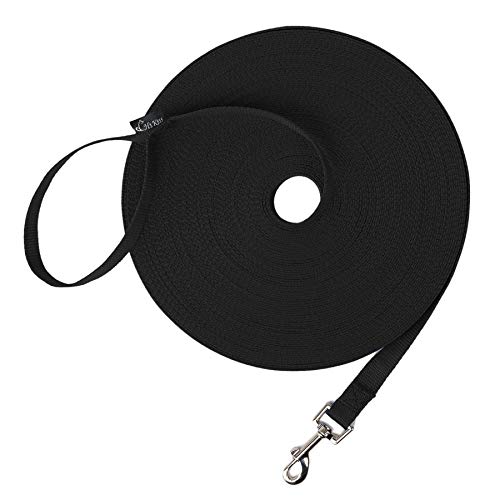
Hi Kiss 30-Foot Nylon Training Lead is a straightforward 30-foot nylon lead with a 3/4-inch width, making it a practical choice for recall practice and open areas where a dog can move away while remaining connected. The maker describes reinforced stitching and a swiveling, nickel-plated clip. Its simple fixed-length construction suits handlers who do not need a built-in control handle or adjustable length markers. A 30-foot line can snag or loop around people and obstacles, so it is less suitable for crowded paths or tight spaces.
Bottom line: Pick this if you want a simple 30-foot nylon lead for open-area recall work.
Waterproof 30-Foot Coated Lead

Waterproof 30-Foot Coated Lead stands apart with a flexible rubber-coated nylon strap that the maker says can be wiped clean after dirty or wet outings. The 0.6-inch width is narrower than the 3/4-inch nylon options here, and the maker says the lead can carry a 700-pound-force pull. That strength claim is not a substitute for choosing equipment suited to your dog or checking the clip and strap before use. This lead suits beach or swimming outings; the fixed 30-foot length still calls for room to manage slack.
Bottom line: Choose this for outings where easy cleanup from wet or muddy conditions matters.
Total Pet 30-Foot Control-Handle Lead

Total Pet 30-Foot Control-Handle Lead adds a control handle and distance markers, so the handler can use the line at shorter distances without carrying the entire 30 feet in play. Its width is 1 inch, wider than the other nylon leads in this comparison. The maker says the handle helps slow the lead gradually; keep a firm grip and avoid wrapping any long line around your hand, since a moving dog can pull suddenly. This design suits training sessions where line length changes, but it is not a compact retracting leash.
Bottom line: Pick this when a handle and shorter working lengths are useful during training.
Nylon 30-Foot Swivel-Clip Lead

Nylon 30-Foot Swivel-Clip Lead is another fixed 30-foot, 3/4-inch nylon lead, distinguished by its swivel-style bolt snap. The maker says the 360-degree swivel resists twisting, which may be useful when a dog changes direction frequently. It is presented for small, medium, and large dogs, but dog size alone does not determine whether a lead and clip are appropriate; match equipment to your dog’s strength and behavior. This lead fits basic recall and obedience practice, while handlers seeking a built-in handle or wipe-clean coating should consider another style.
Bottom line: Choose this if you want a conventional nylon lead with a swivel-style snap.
How to Choose a 30-Foot Dog Leash
A 30-foot lead is best for controlled distance practice in open space, not for routine walking through crowded areas. Fixed long lines are commonly made from nylon webbing, rope, or coated webbing; webbing width affects feel and bulk, while coating is easier to wipe clean. A line this long can drag, snag, or wrap around legs, so scan the area before letting it out. Choose a shorter line when you cannot maintain a clear buffer around other people, dogs, or obstacles. Keep slack organized in loose folds rather than wrapping it around your palm or wrist, and never let a running dog hit the end at full speed.
How to Handle a Long Line Safely
Manage a 30-foot lead by feeding out only the length the space allows and gathering excess into loose loops. A sudden stop can transfer force to the handler and dog, so avoid allowing a dog to sprint to the end of a taut line. Gloves can reduce friction during line handling, but they do not make wrapping the line around a hand safe. Keep the lead away from bicycle wheels, branches, and other dogs; long lines tangle quickly in busy settings. For recall practice, start at a distance where the dog can respond reliably, then extend the working distance gradually instead of immediately using all 30 feet.
Fixed Long Lines Versus Retractable Leashes
A fixed long line gives the handler direct control over slack and does not retract automatically; a retractable leash winds its cord into a handle and uses a brake mechanism. Fixed webbing is often easier to grab along its length, while cord-style retractables are designed around the handle and braking system. Either type can tangle or injure skin if a moving dog pulls against it. Use a fixed line for structured recall practice where you need to choose how much line is available. Use a retractable design only where there is space to keep the cord clear and the brake can be managed without sudden lunges.
| Need | Consider | Trade-off |
|---|---|---|
| General open-area recall | Fixed nylon long line | Requires manual slack management |
| Wet or muddy outings | Coated webbing | Still needs careful line handling |
| Changing distance during practice | Lead with handle or markers | More features do not remove tangling risk |
When a 30-Foot Lead Is Too Long
A 30-foot leash is too long when the available area cannot keep the line clear of passersby, traffic, or obstacles. Use a shorter lead on sidewalks, narrow trails, or anywhere a dog could reach another person before you can gather slack. Long lines are not a substitute for a secure fence or a safe, controlled environment, and they do not guarantee recall. Inspect webbing for fraying and check the clip for bending, corrosion, or a loose swivel before each session; replace damaged gear rather than relying on a strength claim. Keep sessions away from roads and use a shorter line near other dogs.
Frequently Asked Questions
Is a 30-foot leash good for recall training?
A 30-foot leash can give a dog room to practice recall while remaining connected to the handler. Begin at a distance where the dog responds consistently, and add distance gradually. Use the full length only in an open area where the line will not cross people or obstacles.
How do I keep a long dog leash from tangling?
Feed out only the amount of line needed and gather the excess into loose folds. Keep the line away from branches, wheels, and other dogs, and shorten it in crowded spaces. Never wrap the lead around your hand or wrist.
Can a 30-foot leash be used at the beach?
A 30-foot leash can be used where there is enough clear space to manage the full line. Coated webbing is designed for easier cleanup after wet or dirty outings, but saltwater and sand can still affect clips and hardware. Rinse and inspect the clasp after use.
Should a dog run to the end of a long leash?
No; a dog hitting the end at speed can create a sudden jolt for both dog and handler. Keep enough slack to avoid a sharp stop and practice at a controlled pace. Do not wrap the line around your hand to resist a pull.
How often should I check a dog training leash?
Inspect the webbing, stitching, clip, and swivel before each training session. Fraying, broken stitches, a bent clasp, or a swivel that no longer moves freely are reasons to stop using the lead. Wet or gritty outings make a post-use check especially useful.