
Best 69 Degree Golf Wedge: 3 Options Compared

Sixtynine 69° Wedge is the clearest single-club choice because its 69° loft matches the request without requiring a three-wedge set. Choose 69 Golf 54°/60°/69° Set instead if you also need 54° and 60° wedges; choose Gowolf Full-Face 69° Wedge if full-face grooves are your priority.
A 69° wedge has more loft than the 58°–60° lob wedges commonly used for high, short shots, so it suits a specialized shot rather than a typical gap in a wedge setup.
We earn a commission if you buy through links on this page. As an Amazon Associate I earn from qualifying purchases. Products are compared on manufacturer specifications, not hands-on testing.
- Best overall: Sixtynine 69° Wedge – A single 69° wedge, so it matches the requested loft without adding two clubs.
- Best for full-face grooves: Gowolf Full-Face 69° Wedge – The maker describes CNC-milled grooves extending across the face.
- Best for a three-wedge setup: 69 Golf 54°/60°/69° Set – The set pairs its 69° wedge with 54° and 60° clubs.
| Product | Best for | Loft(s) | Configuration | Face feature | Shop |
|---|---|---|---|---|---|
| Sixtynine 69° Wedge | Single-club choice | 69° | Single wedge | Advanced groove pattern | Check Price on Amazon |
| Gowolf Full-Face 69° Wedge | Full-face grooves | 69° | Single wedge | CNC-milled full-face grooves | Check Price on Amazon |
| 69 Golf 54°/60°/69° Set | Three-wedge setup | 54°, 60°, 69° | Three wedges | Heel-and-toe grind | Check Price on Amazon |
69 Degree Golf Wedges
Compare the single-club options with the set that adds two lower-lofted wedges.
Sixtynine 69° Wedge

Unlike the three-club bundle, this is a single 69° wedge for golfers who want to add one highly lofted club. Sixtynine says its groove pattern and surface roughness are designed to support spin control, while its design emphasizes weight distribution and shot trajectory. The name identifies it as a right-handed club, making that a key fit point for left-handed golfers to confirm before choosing. Its 69° loft sits well above common lob-wedge lofts, so it is a specialized option rather than a replacement for a full set of wedge lofts.
Bottom line: Pick this if you want one right-handed 69° club rather than a multi-wedge bundle.
Gowolf Full-Face 69° Wedge

Full-face grooves distinguish this single 69° club from the other options. Gowolf says its CNC-milled face has grooves across the entire face and a textured surface intended to increase friction; it also describes an anti-glare finish and optimized weight distribution. Those face features may interest golfers who want groove coverage beyond the center strike area. The name identifies it as right-handed, so left-handed players should confirm hand orientation before choosing. As with any 69° wedge, the unusually high loft makes it a specialty club, not an all-purpose substitute for lower-lofted wedges.
Bottom line: Choose this if full-face groove coverage is the feature you value most.
69 Golf 54°/60°/69° Set
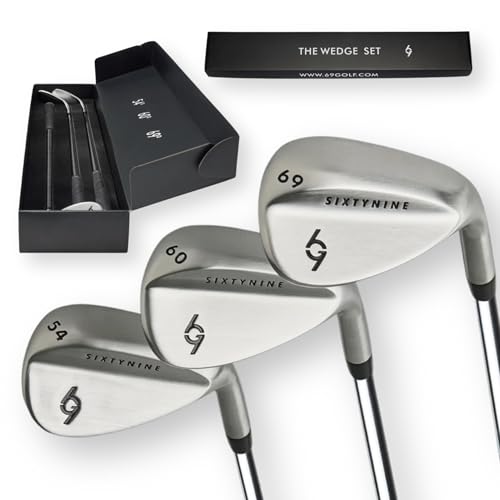
This is the only option that supplies three lofts, pairing the 69° club with 54° and 60° wedges rather than selling only a single high-lofted club. The set uses stepped steel shafts and a heel-and-toe grind, and the name specifies a 35-inch length and right-handed orientation. The maker says the wedges are tournament legal; verify current event rules if compliance is essential. The main limitation is that golfers seeking only a 69° replacement would be taking on two additional clubs, while players building a broader wedge setup may value the added loft choices.
Bottom line: Choose this if you need 54° and 60° wedges alongside a 69° club.
How to Choose a 69 Degree Golf Wedge
A 69° wedge is best treated as a specialty club because common lob wedges are around 58° to 60°, while pitching wedges are often around 44° to 48°. The large loft angle can launch the ball steeply with limited forward roll, but it also makes distance control and clean contact important. Decide first whether you need one specialty club or a series of wedge lofts: a single-club option suits a narrow shot need, while a 54°/60°/69° set covers more loft steps. If you have not practiced with a loft above 60°, start with controlled partial swings before relying on it for a full shot. A 69° wedge is not a default replacement for a sand or lob wedge.
Wedge Loft Gaps and Setup Fit
Many golfers space wedge lofts about 4° to 6° apart to avoid large distance gaps, although swing speed and shot style change the carry difference. A move from 60° to 69° is a 9° loft jump, so check the actual yardage gap rather than assuming the loft number predicts a fixed distance. A 54°/60°/69° combination offers two different gaps: 6° and 9°. Use a range session or known carry distances to decide whether the highest-lofted club earns a spot; if the 69° club overlaps shots you already cover, keep a more even loft progression. Hand orientation and shaft length also affect fit, so confirm those against your existing clubs.
What Groove and Grind Features Mean
Grooves help channel grass and moisture away from the contact area, while face texture can add friction between the clubface and ball. Full-face grooves extend coverage toward the toe, but they do not guarantee spin on every lie; contact quality, ball condition, and grass or sand between face and ball all affect the result. A heel-and-toe grind removes material from those sole areas, which can give a player more ways to open or manipulate the face, though the exact sole shape matters. For a 69° wedge, practice with the face square and opened before using either setup around hazards. A high-lofted shot needs room to land; do not choose loft alone when a lower flight has a safer landing area.
Frequently Asked Questions
How far does a 69 degree wedge typically go?
There is no dependable standard carry distance for a 69° wedge because swing speed and strike quality vary widely. Compare its carry with your 60° wedge over several controlled shots; a 9° loft gap can create a substantial yardage gap.
Is a 69 degree wedge harder to hit?
A 69° wedge can be less forgiving of poor contact than a lower-lofted club because its face presents more loft and the ball launches steeply. Practice partial swings from a level lie before trying it from deep rough or tight lies.
Can I use a 69 degree wedge from sand?
A 69° wedge can be used from sand, but the sole shape and amount of sand matter. In soft bunkers, opening the face and entering the sand behind the ball are common techniques; on firm sand, too much loft or bounce can make clean contact harder.
How should I space wedges in my golf bag?
A common starting point is about 4° to 6° between wedge lofts, then adjust based on actual carry distances. The 54°/60°/69° sequence has gaps of 6° and 9°, so check whether the final gap leaves a shot distance uncovered.
Does a 69 degree wedge replace a sand wedge?
A 69° wedge does not automatically replace a sand wedge, which commonly has about 54° to 56° of loft. A sand wedge usually covers a lower, longer shot range, so keep both if your carry distances show distinct roles.