
Best Accessories to Cut Your Own Hair: 5 Picks

The 360 Mirror Trifold is the best accessory for most people cutting their own hair because its three-way mirror helps you see the back of your head while trimming. Choose a guide instead if your main goal is shaping a neckline, fade, or even trim rather than improving visibility.
Home haircut accessories are aids, not substitutes for sharp, clean clippers or scissors; use a mirror to see your work and a guide to help control where hair is cut.
We earn a commission if you buy through links on this page. As an Amazon Associate I earn from qualifying purchases. Products are compared on manufacturer specifications, not hands-on testing.
- Best overall: The 360 Mirror Trifold – A three-way glass mirror gives a view of the back of your head.
- Best for bangs and layers: Original CreaClip Set – The two-piece clip set is designed to guide bangs, layers, and split-end trims.
- Best for neckline shaping: Adjustable Silicone Neckline Guide – The adjustable silicone template is designed to stay in position around the neck.
- Best for an even trim: 247 Groomed Self Haircut Kit – The grip-and-trim tool is intended to guide clippers for consistent trims.
| Product | Best for | Accessory type | Material | Included pieces | Shop |
|---|---|---|---|---|---|
| The 360 Mirror Trifold | Rear-head visibility | Three-way mirror | Glass | 1 mirror | Check Price on Amazon |
| Original CreaClip Set | Bangs and layers | Hair cutting clips | — | 2 clips | Check Price on Amazon |
| Adjustable Silicone Neckline Guide | Neckline shaping | Neckline template | Silicone | 1 guide | Check Price on Amazon |
| 247 Groomed Self Haircut Kit | Fade and lineups | Neckline and fade guides | — | 2 templates | Check Price on Amazon |
| Grip and Trim Haircut Tool | Even clipper trims | Clipper trimming guide | — | 1 tool | Check Price on Amazon |
Best accessories to cut your own hair
Match the accessory to the task you want help with, since mirrors improve visibility while guides shape or even out a trim.
The 360 Mirror Trifold

For seeing behind your head while you cut, this three-way mirror is the most directly useful accessory in this group. It has distortion-free glass, adjustable door hooks, a height-adjustable setup, and measures about 12 by 8 inches. Tutorials are included according to the maker. The mirror can improve visibility while you work, but it does not guide clipper placement or create a haircut shape; pair it with a separate guide if you need help controlling a neckline or fade.
Bottom line: Choose this if seeing the back of your head is the main challenge.
Original CreaClip Set

For directing hair into a cut rather than viewing the back of your head, the two-piece CreaClip set is designed for bangs, layers, and split ends. Its rotating level is meant to help keep the guide balanced, and the maker provides instructional videos for different styles. It is also presented for children’s haircuts and men’s hair. The clips are not a mirror or a neckline template, so buyers primarily seeking a rear view or a fade outline should choose a different kind of accessory.
Bottom line: Pick this if you want a clip-based guide for bangs or layers.
Adjustable Silicone Neckline Guide

This silicone guide focuses on shaping a neckline, unlike the mirror and hair-sectioning clips elsewhere in this group. Its adjustable snap closure and front locking buckle are intended to help secure it in place, and it can be used with clippers, scissors, or razors. Its portable design may suit occasional home trims. The guide only helps with the neckline area; it is not a full haircutting system or a tool for viewing the back of the head, so it is less suitable when those are the main needs.
Bottom line: Choose this for a neckline outline that can be adjusted around the neck.
247 Groomed Self Haircut Kit
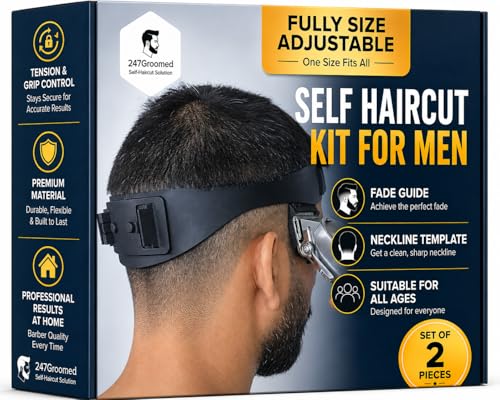
This two-piece set combines a neckline template with a fade guide, making it the most shape-focused option for clipper work. The maker says the fade guide supports flat or curved lines and fits children and adults; the neckline tool is intended for different neck sizes. Use it when a defined edge or fade outline matters more than seeing the back of your head. The set does not include a mirror, so it cannot solve the visibility problem that comes with trimming areas outside your direct line of sight.
Bottom line: Pick this if you want separate tools for neckline and fade shaping.
Grip and Trim Haircut Tool

Unlike the neckline-specific templates, Grip and Trim is presented as a general guide for using clippers to make an even trim on yourself or someone else. The tool measures about 9 inches long and is made in Great Britain. It may be useful for maintaining an existing style between cuts, including when trimming another person’s hair. The maker gives no adjustment range or fit dimensions, so confirm that its shape works for the area and haircut you intend to guide before relying on it.
Bottom line: Choose this for guided, even clipper trims on yourself or another person.
How to choose a home haircut accessory
Choose by the part of the haircut you cannot see or control: a mirror addresses visibility, while a guide helps position hair or outline a cut. A three-way mirror gives a reflected rear view; a hand mirror can also be angled against a wall mirror, though it requires one hand. Clippers and scissors still do the cutting, so guides should not be treated as substitutes for the cutting tool or a clear view. For a self-cut that includes the back of the head, start with a mirror; for a cleanup confined to bangs or a neckline, use the matching guide instead.
| Need | Accessory type |
|---|---|
| See the rear of the head | Three-way mirror |
| Control bangs or layers | Sectioning clip guide |
| Outline the neckline | Neckline template |
| Guide a general clipper trim | Clipper trimming guide |
Set up mirrors and guides for safer trimming
Set up a mirror at eye level and check the rear view before making a cut, since a reflected view reverses left and right. Begin with a small amount of hair; longer clipper guard lengths remove less hair and are easier to shorten gradually than a very short setting. Keep fingers clear of clipper blades and switch the clipper off before changing guards or clearing hair from the cutting head. A neckline template should sit securely without pinching; stop and reposition it if it slips, because a moving edge can produce an uneven line.
Use clipper guides without creating harsh lines
Clipper guides work best as positioning aids, not as guarantees of a blended fade. A fade changes gradually between lengths; a hard guide edge can leave a visible demarcation if hair is cut to the same length on both sides of it. Start with a longer guard, remove less hair, and blend in small steps toward a shorter length. For a neckline, keep the outline conservative rather than raising it sharply, since regrowth makes a high line harder to correct. Clean loose hair from reusable guides after use, and keep them dry before storage.
Common mistakes when cutting your own hair
The most common mistake is cutting before checking the angle in a mirror, particularly behind the ears and at the nape. Make one small pass, inspect both sides in the mirror, then continue only if the lines match. Another mistake is pulling a guide so tightly that it shifts when released; a comfortable, stable fit matters more than maximum tension. Do not use a haircut guide as a blade guard or press it against exposed moving blades. Clean clippers and accessories after each haircut, and keep sharp cutting tools out of reach of children.
Frequently Asked Questions
How do I see the back of my head while cutting?
A three-way mirror shows the back and sides without needing to hold a second mirror. Position it at eye level and turn slowly, since the reflection reverses left and right.
What clipper guard should I start with?
Start with a longer guard than the length you think you need, because each pass removes more hair and a shorter guard cannot restore it. Step down gradually only after checking the cut in a mirror.
Can a fade guide make a blended fade?
A fade guide can help position a line, but a blended fade requires gradually changing clipper lengths. Use small steps between guard lengths to avoid a visible hard band.
How should I clean haircut guides?
Remove loose hair after each cut and wash washable guides with soap and water, then dry them fully before storage. Keep cleaning liquid away from powered clippers unless their care instructions allow it.
Should I cut wet or dry hair at home?
Clipper cuts are generally easier to judge on dry hair because wet hair lies flatter and can look longer or differently shaped as it dries. Scissor techniques vary, so use the condition appropriate to the specific style you are trimming.