
Best Automatic Dog Kennel Door Opener Options Compared

For most households, Rechargeable Automatic Dog Door is the strongest match because it combines automatic operation, an anti-pinch sensor and plug-in or rechargeable power. Choose VUEBEE Solar Automatic Pet Door instead if solar charging and dawn-to-dusk scheduling matter more; PetSafe Electronic Pet Door, Large suits owners who want collar-key access, while Pull-Handle Pet Door Opener and Closer is a door-mounted lever and closer rather than an automatic pet flap.
A kennel door opener either moves or schedules a pet door, or helps a pet pull a regular hinged door open. Match the opening to your dog’s body size and decide whether access control, power source or installation style matters most.
We earn a commission if you buy through links on this page. As an Amazon Associate I earn from qualifying purchases. Products are compared on manufacturer specifications, not hands-on testing.
- Best overall: Rechargeable Automatic Dog Door – Combines an anti-pinch sensor with plug-in or 4,000mAh rechargeable power.
- Best for solar scheduling: VUEBEE Solar Automatic Pet Door – Offers solar charging and light-sensor, timer and manual modes.
- Best for selective access: PetSafe Electronic Pet Door, Large – Uses collar keys for entry control and supports up to five keys.
| Product | Best for | Power or control | Access feature | Size or capacity | Shop |
|---|---|---|---|---|---|
| Rechargeable Automatic Dog Door | Safety-focused access | Plug-in or 4,000mAh battery | Anti-pinch sensor | Small/medium dogs | Check Price on Amazon |
| VUEBEE Solar Automatic Pet Door | Solar scheduling | 7W solar or USB-C | Light sensor, timer, manual | 3.9 x 18.9 in. (small) | Check Price on Amazon |
| PetSafe Electronic Pet Door, Large | Collar-key control | Four D-cell batteries | Up to five collar keys | Dogs up to 100 lb | Check Price on Amazon |
| Pull-Handle Pet Door Opener and Closer | No-cut interiors | Pull lever and closer | Pet-operated lever | Standard door panels | Check Price on Amazon |
| SmarketBuy Large Double-Panel Dog Door | Large passive opening | — | Free two-way entry | 13 x 18 in. flap | Check Price on Amazon |
Automatic Dog Kennel Door Openers Compared
Compare how each option powers, controls or physically enables pet access before choosing a setup.
Rechargeable Automatic Dog Door

Rechargeable Automatic Dog Door is the clearest fit for an automatic door where movement safety is a priority: its anti-pinch sensor is designed to stop and reverse when it detects an obstruction. The unit can run from a plug-in adapter or its built-in 4,000mAh rechargeable battery; the maker says a full charge can last up to 30 days. An LCD screen and safe-lock feature are also part of the product name. The tradeoff is that the adapter is not included, so plan for a separate power source if you do not want to rely on charging.
Bottom line: Choose this if you want an automatic door with an anti-pinch feature and two power options.
VUEBEE Solar Automatic Pet Door
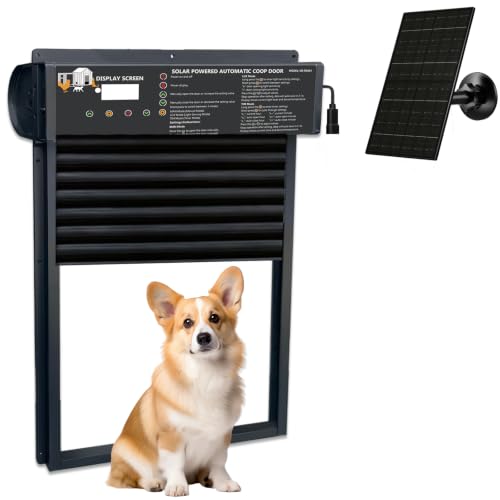
VUEBEE Solar Automatic Pet Door stands apart with solar charging and three operating modes: light-sensor operation for dawn and dusk, a timer for scheduled access, and manual control. Its 7W solar panel charges a built-in rechargeable battery, and USB-C charging provides another way to replenish it. The small size is 3.9 by 18.9 inches, so check that opening against your pet’s dimensions before selecting it. Its solar approach depends on available sunlight, making the USB-C option useful when the panel cannot receive enough sun.
Bottom line: Pick this when solar charging and schedule flexibility are more important than collar-key access.
PetSafe Electronic Pet Door, Large

PetSafe Electronic Pet Door, Large differs from timed or solar doors by granting access through an electronic key worn on the pet’s collar. Programmable entry, exit and auto-lock settings help manage which way the door can be used, and the system can be set up for as many as five keys. The large model is intended for dogs up to 100 pounds and uses four D-cell batteries, which are not included. It is a partial match for an automatic kennel door opener because its core advantage is selective access rather than a timer or solar schedule.
Bottom line: Choose this for collar-key access control and a large-door option for dogs up to 100 pounds.
Pull-Handle Pet Door Opener and Closer

Pull-Handle Pet Door Opener and Closer is a mechanical alternative to a powered pet flap: a pull lever lets a dog use a standard hinged door, and a closer moves the door back toward its closed position afterward. Its no-cut setup may suit renters or interior doors where cutting an opening is unwanted. Magnetic strips cover the latch area so the latch does not fully engage, which enables the lever to pull the door open. This option does not provide timed or electronically controlled access, so it is best for homes that want assisted door operation rather than a programmable kennel entrance.
Bottom line: Pick this for a no-cut interior-door setup that gives a pet a lever to pull.
SmarketBuy Large Double-Panel Dog Door

SmarketBuy Large Double-Panel Dog Door is a passive, double-panel pet door rather than an automatic opener. Its aluminum frame measures 16 by 21 inches, with a 13-by-18-inch flap opening and a fit for doors or walls 1.3 to 2.5 inches thick. The two panels are intended to provide more insulation than a single flap, while pets push through in either direction. This is a partial match if the main need is a large permanent access opening; it does not supply timer-based or sensor-controlled movement, so choose it only when passive access is acceptable.
Bottom line: Choose this when you need a large, two-way opening and do not need automation.
How to Choose an Automatic Dog Door
Choose an automatic dog door by deciding whether the priority is scheduled movement, restricted access or helping a pet operate a regular door. Timers and light sensors suit households that want access to follow a routine; collar keys are useful when only selected pets should pass. Mechanical pull levers address a different problem: giving a dog a way to open a hinged door without cutting an opening. Before settling on a design, consider how the door will be powered and whether you need access limited by direction or time. A practical rule is to prioritize collar-key control if preventing unkeyed pets from entering matters more than automatic scheduling. For outdoor use, examine how the door closes and whether the installation suits the door or wall thickness.
Measure Your Dog and the Opening
Measure your dog before choosing a pet door opening; the animal should be able to pass without squeezing or jumping. Measure shoulder height from the floor and body width at the widest point, then compare those measurements with the actual clear opening rather than the frame’s outside dimensions. A useful fit rule is to choose an opening at least 2 inches taller than the dog’s shoulder height, while allowing extra width for a broad chest. For the large double-panel door, the flap opening is 13 by 18 inches, which is distinct from its 16-by-21-inch frame. For an electronic model described for small or medium dogs, confirm the actual opening dimensions before ordering if your dog is near the upper end of that range.
Automatic, Electronic and Mechanical Door Types
Automatic doors and mechanical door openers solve different access problems. A timer or light-sensor door changes access according to a schedule or daylight, while a collar-key door reacts to a pet wearing its paired key. A pull-lever opener lets the animal operate a regular hinged door, and a passive flap permits two-way passage without a schedule. Use the comparison below to narrow the type before considering installation. If control over which pet enters is essential, a collar-key system is the relevant category; if the main goal is timed access, favor a timer or light-sensor model. A passive flap is simpler in function but does not offer programmed restrictions.
| Need | Door type | Key consideration |
|---|---|---|
| Scheduled access | Timer or light-sensor door | Power and schedule settings |
| Restrict access by pet | Collar-key electronic door | Number of keys supported |
| Use a hinged interior door | Pull-lever opener and closer | Door latch and closing action |
| Basic two-way passage | Passive flap door | Opening dimensions |
Power, Installation and Pet Safety
Power planning matters because automatic movement and access controls depend on a reliable energy source. A rechargeable battery avoids a permanent outlet but needs periodic charging; solar charging depends on panel exposure, while battery-operated electronic doors require replacement cells. Keep battery compartments and charging cables out of a pet’s reach, and inspect moving panels or closers for obstructions before allowing regular use. Anti-pinch sensing is a useful safety feature, but it does not replace supervising a pet as it learns a new door. Installation also affects operation: a door must fit the measured opening and door or wall thickness, and a wall installation can require a compatible kit. Avoid forcing a pet through a moving door during training.
Frequently Asked Questions
How should I measure my dog for a pet door?
Measure shoulder height from the floor and the widest point of the chest, then compare both with the usable opening. An opening about 2 inches taller than shoulder height is a useful starting rule, with added width for a broad dog.
Do solar pet doors work in cloudy weather?
Solar charging depends on the panel receiving sunlight, so cloudy conditions can reduce charging. A model with USB-C charging provides an alternate way to recharge when solar exposure is limited.
How many collar keys can an electronic pet door use?
The PetSafe electronic door supports up to five keys. Each authorized pet needs a compatible key worn on its collar for selective entry and exit.
What is the difference between an automatic pet door and a door opener?
An automatic pet door controls a pet opening through timing, light sensing or electronic access, while a pull-handle opener lets a pet operate a regular hinged door. Choose based on whether you need scheduled access or help moving an existing door.
Can I use an automatic pet door in a wall?
Some electronic doors support wall installation only with a separate wall-install kit, while other models may be designed for doors or walls. Confirm that the chosen unit and installation kit accommodate the wall thickness before cutting an opening.