
Best Automotive Short Circuit Finders Compared by Fit

EM415Pro Wire Tracer is the best automotive short circuit finder for most buyers because its 6–42V DC range covers low-voltage vehicle circuits and its 7-inch flexible probe reaches tight spaces. Choose V200 Pro Circuit Tester instead if you need additional functions such as relay, polarity, or trailer-light testing; it is a broader circuit tester rather than a dedicated wire tracer.
We earn a commission if you buy through links on this page. As an Amazon Associate I earn from qualifying purchases. Products are compared on manufacturer specifications, not hands-on testing.
- Best overall: EM415Pro Wire Tracer – Its 6–42V DC range and 7-inch flexible probe combine vehicle compatibility with access around dashboards and fuse boxes.
- Best for added test modes: V200 Pro Circuit Tester – It adds voltage, continuity, polarity, relay, fuse, and trailer-light tests.
- Best for adjustable tracing: SolderStick TrueTrace – Its adjustable sensitivity and 6–42V DC range suit tracing across several vehicle types.
| Product | Best for | Voltage range | Probe or cord | Extra functions | Shop |
|---|---|---|---|---|---|
| EM415Pro Wire Tracer | Tight wiring access | 6–42V DC | 7-inch flexible probe | Open/short tracing; voltage detection | Check Price on Amazon |
| V200 Pro Circuit Tester | Multiple circuit tests | 6V, 12V, 24V systems | 40-foot cord | Voltage, continuity, relay | Check Price on Amazon |
| SolderStick TrueTrace | Sensitivity adjustment | 6–42V DC | — | Adjustable sensitivity; audible guidance | Check Price on Amazon |
| AWBLIN Wire Tracer | Basic fault tracing | 6–42V DC | — | Sound and light indication | Check Price on Amazon |
Automotive Short Circuit Finders
Compare dedicated wire tracers with a broader circuit tester, then choose by the faults and access your work requires.
EM415Pro Wire Tracer

The 7-inch flexible probe is the distinguishing feature of EM415Pro Wire Tracer, helping reach wiring around dashboards, fuse boxes, connectors, and harnesses. The transmitter and receiver use an audible signal to trace circuit paths and locate open or short circuits, and the tool is designed for low-voltage DC diagnostics in cars, trailers, and trucks.
Choose it when access is the main constraint. The feature set centers on tracing and voltage detection, so technicians who also need relay, continuity, or trailer-light tests may prefer a multipurpose tester.
Bottom line: Pick this when a flexible probe matters more than a broad set of test modes.
V200 Pro Circuit Tester

Its 40-foot cord is useful when the vehicle and test point are far apart.
It is a fit for buyers who want one tool for tracing and several circuit tests across 6V, 12V, and 24V systems. That breadth may be unnecessary if the job is only finding a short or open; its system range is also different from the 6–42V range of the dedicated tracers.
Bottom line: Choose it when you need tracing plus relay, continuity, or trailer-light checks.
SolderStick TrueTrace

Adjustable receiver sensitivity sets SolderStick TrueTrace apart from the other dedicated tracers, which can help tune signal detection as wiring gets crowded or the signal becomes harder to isolate. It is intended to find opens, shorts, and broken wires in cars, trucks, RVs, and motorcycles, with audible guidance during tracing.
Its 6–42V DC range suits low-voltage automotive work. The specifications do not establish a probe length or extra test modes, so buyers who need a specified reach or functions beyond tracing should choose a tool whose features match that need.
Bottom line: Pick this when adjustable sensitivity is useful for your tracing task.
AWBLIN Wire Tracer
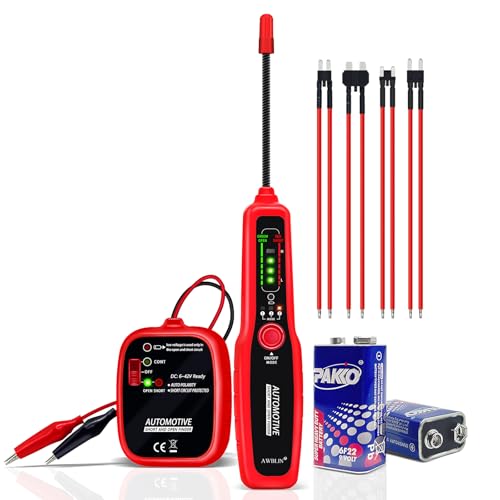
AWBLIN Wire Tracer pairs a transmitter and receiver with sound and light indication, distinguishing it from the other tracers through its dual feedback cues. Its uses include locating breaker points, open connections, broken wires, and continuity faults without damaging insulation. The maker says the wiring must be powered by a DC supply before tracing.
This makes it a candidate for powered low-voltage circuits where visual as well as audible cues are useful. Its probe reach and additional diagnostic functions are not established in the specifications, so prioritize another option if a particular reach or a wider test suite is essential.
Bottom line: Choose it for tracing where both sound and light cues are valuable.
How to choose an automotive short circuit finder
Choose by system voltage, fault type, and access to the wire, not by the word “finder” alone. A transmitter-and-receiver tracer follows a signal along a powered circuit; the receiver’s tone changes as it approaches a fault or signal path. A circuit probe tester may add checks for voltage, continuity, polarity, relays, or lamps. For basic car wiring, favor a tool whose DC range covers the circuit; a broader test suite matters when one tool must handle several jobs.
Separate open-circuit diagnosis from short-finding: an open is a break in continuity, while a short is an unintended connection that can blow a fuse or overheat wiring. Never bridge a fuse with a larger fuse or wire. If the circuit’s current rating or condition is uncertain, stop and isolate the circuit before testing.
Voltage range and vehicle fit
Match the tracer’s range to the circuit under diagnosis; a tool’s range does not mean it fits every electrical system. Passenger cars commonly use 12-volt systems, while some equipment uses 6-, 24-, or 48-volt circuits. Read the circuit voltage at the wiring or in the vehicle service data before connecting a tester, and do not apply a DC-only tracer to household AC wiring.
For a powered circuit, confirm that the tool supports its voltage and that the circuit can safely remain energized during tracing. Remove jewelry and keep probe tips from touching adjacent terminals; accidental contact can create a short. Disconnect power when the diagnostic step calls for an unpowered continuity check.
Access, signal tracing, and safe use
Probe reach matters most when wires sit behind dashboards, fuse panels, or under carpet; a flexible probe can reduce awkward positioning, but it does not make a sealed or inaccessible harness safe to probe. Start at an accessible connector, follow the wire path, and use the receiver’s signal change to narrow the search instead of piercing insulation.
Work in a ventilated area, keep leads clear of belts and fans, and avoid probing airbag circuits unless the vehicle procedure specifically permits it. SRS wiring can deploy an airbag if mishandled. A useful decision rule is to choose a flexible probe when the target is beyond a straight reach or behind a panel; otherwise, prioritize the tool’s voltage and test-mode match.
Dedicated tracers versus multipurpose testers
A dedicated tracer emphasizes locating a wire path or fault, while a multipurpose circuit tester adds checks that can reduce tool changes during electrical diagnosis. The right category depends on whether the task is locating a short or also testing components, trailer lamps, and relays.
The table compares the main tool type with the job it suits; it is a category guide, not a claim that every model includes every function.
| Tool type | Typical use | Choose when |
|---|---|---|
| Wire tracer | Follow a signal to trace wiring and locate faults | Wire path or open/short location is the main task |
| Multipurpose circuit tester | Trace plus voltage, continuity, relay, or lamp checks | Several circuit checks are needed in one tool |
Frequently Asked Questions
Can a short circuit finder trace unpowered wires?
A tracer that requires a powered DC supply cannot trace an unpowered circuit in that mode. Continuity testing is a separate procedure and should be done only with power disconnected.
What voltage do automotive wire tracers support?
Ranges vary by tool: some dedicated automotive tracers cover 6–42V DC, while other testers specify 6V, 12V, and 24V systems. Check the circuit voltage before connecting the tool.
Can I use an automotive circuit tracer on household wiring?
No, do not use an automotive DC tracer on household AC wiring unless its manufacturer specifically rates it for that purpose. Household circuits can carry lethal voltage, and automotive tools are not a substitute for a properly rated mains tester.
How can I trace a wire without damaging its insulation?
Use an accessible connector and follow the receiver signal along the wire rather than piercing the insulation. Many automotive tracer designs are intended to track wires without cutting or damaging insulation.
Should power stay on during continuity testing?
No, disconnect power before a continuity check because an energized circuit can damage the meter or create a short. A powered tracing mode is different, so confirm the tester’s operating mode and circuit requirements first.