
Best Bandage for Fingertip: 5 Options Compared

Flex-Band Large Fingertip Fabric is the best bandage for fingertip coverage when you need a larger 2-by-2.5-inch wrap, while smaller fingertips may fit a shorter bandage more neatly. Choose a fabric style for movement, but consider a different dressing if the injury is deep, gaping, or bleeding heavily.
We earn a commission if you buy through links on this page. As an Amazon Associate I earn from qualifying purchases. Products are compared on manufacturer specifications, not hands-on testing.
- Best overall: Flex-Band Large Fingertip Fabric – Its 2-by-2.5-inch large fingertip shape offers more wrap area for a larger fingertip.
- Best for smaller fingers: CURAD Flex-Fabric Fingertip Bandages – The 2-by-1.75-inch size is shorter than the large fingertip options.
- Best for longer coverage: Flexible Fabric Fingertip Bandages – The 3-by-1-inch shape gives a longer strip to wrap around a fingertip.
| Product | Best for | Size | Count | Material or pad | Shop |
|---|---|---|---|---|---|
| Flex-Band Large Fingertip Fabric | Larger fingertips | 2 × 2.5 in | 50 | Flexible fabric; non-stick pad | Check Price on Amazon |
| CURAD Flex-Fabric Fingertip Bandages | Shorter wrap fit | 2 × 1.75 in | 100 | Flex-fabric | Check Price on Amazon |
| Flexible Fabric Fingertip Bandages | Narrow wrap shape | 3 × 1 in | 100 | Woven fabric; non-stick pad | Check Price on Amazon |
| Dealmed Fabric Fingertip Bandages | Individually wrapped | 1.75 × 3 in | 100 | Fabric; non-stick pad | Check Price on Amazon |
| MED PRIDE Sterile Fingertip Fabric Bandages | Latex-free option | 1.75 × 3 in | 100 | Fabric | Check Price on Amazon |
Fingertip bandages compared
Compare the bandage dimensions and construction against the area you need to cover and wrap.
Flex-Band Large Fingertip Fabric

Flex-Band Large Fingertip Fabric is the largest fingertip format here at 2 by 2.5 inches, giving larger fingers more material to wrap than the shorter 2-by-1.75-inch option. The flexible fabric is designed to conform around contours, and the absorbent island pad is non-stick. Each bandage is sterile, individually sealed, latex-free, and uses hypoallergenic adhesive with rounded, beveled edges. This suits a fingertip that needs broader coverage without a rigid dressing. Its box has 50 bandages, fewer than the 100-count alternatives, so it may be less suitable for restocking a shared first-aid supply.
Bottom line: Choose this for a larger fingertip that needs broader wrap coverage.
CURAD Flex-Fabric Fingertip Bandages

CURAD Flex-Fabric Fingertip Bandages has the shortest fingertip bandage length in this group, at 1.75 inches, which can suit a smaller finger or a wound that needs less wrap material. The fabric construction and adhesive backing provide a flexible, self-adhesive format, and the box contains 100 bandages. Compared with the 3-inch designs, the shorter shape may be easier to position without excess material overlapping around a narrow fingertip. The specifications do not identify a pad construction, so buyers who specifically need a non-stick wound pad should confirm that feature before ordering.
Bottom line: Pick this when a shorter bandage shape is the better fit.
Flexible Fabric Fingertip Bandages
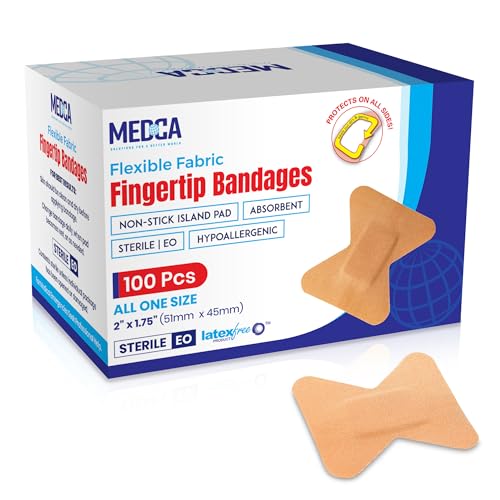
Flexible Fabric Fingertip Bandages uses a narrow 3-by-1-inch shape rather than the broader 1.75-inch-wide formats, offering a longer strip to wind around the fingertip. Its woven fabric is described as breathable, stretchable, hypoallergenic, and latex-free, with an absorbent non-stick island pad. The 100-count box suits buyers who want a supply of individually usable fingertip coverings. The product claims include protection from infection and faster healing; those outcomes should not be assumed from a bandage alone. Because its one-inch width is narrower, it may not cover a broad fingertip as fully as the wider choices.
Bottom line: Choose this if a longer, narrower wrap suits your finger.
Dealmed Fabric Fingertip Bandages

Dealmed Fabric Fingertip Bandages combines the longer 3-inch length with a 1.75-inch width, a broader wrap profile than the 3-by-1-inch style. Each of its 100 bandages is individually wrapped, and the fabric is described as flexible and breathable with a non-stick pad. That combination suits a household or kit where single sterile packages are convenient to keep on hand. It is latex-free and intended for minor cuts, scrapes, and burns. The package dimensions do not establish how much overlap you will get around a particular finger, so match the wrap area to the fingertip rather than relying on the nominal size alone.
Bottom line: Pick this for an individually wrapped, broad fingertip bandage.
MED PRIDE Sterile Fingertip Fabric Bandages

MED PRIDE Sterile Fingertip Fabric Bandages shares the 1.75-by-3-inch format with another option but emphasizes sterile, individually wrapped packaging and latex-free, breathable, flexible fabric. The longer length can provide wrap material around the fingertip, while the 1.75-inch width covers more area than a narrow one-inch strip. No pad construction is identified here, so buyers who require a non-stick pad should confirm that feature before choosing it. The product is aimed at minor fingertip wounds rather than injuries needing medical assessment.
Bottom line: Choose this for its sterile, latex-free fabric and stated moisture-wicking feature.
How to choose a fingertip bandage size
Choose by matching pad coverage first, then checking whether enough adhesive material remains to wrap around the finger. The sizes here range from 2 by 1.75 inches to 2 by 2.5 inches and 1.75 by 3 inches; a 3-by-1-inch option is longer but narrower. Measure the fingertip across its widest point and make sure the pad covers the wound without placing adhesive directly on it. As a practical rule, pick a wider format when the wound crosses the fingertip edge, and a narrower strip when the wound is small and the finger is slim. Flexible fabric can move with finger bends, but a poor fit can lift during hand use.
| Need | Shape to consider |
|---|---|
| More width around fingertip | 2 × 2.5 in or 1.75 × 3 in |
| Shorter coverage | 2 × 1.75 in |
| Long, narrow wrap | 3 × 1 in |
Fabric and pad features that matter
Fabric fingertip bandages use an adhesive backing and a central pad, with flexible material intended to bend around the fingertip. A non-stick pad can reduce sticking to the wound when the dressing is changed, while an absorbent pad takes up some wound fluid; these are separate traits, so check that both are present if needed. Breathable fabric does not mean a bandage can stay on indefinitely: replace it if it becomes wet, dirty, loose, or saturated. Sterile, individually wrapped bandages are useful for keeping unused dressings protected until opening. Latex-free claims matter to people avoiding natural rubber latex, but adhesive sensitivity can still occur with other materials.
When a fingertip cut needs more than a bandage
A small, shallow cut that stops bleeding with steady pressure is generally the kind of minor wound adhesive bandages are meant to cover. Press clean gauze firmly on a bleeding fingertip for about 10 minutes without repeatedly lifting it to check; seek urgent medical care if bleeding continues, the cut is deep or gaping, or the fingertip is partly severed. Wash a minor wound with clean running water before covering it, and avoid putting adhesive over the wound itself. A bandage protects the area but does not treat serious injury or replace medical evaluation. For a wound with embedded debris or reduced sensation or movement, get professional care rather than relying on a dressing.
How often to change a fingertip bandage
Change a fingertip bandage at least daily and sooner if it gets wet, dirty, loose, or soaked through. Frequent handwashing can loosen adhesive, so dry the skin around the wound before applying a replacement; damp skin makes a secure seal harder to achieve. Remove a sticking dressing slowly after wetting it with clean water, rather than pulling it sharply from healing tissue. Check the wound during each change for worsening redness, swelling, warmth, pus, or increasing pain, and seek medical advice if those signs develop. A snug wrap should stay in place without causing numbness, tingling, color change, or a cold fingertip; loosen or remove it if circulation seems affected.
Frequently Asked Questions
Should a fingertip bandage wrap around the nail?
A fingertip bandage should cover the wound without pressing hard on the nail or restricting the finger. Choose a width that reaches around the fingertip securely, and check that the tip remains warm and normally colored after application.
How long can I leave a fingertip bandage on?
Change a fingertip bandage at least once every 24 hours, and sooner if it gets wet, dirty, loose, or saturated. Wash and dry the surrounding skin before putting on a fresh one.
What should I do if the bandage sticks to a cut?
Soak the dressing with clean water before easing it off instead of pulling it dry. Non-stick pads are designed to lessen sticking, but a dressing can still adhere if wound fluid dries.
When should a fingertip cut get medical care?
Seek urgent care for a deep or gaping cut, a partly severed fingertip, or bleeding that continues after about 10 minutes of firm pressure. Reduced sensation or movement also warrants prompt assessment.
Can I use a fabric bandage on a wet fingertip?
Dry the skin around the wound before applying an adhesive bandage because moisture can weaken adhesion. Replace the dressing if it becomes wet during handwashing or other activity.