
Best Battery Powered Fuel Transfer Pumps Compared

Keimi Cordless Fuel Pump, 5 GPM suits most buyers seeking a battery powered fuel transfer pump because it combines a claimed 5 GPM flow with auto-stop and hand-trigger modes. Choose Cordless Fuel Pump, 5.5 GPM instead if you already use a compatible DeWalt 20V or Milwaukee 18V battery; the other models use AA/D batteries or USB power.
These pumps move liquid from a fuel can or other container into equipment; compatibility and safe handling matter as much as flow claims.
We earn a commission if you buy through links on this page. As an Amazon Associate I earn from qualifying purchases. Products are compared on manufacturer specifications, not hands-on testing.
- Best overall: Keimi Cordless Fuel Pump, 5 GPM – Offers auto-stop and hand-trigger operation, with 12V vehicle-outlet power as another option.
- Best for cordless tool batteries: Cordless Fuel Pump, 5.5 GPM – Accepts compatible DeWalt 20V or Milwaukee 18V batteries and has a claimed 5.5 GPM flow.
- Best for USB power: Auto-Stop Fuel Pump, 3.8 GPM – Can run on 4 AA batteries or USB-C power and includes four can adapters.
| Product | Best for | Power options | Claimed flow | Hose length | Shop |
|---|---|---|---|---|---|
| Keimi Cordless Fuel Pump, 5 GPM | Flexible power | Select 20V/18V packs; 12V outlet | 5 GPM | 51 in. | Check Price on Amazon |
| Cordless Fuel Pump, 5.5 GPM | Tool battery owners | DeWalt 20V / Milwaukee 18V | 5.5 GPM | 57 in. | Check Price on Amazon |
| Auto-Stop Fuel Pump, 3.8 GPM | USB-C power | 4 AA or USB-C | 3.8 GPM | 51 in. | Check Price on Amazon |
| MISFANS Auto-Stop Fuel Pump, 3.8 GPM | Auto-stop transfers | 4 AA or USB power | 3.8 GPM | 51 in. | Check Price on Amazon |
Battery Powered Fuel Transfer Pumps
Compare power sources, controls, and hose reach before choosing a pump for your fuel can or equipment.
Keimi Cordless Fuel Pump, 5 GPM

Keimi Cordless Fuel Pump, 5 GPM stands apart for offering both automatic sensing and squeeze-to-run control. The pump works with select DeWalt 20V and Milwaukee 18V batteries or 12V vehicle-outlet power, and its reinforced hose is 51 inches long. Four adapters cover openings measuring 2.0, 2.1, 2.75, and 3.75 inches. The maker claims a transfer rate of up to 5 gallons per minute.
Keep the receiving tank attended even when using auto-stop. Battery fit is limited to select packs, so confirm compatibility and can opening size before use.
Bottom line: Choose this if you want manual trigger control as well as automatic sensing.
Cordless Fuel Pump, 5.5 GPM

Cordless Fuel Pump, 5.5 GPM has the longest hose in this group at 57 inches and is made for compatible DeWalt 20V or Milwaukee 18V batteries. Its maker claims a 5.5 GPM flow rate, and the pump includes five adapters, auto shut-off, and a beep alert. The bare-tool format makes sense for someone who already owns a compatible battery.
Battery compatibility is the key constraint: this is not a general AA-powered model. The feature set names gasoline, diesel, and kerosene, but the maker does not identify the adapter sizes.
Bottom line: Pick this if your battery platform is supported and you need extra hose reach.
Auto-Stop Fuel Pump, 3.8 GPM
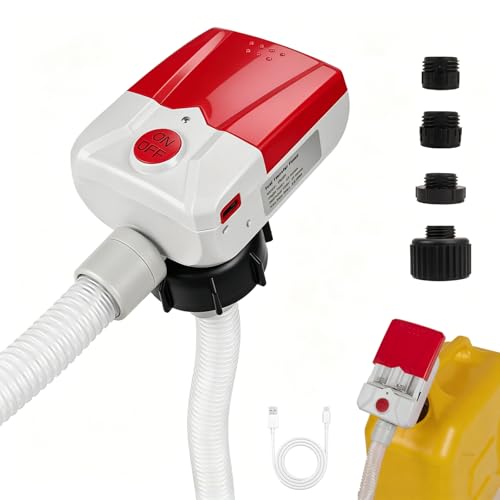
Auto-Stop Fuel Pump, 3.8 GPM is the option with USB-C power alongside four AA batteries, useful when you want a non-tool-battery alternative. It has a 51-inch hose, four can adapters, a one-key start/stop control, and an auto-stop sensor with a beeper. The maker claims a 3.8 GPM flow rate.
The AA batteries and fuel can are not included.
Bottom line: Choose this for USB-C operation or if you prefer AA batteries to a tool pack.
MISFANS Auto-Stop Fuel Pump, 3.8 GPM

MISFANS Auto-Stop Fuel Pump, 3.8 GPM is another 3.8 GPM auto-stop option with four adapters, a 51-inch hose, and USB or four-AA power. That makes its core configuration similar to Auto-Stop Fuel Pump, 3.8 GPM, while the product name specifically identifies the MISFANS model. The maker claims 3.8 gallons per minute and describes a sensor that cuts off flow when the receiving tank is full.
Choose it if those power and hose specifications suit your setup, but do not assume its USB connection is USB-C: the maker says USB without naming the connector. Adapter sizes also need confirmation for your can.
Bottom line: Choose this if AA or USB power and auto-stop meet your needs.
How to choose a battery powered fuel transfer pump
Start with the power source you can use reliably, then match the connection and controls to the job. AA-powered pumps typically use 4 AA cells; other cordless models depend on a compatible tool battery, and some also allow 12V or USB power. Flow claims in this set range from 3.8 to 5.5 gallons per minute, but actual transfer speed can change with liquid viscosity, lift height, hose routing, and battery charge. For a short transfer where you need active control, a hand trigger lets you stop by releasing it; auto-stop sensors are an added control, not a reason to leave a filling tank unattended. If the can opening is under 2 inches, verify adapter fit before choosing a model with only larger listed adapters.
Fuel can adapters and hose reach
Adapter fit is often the deciding factor: pump adapters must match both the can opening and its thread or neck shape. The Keimi pump lists 2.0-, 2.1-, 2.75-, and 3.75-inch adapters, while other models mention four or five adapters without giving their sizes. Measure the opening and compare it with the adapter dimensions before purchase; adapter count alone does not establish fit. A 47-inch hose may work for nearby containers, while 51- and 57-inch hoses offer more reach but can be harder to route neatly. Keep hose bends broad and avoid pinching the line, since restrictions can reduce flow.
Safe fuel transfer and auto-stop use
Gasoline vapor ignites easily, so transfer fuel outdoors or in a well-ventilated area, away from flames, sparks, smoking, and hot equipment. Keep the receiving tank on stable ground and remain present throughout filling; an auto-stop sensor is a backup control, not unattended protection. Static electricity can ignite fuel vapor, so keep the nozzle in contact with the receiving container while transferring and avoid pouring fuel near ignition sources. Use a pump only with liquids its maker identifies as compatible, and do not assume a water-transfer pump is suitable for every fuel. Stop immediately if a hose leaks or the pump behaves unexpectedly.
Understanding flow rate and transfer time
Gallons per minute is a maximum-style comparison, not a guaranteed fill time in every setup. At a theoretical 3.8 GPM, a 5-gallon transfer would take about 1 minute 19 seconds; at 5 GPM, it would take 1 minute, before accounting for setup or flow reductions. Actual output varies with battery charge, vertical lift, hose resistance, and fuel temperature. A longer hose can add resistance, and a weak battery can reduce motor performance. Treat the figures as maker claims and choose enough margin for the task rather than relying on a fastest-case calculation.
Frequently Asked Questions
Can a fuel transfer pump run dry?
Avoid running a fuel transfer pump dry unless its maker explicitly allows it. Dry operation can overheat or damage a pump, and fuel systems should be primed and used only as directed.
How long does a battery fuel pump hose need to be?
A hose should reach from the container to the receiving tank without stretching or tight bends. These models use hoses from 47 to 57 inches, so measure the route and leave a little slack.
Can one pump transfer gasoline and diesel?
Some pumps are described for both gasoline and diesel, but compatibility is model-specific. Verify the maker’s allowed liquids before transferring, and never infer fuel compatibility from a pump’s use with water.
Does an auto-stop fuel pump prevent spills?
An auto-stop sensor can stop flow when its sensor detects fuel, but it cannot guarantee spill prevention. Stay with the transfer, keep the receiving container stable, and stop flow if the sensor or hose behaves unexpectedly.
How do I choose the right fuel can adapter?
Measure the can opening and match both its diameter and neck or thread shape to the adapter. For example, the Keimi model includes a 2.0-inch adapter, but a diameter match alone may not ensure a secure fit.