
Best Black and White Checkered Vinyl Flooring Compared

For most rooms, ASSTINOUS 40-Pack Checkered Tiles is the practical pick because its 40 twelve-inch tiles cover 40 square feet in a classic checkerboard pattern. Choose Livelynine Checkered Vinyl Roll instead for a cut-to-fit roll or ZRJT 30-Pack Matte Checkered Tiles when you want a 30-square-foot pack of twelve-inch tiles.
We earn a commission if you buy through links on this page. As an Amazon Associate I earn from qualifying purchases. Products are compared on manufacturer specifications, not hands-on testing.
- Best overall: ASSTINOUS 40-Pack Checkered Tiles – Forty 12-by-12-inch tiles provide 40 square feet of checkerboard flooring.
- Best for a cut-to-fit roll: Livelynine Checkered Vinyl Roll – The 15.8-by-78.8-inch self-adhesive roll can be trimmed to size.
- Best for a 30-square-foot room: ZRJT 30-Pack Matte Checkered Tiles – The 30-tile pack covers 30 square feet with 12-inch squares.
| Product | Best for | Format | Size | Coverage | Shop |
|---|---|---|---|---|---|
| ASSTINOUS 40-Pack Checkered Tiles | Most room refreshes | Tile pack | 12 × 12 in | 40 sq ft | Check Price on Amazon |
| Livelynine Checkered Vinyl Roll | Cut-to-fit coverage | Roll | 15.8 × 78.8 in | 8.65 sq ft | Check Price on Amazon |
| ZRJT 30-Pack Matte Checkered Tiles | Matte tile finish | Tile pack | 12 × 12 in | 30 sq ft | Check Price on Amazon |
Black and White Checkered Vinyl Flooring
Compare the tile packs and roll by format, dimensions, and stated coverage before choosing for your space.
ASSTINOUS 40-Pack Checkered Tiles

ASSTINOUS 40-Pack Checkered Tiles combines a traditional black-and-white checkerboard with a 40-tile pack, making its coverage easy to estimate: twelve-inch squares cover 1 square foot apiece. The maker says the vinyl surface resists water, scratches, and wear, and describes it as textured. This format suits a small floor refresh where square tiles can be arranged in alternating colors. Its peel-and-stick backing calls for a clean, flat surface, so it is less suited to uneven flooring or a room that needs a continuous sheet with few seams. Check the floor’s surface compatibility before installing.
Bottom line: Choose this pack when 40 square feet of twelve-inch checkerboard tiles fits your project.
Livelynine Checkered Vinyl Roll
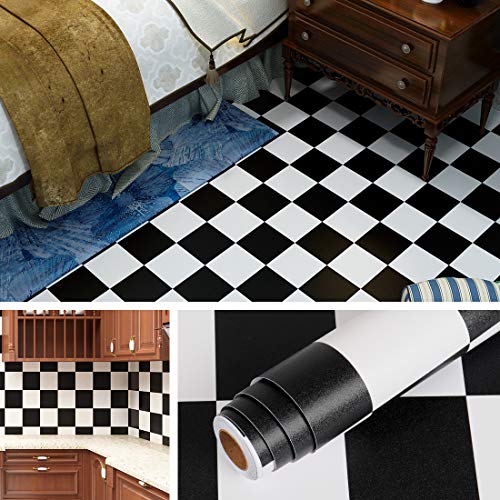
Unlike square tile packs, Livelynine Checkered Vinyl Roll comes as a narrow roll that can be trimmed to fit smaller areas or shapes. The maker gives its total coverage as 8.65 square feet and says the vinyl is waterproof, oil-proof, and removable. Its backing has gridlines for measuring cuts, and the check squares are 3.8 inches across. The roll suits a compact project or a surface that benefits from fewer tile seams. Its limited coverage means multiple rolls may be needed for a larger floor, and the thin contact-paper format is not the same as a rigid tile.
Bottom line: Pick the roll for a small area where trimming flexibility matters more than rigid tile format.
ZRJT 30-Pack Matte Checkered Tiles

ZRJT 30-Pack Matte Checkered Tiles offers a matte black-and-white tile pack with 30 twelve-inch squares, which totals 30 square feet. That smaller pack can suit a room or defined section where a 40-square-foot set would leave more unused coverage. The maker says the tiles have a water-resistant layer, a wear-resistant layer, and a non-slip surface. Its peel-and-stick format is intended for indoor floors and surfaces, including laundry rooms and RV floors. A pack covers less floor area than ASSTINOUS 40-Pack Checkered Tiles, so measure the full installation area and allow for cuts before deciding how many packs the project needs.
Bottom line: Choose this option when you want matte twelve-inch tiles and the 30-square-foot pack suits your measured area.
How to choose checkered vinyl flooring
Start with format and measured coverage: twelve-inch tiles cover 1 square foot each, while a roll’s coverage depends on its width and length. Measure the floor’s length and width in feet, multiply them for square footage, then account for perimeter cuts and obstacles; a simple rectangle needs less cutting than a room with alcoves. Check the product’s coverage against that measurement rather than assuming packs are interchangeable. Peel-and-stick flooring adheres best to a clean, dry, smooth, flat surface; bumps, grit, and old flooring texture can interfere with adhesion or show through thin material. A roll can reduce the number of seams, while square tiles make alternating checkerboard placement straightforward.
Plan the checkerboard layout and cuts
Lay out the pattern before removing adhesive backing: a checkerboard needs alternating black and white squares, and the first row determines how the pattern meets the room edges. For a square room, find the center and dry-fit a row in each direction so narrow slivers do not end up along the most visible walls. Twelve-inch tiles are 1 foot on each side, so mark a 12-inch grid for tile alignment; the roll’s smaller check squares call for a different visual scale. Cut vinyl with a sharp utility knife and a straightedge, keeping hands clear of the blade. Leave room for doorways and fixed fixtures in your coverage calculation.
Understand peel-and-stick floor limits
Peel-and-stick vinyl is a surface finish, not a way to repair an uneven or damaged subfloor. Clean and dry the surface, remove loose debris, and address bumps or gaps before installation; a thin vinyl layer can telegraph imperfections. Water-resistant material does not make every seam or room waterproof: moisture can reach the floor underneath through edges and joints, so distinguish a product’s surface claim from a fully sealed installation. Do not place self-adhesive flooring over carpet, and check that existing flooring is firmly attached and compatible. In bathrooms or kitchens, avoid assuming that a non-slip surface claim guarantees traction when the floor is wet.
Estimate coverage before buying
Coverage math is simplest with square tiles: multiply the tile count by the area of each tile, then compare the total with your measured floor area. A 12-inch square is 1 square foot; rectangular rolls require multiplying the width by length after converting both dimensions to feet. Add a cutting allowance rather than planning to use every square inch, especially around door jambs, cabinets, and irregular edges. Use this quick guide to match a project size to the available format.
| Project need | Useful format | Coverage reference |
|---|---|---|
| Regular floor with alternating squares | 12-inch tile pack | 1 sq ft per tile |
| Small area needing custom cuts | Trim-to-fit roll | 8.65 sq ft per listed roll |
Frequently Asked Questions
How many 12-inch tiles cover one square foot?
One 12-inch square covers 1 square foot because each side measures 1 foot. For a floor measuring 30 square feet, plan for at least 30 tiles plus extra for cuts and mistakes.
Can peel-and-stick vinyl go over old flooring?
It can adhere over some existing hard floors when the surface is clean, dry, smooth, and firmly attached. Avoid carpet and check compatibility before installation, since texture, loose areas, or uneven seams can affect adhesion.
Is peel-and-stick vinyl waterproof at the seams?
A waterproof or water-resistant vinyl surface does not automatically seal the floor beneath it. Seams and perimeter edges can let moisture through, so do not treat peel-and-stick tiles as a waterproofing system.
How much extra flooring should I allow for cuts?
Allow extra material for perimeter cuts, doorways, and irregular shapes rather than ordering exactly to the room’s square footage. A simple rectangular room needs less cutting allowance than one with alcoves or multiple fixtures.
How do I keep a checkerboard pattern straight?
Mark perpendicular guide lines and dry-fit the first rows before sticking tiles down. With 12-inch tiles, a 12-inch grid helps keep alternating squares aligned across the floor.